Sometime around the first of each year, I get stingy. Maybe
it’s the fact that I overspent on Christmas gifts for my family, which seems to
be a personal weakness of mine. Or maybe it’s that I subconsciously make a New
Year’s resolution to be more thoughtful in my purchases. That means I plan to
not get excited about every new trend that I’m sure will make my life easier
and more enjoyable and therefore give in to my uncontrollable urge to buy it!
So, in my quest to be more frugal with money and at least make
my purchases a “bargain”, I researched the best times of the year to buy just
about anything. You know a bargain is not a bargain if you don’t need it. My
husband always gets worried when I tell him how much money I saved on
something! Of course, not purchasing something saves you even more!
If you actually plan purchases you need, there is little
reason to purchase anything unless it’s on sale. Sales are an everyday
occurrence. However, you can save a lot of money just by knowing when the
lowest sale price for an item is most likely to happen. This is especially true
for big-ticket items.
I researched the best months to buy things from five
different sources.
Forbes.com
The Krazy Coupon Lady
Money Under 30
Nerd Wallet
The Penny Hoarder
And these sites researched other sources, such as Consumer
Reports, which is probably the most credible and least biased organization that
reviews and rates products. Other sources of the sources included Lifehacker,
Freeshipping, Wisebread, Finder.com and Deal News.
From this research, I compiled an annual calendar for The Best Time to Buy Anything. Holidays and annual sales drive many of the best times to purchase some items. For instance, the Consumer Electronics Show in January unveils many new models of electronics, which makes early January a good time to buy TVs, especially if you’re willing to consider older models. January is also known for white sales on bedding and linens.
The best use of the buying calendar is that it allows you to
plan purchases, especially for expensive items.
The experts don’t always agree on the best months to get good deals on products, so you’ll see some of the same products listed in several months of the year. And clearance sales of some larger items occur several times a year because retail stores need the space for newer inventory.
You can download your free copy of The Best Time to Buy Anything annual calendar below:
Do you feel bombarded by all the emails, social media posts and articles about how to make 2020 your best year ever? I’ve got to admit, I’m a little stressed out about all the information about how I can improve myself in some way. Obviously, I’m not good enough as I am!
Here are a few of the email subject lines showing up in my inbox lately: “New Year, New You; Will You Accept the Challenge?; Don’t Miss Out On……; It’s the Magic Formula; Get a Head Start on …..; 5 _____ Mistakes You Don’t Even Know You’re Making”! The list could go on and on with subject lines and titles that imply I need to know more, do more or be more.
Even the title of the article I’m sharing with you today implies I should have done something that I didn’t do – “Why Didn’t I Think of That?” Well, the reason I’m reading the article is to get tips that I didn’t think of! And if I had already thought of them, I wouldn’t need to read the article.
You are enough. Just the way you are. (Wow, I’m sounding a little like Mr. Rogers here!) But my best advice to you this new year, new decade is not to try and reinvent yourself. I cannot think of one year in which I made New Year’s resolutions that I actually accomplished . Most of my past resolutions never made it into February! So that means I started off that new year as a failure.
I don’t mean for you to sit back and do nothing to improve yourself. But be selective and make choices that help you improve the quality of your life or make life a little easier or more efficient for you. And that’s where I aim to help.
My goal is to offer tips and hacks that you can use with little or no effort. I hope to provide a smorgasbord of ideas from which you can choose to implement if they meet your needs.
And that brings me to my request of you. How can I help? As I offer Home Economics Reimagined to you, what are the things you need to make your life a little easier? Comment and let me know what you need to know. Or click on the Contact Me page to email me. I will respond to each and every suggestion.
In the meantime, check out this article of simple tips to make life simpler: https://vickiloves.me/handytips. Number 7 alone is worth the read!
It’s the most wonderful time of the year – or so a familiar Christmas song says. But it’s also a time of hustle, bustle and stress, with so much to do and so little time to get it done. Some people revel in the shopping experience, getting to stores early to get that special deal of a doorbuster. I’m not one of them. I prefer laptop shopping.
For either way you like to shop, you probably need some method of keeping up with all you have to do and all you’ve already done. I use a phone app called Santa’s Bag. My daughter introduced me to this free app last year and it has replaced my little notebook with scribbled and crossed-out lists.
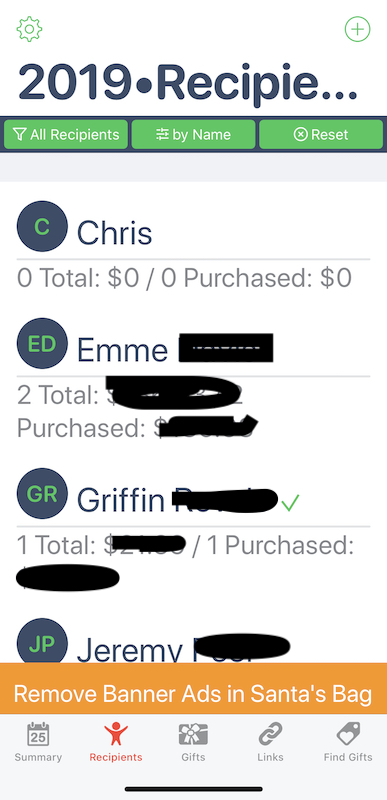
First, I enter the names of everyone for whom I need to purchase a gift. You can set up an overall budget and/or individual budget. Unfortunately, I have great difficulty sticking to one, so I just try to keep a close look and make sure I’m equitable with purchases. When I purchase a gift for a recipient, I enter the name of the gift, the store from which it was purchased and the purchase price.
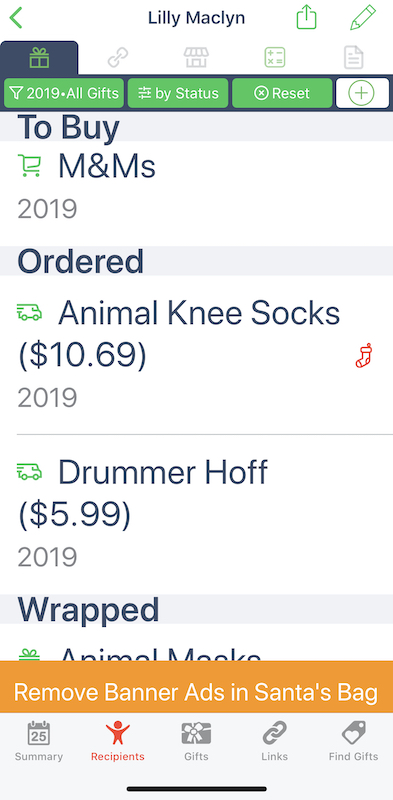
Once the name of a gift is entered for a recipient, there are several icons to select that put the item in a list that tells you the status of what you have completed and what you still need to do. Those include: Idea; To Buy; Ordered; To Wrap; Wrapped; To Send; and Given. An additional icon identifies a gift as Stocking Stuffer. I request wish lists from family members and label the items as Ideas. Then, when I purchase a gift, I select the Ordered icon. When the gift arrives (I am well acquainted with the UPS and FedEx delivery people!), I
change to the To Wrap icon. The last icon I use is Wrapped, and then the gift goes under the tree
You can use none, any or all of the icons. When you click on the appropriate icon for a gift, it creates a to-do list by moving all similarly labeled gifts together. Then at a glance I know what has been ordered, what I need to wrap and the final list I work toward is Wrapped.
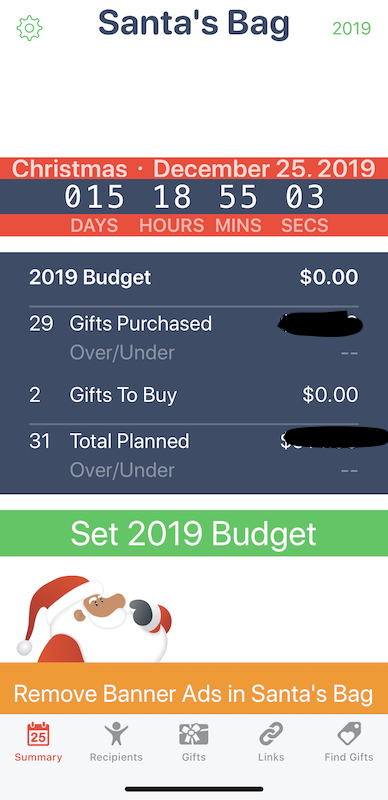
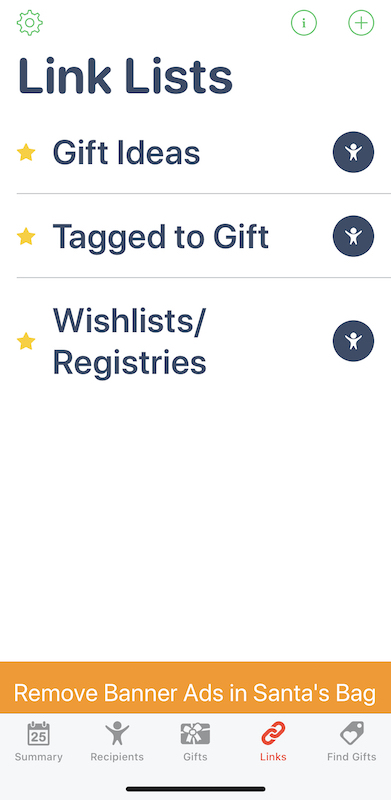
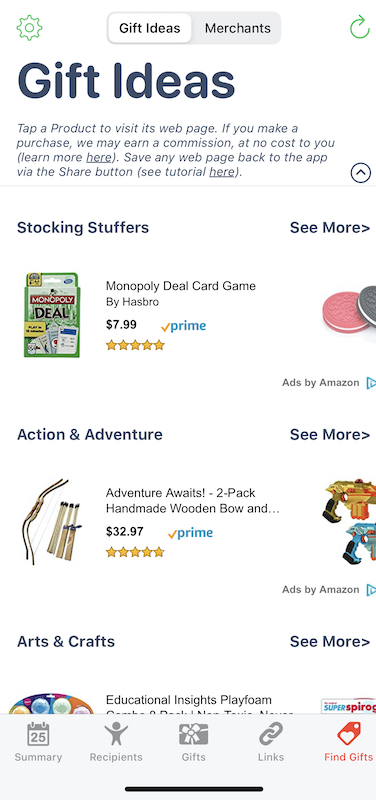
I like the simplicity of Santa’s Bag. It is intuitive and easy to set up and use. I can use as many or as few of the many features as I need. Screenshots of some of the features and layout are below.
Budget Page
Recipient List
& Status
How to Sort Lists
Gifts for
Individual
Additional Features
Gift Ideas Search
Some other gifting apps available and their main features include:
Christmas – similar features to Santa’s Bag; matter of preference as to whether you like Christmas or Santa’s Bag
Giftry – this app is more of a year-round gift planner; can select favorite stores and enter or search for possible gifts
Giftster – is an online gift registry connecting family and friends; gives options to create groups and lists and share wish
lists with others in your group; use for all types of events and holidays
Gifted – keeps track of gifts, people and events; can add or import people; add birthdates, anniversaries and other
events; then add gift ideas; has progress slider to keep track of each gift; has profile pages for each person
GiftPlanner – similar to other apps for gift planning. Upgraded paid version allows you to import gift ideas from the web
In addition to Santa’s Bag, I use one other indispensable online shopping app – Rakuten. Formerly known as Ebates, Rakuten allows you to earn cash back from online stores. During the Christmas holidays, cash back percentages are often doubled or even tripled. Since I have been using Rakuten, which has been several years now, I have received close to $2000 back in ebates! I never shop online without checking Rakuten for stores offering cash back. You can earn additional cash back by referring friends to Rakuten.
A few other must-have shopping apps include:
Honey (joinhoney.com) – best for online coupons and price alerts
Fakespot (fakespot.com) – best for choosing what and where to buy by spotting fake reviews and flagging most helpful reviews
PriceBlink (priceblink.com) – best for price comparisons for an item among other stores; PriceBlink does not have a mobile app, so you could use the ShopSavvy mobile app instead
RetailMeNot (retailmenot.com) – best for in-store coupons and sales
For your best shopping experience, consider your priorities and what you want an app to do for you. There are a lot of choices out there. I hope these few get you started.
To your less stressful and more enjoyable shopping experience!
Thanksgiving is the holiday that’s just too good for its own
good. This unassuming holiday is sandwiched between holidays that are the two
biggest bullies of the year. Okay, perhaps that is a little harsh, but think
about it.
Halloween has become the little giant of commercialism.
Whole retail stores pop up a few months before Halloween and then disappear as
quickly as they came. I never owned a store-bought Halloween costume. Come to
think of it, I don’t remember ever having dressed up for Halloween or going
trick or treating! We did live in a very rural setting, and people just didn’t
go trick or treating on Halloween.
But now, children are asked what they want to be for
Halloween just like they are asked what they want to be when they grow up! And
adults are even worse. The retail stores are really for adults. At least I
think they are; I’ve never been in one. As you can tell, Halloween is not among
my favorite holidays.
And what about Christmas? I’ve seen homes decorated for
Christmas in early November. It’s like people are going straight from Halloween
into Christmas! I’ve even seen homes that leave up their Christmas decorations
until almost spring! Well, maybe not that long, but when 25% of the year is about
Christmas, I’m thinking that’s a little too much. And we won’t even talk about
the excessive shopping for Christmas, something that some people do year-round.
Don’t get me wrong. I’m not against Christmas. I love giving
gifts, especially for my grandchildren. And I try especially hard to give gifts
that my family members actually want, need and use. I love Christmas music. It
lifts the spirits and brings back wonderful childhood memories.
But, let’s get back to Thanksgiving, the introvert of
holidays. It doesn’t stand a chance. I
believe celebrating the true spirit of Thanksgiving helps ease you into the
spirit of Christmas. By being thankful for your blessings, you can then
approach Christmas with the joy of sharing. It’s so easy to get caught up in the
frenzy of Christmas decorating and shopping that we sometimes forget the real
reason for the season.
I’ve been keeping a gratitude journal for some time now, and
it’s been a spiritually rewarding experience. Every evening, I write five
things for which I’m grateful. I write them in complete sentences, starting
with “I am grateful for”. This practice
has made me more aware of the little things I encounter every day that are a
blessing to me in some way.
Of course, I find myself often being grateful for family
members. But I have grown from just saying I’m grateful for them to seeing
qualities, character traits or good deeds that fill my heart with thankfulness.
I’m also more aware of little things I previously overlooked that enrich my life. Now, I often pause to be thankful in the moment when I see a beautiful cardinal at the bird feeder or watch two squirrels playfully scampering up a pine tree.
All I’m saying is that if we give Thanksgiving a chance to be more than a turkey feast with family, it can enrich our lives throughout the year.
While the dictionary defines happiness as “the state of being happy”, that gives you very little information about what the state of happiness feels like. I used to think happiness was about having things, but then I got older and hopefully wiser. Happiness is more about being. And it is a choice.
I taught Child Care Services several years to high school students. One of the discussion strategies I used was WHIFs. A WHIF is WHat IF a specific scenario existed and you had to respond to it. In the course, scenarios were usually around dealing with preschool children and their behavior. In other words, WHat IF a child (or children) were doing something that required a caregiver to take action. What would you do in that situation? How would you respond that would provide a teachable moment for the children or model a more appropriate behavior or even apply disciplinary action?
I think applying a WHIF to situations in your life is often an appropriate decision-making process for adults. In terms of happiness, as in most life situations, the response you choose can either add to your overall happiness or detract from it. It is especially helpful in potentially negative situations to ask yourself this question: What if I choose to _________? (Fill in the blank with a choice you could make in a situation.) Would that choice fulfill my needs or add to my peace and contentment? Or what if I choose to _________? (Fill in the blank with another choice you could make in the same situation.) What would be the likely outcome of that choice?
Your response to your WHIF has the potential to either add to your happiness and move you further toward your goals and dreams in life or move you further away from those goals and dreams and possibly the people you love the most.
Do any of these attributes or feelings apply to you? Do any of them define or contribute to your happiness? Consider how your choices impact your happiness level by applying your own WHIF.
Your Needs are Met – When a person is happy, their needs are usually being met at the level they want them to be met. It doesn’t mean that someone is not having a hard time, it’s more about how you make what you have fill your needs.
You Feel Satisfied – When you are happy, you tend to feel simply satisfied with your life. You think about your life and feel good about it.
You Feel Content – A happy person tends to feel content about their life in general. They are not in a constant state of stress. But remember happy people do have stress, they’re just better at feeling content even when things aren’t perfect.
You Are at Peace – Peace tends to go with contentment. Happy people tend to know that everything will turn out okay and are good at turning negativity into positivity.
The truth is, happiness is how you define it personally for you. It’s not about getting tons of stuff unless you want that. It’s not about finding a spouse unless you want that. It’s not about having kids unless you want that. It’s all up to you how you define happiness.
Happiness is not a destination that you get to one day and stay at. It’s a lifelong journey that will have many ups and downs and struggles. But, you get to decide how those ups and downs of life affect you. You have it in your power to be happy where you are in your life right now. So, the next time you’re faced with a potentially negative situation, apply a WHIF to consider the impact of your actions. While you do have to do more than think positively to really and truly feel happy, it does start with your thoughts. Make your choices manifest happiness through your actions.