
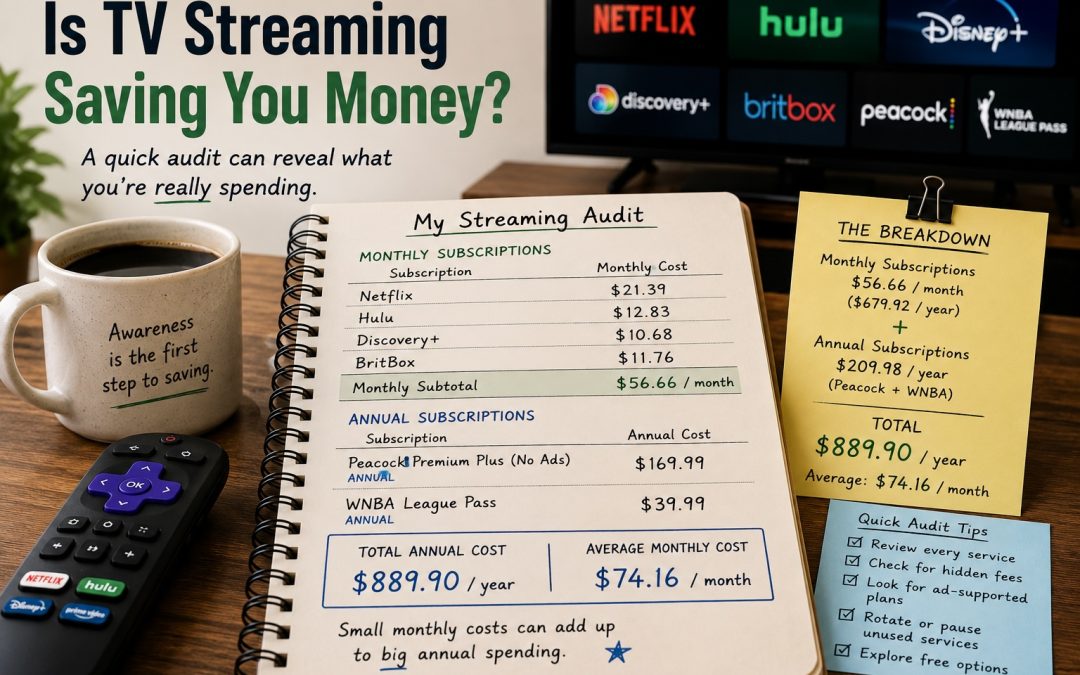
Is TV Streaming Saving You Money?
Or Has It Quietly Become Your New Cable Bill?
Is TV Streaming Saving You Money?
Or Has It Quietly Become Your New Cable Bill?
When people first started “cutting the cord,” streaming felt like a smart financial move.
No contracts.
No cable boxes.
No long-term commitments.
Just pay for what you want and cancel what you don’t.
Somewhere along the way, though, streaming quietly became its own version of cable.
Recently, I decided to go through our household streaming subscriptions and see what we were actually spending. And honestly, it took some time — because I had to track down where each payment was coming from.
That alone taught me my first lesson:
Pay for all streaming services from one source — either one bank account or one credit card.
(For me, one specific credit card made the most sense.)
Then I looked at the total.
And that’s when I was surprised.
Not because we had dozens of subscriptions. We didn’t.
But because prices have continued creeping upward while streaming companies keep finding new ways to package, bundle, upsell, and tier their content.
According to recent reports, the average household now spends around $84 per month on streaming services — more than $1,000 per year.
That’s more than many people used to pay for cable.
Streaming Isn’t Necessarily Cheap Anymore
The problem usually isn’t one streaming service.
It’s the stacking.
- Netflix
- Hulu
- Disney+
- YouTube TV
- Apple TV+
- Sports packages
- Premium upgrades
- “We forgot to cancel that free trial”
Individually, they often seem manageable.
But when your favorite shows or sports are spread across multiple services… well, you can see where this is going.
Together, they quietly become a second utility bill.
And unlike cable, streaming subscriptions are easy to ignore because they’re spread across:
- Apple
- Amazon
- Roku
- Credit cards
- Phone bills
- Annual renewals
- App stores
That makes it much harder to notice the real total.
Prices Keep Climbing
Netflix raised prices again in 2026.
YouTube TV now sits around $83 per month.
Disney+, Hulu, Max, Peacock, and others have all increased prices over the last few years.
Some services now cost more than double what they charged when they launched.
Our Netflix bill just went up again last month. When we started, it was only $8.55 per month.
And many of us are paying those increases automatically without ever reevaluating whether the service still fits our viewing habits.
What I Learned From Auditing My Own Subscriptions
When I finally reviewed everything, I realized something important:
Streaming requires strategy now.
It’s no longer just “set it and forget it.”
After looking through our subscriptions, I decided to keep the services we genuinely use and enjoy — including WNBA League Pass.
But I also realized how easy it would be for costs to keep creeping upward without regular review.
And honestly, that’s the business model.
Streaming companies are counting on us to ignore the monthly charges.
7 Ways To Keep Streaming Costs Under Control
- Audit Your Streaming Services
Before canceling anything, figure out exactly what you have and what it costs.
Check:
- Credit card statements
- Apple subscriptions
- Roku subscriptions
- Amazon subscriptions
- Annual renewals
- Sports add-ons
- Premium upgrades
Then ask yourself:
- How often do we actually use this?
- Would we notice if it disappeared?
- Are we paying for convenience or habit?
- Is anyone even watching this anymore?
This one step alone can uncover a surprising amount of wasted spending.
- Rotate Services Instead of Keeping Everything Year-Round
This may be the single best strategy for saving money on streaming.
Instead of paying for every service every month:
- Keep one or two core services
- Rotate the others
- Watch what you want
- Cancel
- Move on
Most streaming services are month-to-month anyway.
There’s no rule saying you must keep every subscription active all year long.
- Don’t Automatically Reject Ad-Supported Plans
Many of us switched to streaming specifically to get away from commercials.
But ad-supported plans can significantly reduce costs.
Netflix, Disney+, Hulu, Peacock, and others all offer lower-priced options with ads.
And honestly?
Some of the ad loads are still lighter than traditional cable television used to be.
If you’re carrying several premium ad-free plans, downgrading one or two could save a meaningful amount over the course of a year.
Personally, I decided the ads were more annoying than paying a little extra to avoid them. But we still use some ad-supported services.
- Bundles Can Save Money — Or Waste It
Bundles sound great in theory.
Sometimes they are.
Disney now offers multiple combinations involving Disney+, Hulu, ESPN, and Max.
But bundles only save money if you genuinely use most of what’s included.
Otherwise, you’re simply paying for extra services at a slight discount.
Before signing up for a bundle, ask:
- Would I subscribe to these separately?
- Is anyone actually using the sports package?
- Am I paying for convenience more than value?
- Watch for Hidden Fees
One thing that surprised me during this research was how many streaming services now have cable-style fees attached.
That can include:
- Taxes
- Local channel fees
- Regional sports fees
- Add-on charges
Some live TV services add sports-related fees that can increase your bill by another $10–15 per month depending on your ZIP code.
Before signing up, always look at the final checkout total — not just the advertised monthly price.
- Free Streaming Has Improved Tremendously
This may be the biggest surprise of all.
Free streaming services are much better than they used to be.
Platforms like:
- Tubi
- Pluto TV
- Roku Channel
- Sling Freestream
- Plex
- Xumo Play
- Google TV Freeplay
…offer large libraries of movies, older TV shows, live channels, news, and niche content.
Tubi alone reportedly reaches around 80 million monthly viewers.
No, you won’t get every brand-new release or premium sports event.
But if your goal is simply finding something enjoyable to watch in the evening, free streaming options are far more useful than many people realize.
- Sports Changes the Entire Equation
Sports is where streaming gets expensive quickly.
League passes, ESPN access, regional sports networks, and exclusive streaming rights can dramatically increase costs.
That’s why many people who think they’re paying “just for Netflix” end up with much larger streaming bills.
Some newer options are trying to address this. Sling recently introduced a lower-cost ESPN-focused package for around $20 per month.
But sports fans still need to think strategically.
Ask yourself:
- Which sports matter most?
- Which seasons do you actually watch?
- Could you subscribe seasonally instead of year-round?
- Would an antenna handle some local games?
What My Streaming Audit Looked Like
Even though none of our individual subscriptions felt outrageous on their own, they still added up to a significant amount.
- Netflix — $21.39/month
- Hulu — $12.83/month
- Discovery+ — $10.68/month
- BritBox — $11.76/month
- WNBA League Pass — $39.99/year
- Peacock Premium Plus (annual no-ads plan) — $169.99/year
Some of these stayed because we genuinely use and enjoy them.
Peacock, for example, was cheaper annually than paying monthly, and we chose the no-ads version because we watch it frequently.
But honestly, the best deal for us is Discovery+ because it includes so many channels we actually watch:
- Food Network
- ID
- HGTV
- Discovery
- Magnolia Network
- Travel Channel
- OWN
- Science
- Animal Planet
- CNN
- TLC
Adding everything together reminded me how quickly “just one more streaming service” turns into a meaningful monthly expense.
But ultimately, it comes down to individual priorities and choices.
My Final Take
After going through all of this, I didn’t decide to eliminate our streaming services.
We watch a lot of TV in the evenings.
(Truthfully, it keeps me awake until bedtime instead of falling asleep in a chair while reading a book.)
But I did decide to pay closer attention to it.
I moved all our payments to one credit card so I can monitor price increases more easily and adjust services as needed.
I’ll probably make the biggest changes around seasonal sports subscriptions.
Because the real problem isn’t streaming itself.
It’s how easily small monthly charges accumulate without us noticing.
And that’s exactly what streaming companies are hoping for.
A quick audit once or twice a year may be enough to save hundreds of dollars without feeling deprived at all.
Your Final Take
Do your streaming services need an audit?
What do you think you’d learn?
If you’d like to audit your own streaming services, download this free checklist to guide you.
The TV Streaming Quick Audit
Most people have no idea how much they’re actually spending.