I Teach This. I Hadn’t Finished It Myself.

I Teach This. I Hadn’t Finished It Myself.

This fall, I’m getting my own affairs in order — in public. You’re welcome to walk along.

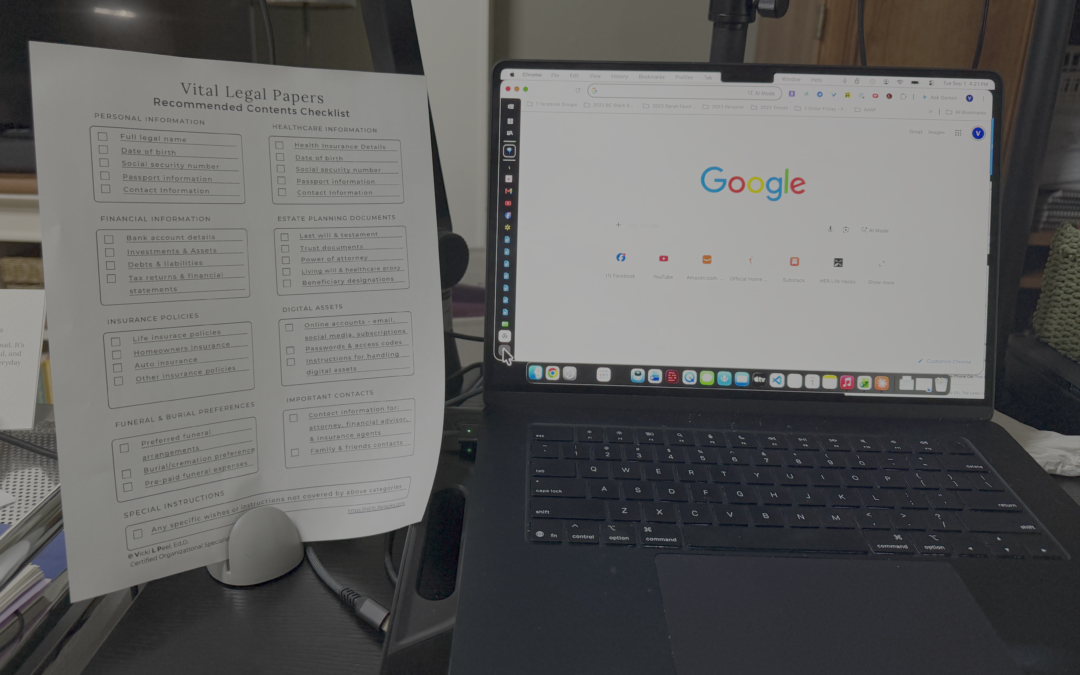
Last week I pulled out my own Vital Legal Papers Checklist — the one I made for my readers — and did something I’d been putting off longer than I care to admit.

I checked my own work.

The results were mixed.


Starting to Build the System

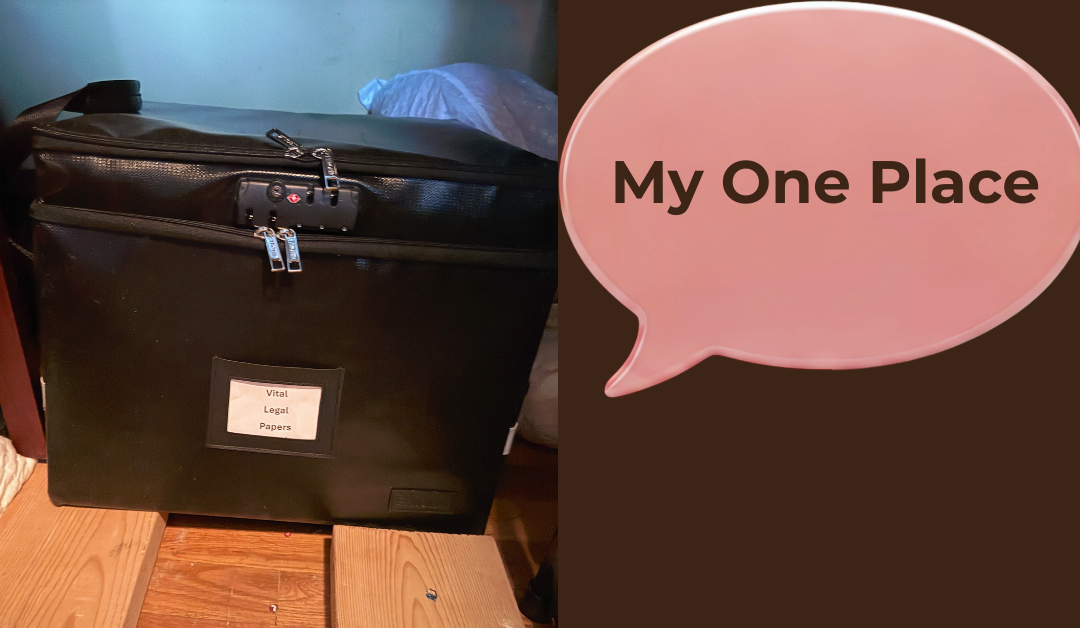
Some things passed. My will is exactly where it should be — in the safety deposit box at the bank. My passwords are all current, too. I’d love to tell you that’s because I’m disciplined, but the truth is simpler: I use a password manager, and it does the remembering for me. That’s not discipline. That’s a system. (And that difference is going to come up again and again this fall.)

Then it got humbling.

My insurance papers? I have most of them. But “most of them” and “all in one place” are two very different things. Some are filed where they belong. Others are — well, elsewhere. I know it’s somewhere is a phrase I hear from readers all the time. It turns out I say it too.

And then the part I’d been avoiding entirely: the notes for my children. The page that tells them where everything is, who to call, and what they’d need to know if I weren’t here to answer questions.

I haven’t written a word. Not a rough draft. Not a list on the back of an envelope. Nothing.


What’s the Cost of Not Doing

Here’s the thing that struck me as I sat there with my own checklist: my papers are in better shape than my family’s ability to find them. The will exists — but the map to it lives only in my head. If something happened to me tomorrow, my family wouldn’t be starting from nothing. They’d be starting from guessing. And I’m not sure that’s much better.

I know what that guessing costs, because I’ve lived it from the other side. When my mother and my mother-in-law passed, my husband and I served as executors of our parents’ estates — and losing them taught us a lot. I learned firsthand what it means to sort through everything — the papers, the accounts, the decisions — while you’re grieving. It’s a burden I decided long ago my children would not carry.


What? How?

But deciding, it turns out, isn’t the same as finishing.

And since we’re being honest, here’s one more confession. Sitting there with my own checklist, I realized it tells you what to gather — but not how. Where should the originals live, and where should the copies go? What’s fine in a box on a shelf, and what belongs somewhere more secure? What needs to be written down for your family, and how much information is enough? My checklist doesn’t answer those questions yet.

Neither do I. That’s what this fall is for.

As I work through my own checklist, I’ll be asking those questions out loud, figuring out the answers, and adding what I learn — which means the checklist you download today is going to keep getting better as we go. You’re not just watching me get my affairs in order. You’re watching the how get built.

So this fall, I’m finishing — in public. Each week I’ll take one step toward what I call being legacy ready: papers findable, accounts written down, the house a little lighter, the stories saved. I’ll show you exactly what I did, how long it took, what I put off and why, and what I’d tell a friend to do differently.

Not because I enjoy confessing. Because I know from thirty-four years in education that people finish things when someone is doing it alongside them — and almost never when they’re alone at the kitchen table with a stack of folders.


Promises…Promises…

A few promises about what this series will not be.

It won’t be morbid. This is about living with your affairs in order, not dwelling on the end. A folder full of answers makes life lighter, not heavier.

It won’t be overwhelming. One step a week. Some steps take an afternoon. Most take less.

And it won’t require you to be organized already. You can start where you are. Clearly, I did.

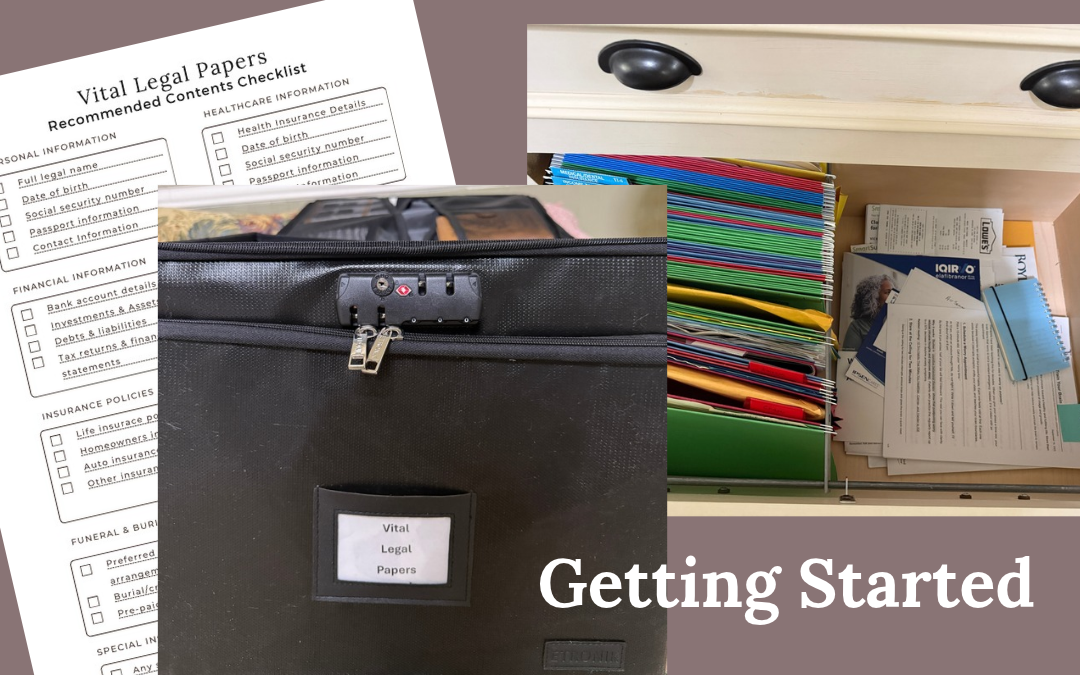
If you’d like to walk along with me, start where I started: the Vital Legal Papers Checklist. It’s free, it’s short, and this week your only assignment is the same one I’m giving myself — print it and look it over. Don’t gather a single document yet.


The Real Question

So let me ask you what I had to ask myself: if your family needed your important papers tomorrow, would they know where to look — and could they get to them?

I’d love to hear where you are with this. No shame in the answer. I just told you mine.

Next time: the first step I’m taking — choosing where everything will live.

My Website Was Hiding My Name. Literally.

My Website Was Hiding My Name. Literally.

What rebuilding my own front door taught me about the clutter we stop seeing.

I teach people how to clear clutter from their lives. So it’s only fair to tell you what I found on my own website this week.

Clutter revealed

For years, I hesitated to share my website link. I couldn’t have told you exactly why.

The site worked, mostly. But it felt like a junk drawer — the menu had grown to more than a dozen items, there were sign-up forms from three different seasons of my business, and somewhere along the way it had stopped saying anything clearly.

So this month I decided to practice what I preach and clean my own digital house.

Here’s what I found buried in the workings: one line of code, added years ago, that had been hiding my website’s entire header. My logo. My name. Hidden — on every page, all this time. I never knew it was there.

I’ve been thinking about that line of code ever since. Because it isn’t really a story about websites.

Nothing on that site got cluttered on purpose. Every menu item made sense when it was added. Every sign-up form belonged to something I was trying at the time.

That’s how it happens in our homes, too — no one decides to have a full attic. It arrives one reasonable decision at a time, until one day the accumulation is hiding the very thing that matters most. In my case, quite literally my own name.

Less is more.

So I didn’t redesign my website. Mostly, I removed. The menu went from fourteen items to five. The competing sign-up forms became one. And now, when you arrive, the site asks you a single question — the one my whole business is built around at this moment in time:

If something happened to you tomorrow, would your family know where to look?

A few things I learned along the way, in case you’re circling a project like this yourself:

Clutter accumulates one sensible choice at a time. That’s why it’s nobody’s fault — and why it takes a deliberate afternoon to reverse.

Findable beats perfect. My site isn’t perfect. But a visitor can now find what matters in five seconds, and that’s the standard worth meeting.

And you’re not too old for this. I spent this week untangling caching gremlins and rebuilding page sections at an age when I’m supposed to be intimidated by technology. I wasn’t fast. I was stubborn. Stubborn works fine.

Free and clear

If you’d like to see the results, come visit: https://herlifehacks.com .

While you’re there, you’ll meet the new front door — my free Vital Legal Papers Checklist, one page that helps you gather the important papers your family would need, so they’re findable when it matters. It’s the first step of everything I teach, and it’s yours for an email address.

So, let me ask you the question I had to ask myself: what’s one thing in your life that’s been hidden — not by anyone’s bad decision, but by years of perfectly reasonable ones? I’d love to hear. I read every reply.


Where I Am Right Now (And Why I’m Pausing to Notice)

Where I Am Right Now (And Why I’m Pausing to Notice)

Over the past few weeks, I’ve been doing something that doesn’t come naturally to me.

I’ve been looking—on purpose.

Without fixing, optimizing, or declaring a big new plan.

Just looking at something  that I’ve historically put last – finances

I didn’t begin with a budget or a spreadsheet overhaul. I started by noticing how much avoidance had quietly shaped my habits over the years.

Bills were paid.
Money was in the bank.
Everything seemed “fine.”

And yet, I didn’t really know what was happening beneath the surface—especially with subscriptions, recurring charges, and the way small decisions compound over time. 

That pattern of avoidance wasn’t about math. It was about being afraid to see the whole picture at once. Because once you see it, you can’t unsee it.

So I made a decision:
I would stop avoiding—and start observing.

What I’ve Been Doing (Quietly and Imperfectly)

I’ve been taking what I call a “just look” approach.

That has meant:

  • Pulling statements instead of skimming them
  • Tracking subscriptions instead of assuming I remembered them all
  • Discovering charges I thought were canceled—and dealing with the fallout
  • Realizing that some things can’t be understood without a bit of organizing first, especially when deadlines (like taxes) are involved

None of this has been fast. And none of it has been polished.

In fact, some weeks looked like progress. Others not so much. 

But something important shifted along the way: the fear I’d built up over years of not looking was far worse than the reality of finally seeing things as they are.

What Surprised Me Most

What surprised me wasn’t how much needed attention—it was how much relief came with taking responsibility.

Once I stopped postponing decisions, I felt steadier.
Once I worked through a process one time, the next time took a fraction of the energy.
Once I admitted, “I don’t actually have a system here,” the path forward became clearer.

That’s a pattern I recognize from many other areas of life and work. It’s rarely the task itself that drains us—it’s the friction created by not having a repeatable way to approach it.

Why I’m Sharing This Now

I’m pausing here—not because I’m done, but because I’m not.

I haven’t named this phase.
I haven’t packaged it.
I’m not ready to call it a system.

What I am doing is paying attention to what’s changing as I move from avoidance to awareness, from reaction to intention. 

And I know I’m not the only one who has postponed certain areas of life simply because everything else felt more urgent.

If you’re reading this and thinking, “I’ve been meaning to look at that…”—whether it’s finances, files, commitments, or something else entirely—you’re just at the moment before clarity.

I’ll keep sharing what I’m noticing as I go.
Not as advice or instruction.
But as someone willing to look—and learn—out loud.

Legacy Living Starts Here

Legacy Living Starts Here

Legacy Living Starts Here:

A Manifesto, A Framework, and a Weekly Rhythm to Build What Matters

Some seasons of life ask us to go deeper, not faster. To get clearer, not busier. To make room for what matters—and let go of what no longer does.

That’s why I created HER Life Hacks and the C.O.P.E. Framework. And it’s why today, I’m unveiling something even more intentional:

The Legacy Living Manifesto
📍 The C.O.P.E. Framework (Clear. Organize. Preserve. Empower.)
📅 The BLT Weekly Track: A rhythm of life and business content designed for impact

🌱 Introducing the Legacy Living Manifesto


Legacy isn’t something you write at the end of your life—it’s something you live, daily. The Legacy Living Manifesto is a declaration of values, vision, and action for women 50+ who want to live with purpose and finish well.

It’s not a list of goals or resolutions. It’s an incentive—an invitation to step forward with clarity, courage, and intention.

Legacy Living Manifesto
Legacy Living Manifesto - C.O.P.E.

Downloadable and Printable Legacy Living Manifesto

   The C.O.P.E. Framework: Your Legacy Starts          Now


At the heart of everything I offer is the C.O.P.E. Framework:

  • C – Clear Clutter: Let go of the excess. Keep what matters.
  • O – Organize: Put things in place that make life easier and more meaningful.
  • P – Preserve: Capture your stories, your wisdom, your voice.
  • E – Empower: Live with purpose. Pass on more than things—pass on strength.

Every tool, tip, product, and post at HER Life Hacks connects to one of these four pillars. Together, they support you in creating a life (and legacy) by design—not default.


COPE Pyramid 

🥪 What Is BLT? Your Weekly Legacy Content Plan


Legacy Living is easier when you know what to expect. So, I’ve created a rhythm to anchor your week:

  • B = Business Legacy Track (Tuesdays): Streamline your digital life, repurpose your content, organize your assets, and design a business that reflects your values.
  • L = Life Legacy Track (Wednesdays): Focus on home, family, estate prep, decluttering, organizing, memory-keeping, and all the meaningful layers of life that shape your story.
  • T = Together Track (Fridays): The intersection where life and business meet. Think productivity, time management, legacy tech tips, or personal stories with broader applications.

Each week, you’ll receive content that fits within one of these tracks—always grounded in the C.O.P.E. pillars, always aligned with the bigger picture: living well, finishing strong, and leaving nothing unsaid.

❤️ You’re Invited


This is more than a blog post. It’s your invitation to embrace a different pace and a deeper purpose.

Subscribe, follow along, and participate. Whether you’re ready to tackle your closets, your content, or your calling—I’ve got something coming your way that will help.

This is where Legacy Living begins. I’m so glad you’re here.

To your storied life,

Live well. Finish strong. Leave nothing unsaid.

Go to https://HERLifeHacks.com to subscribe to my newsletter. You are welcome here!


I’m Vicki Peel, Ed.D. — creator of HER Life Hacks,

certified organizational specialist,

and your guide to Legacy Living.

Here, we declutter what doesn’t matter, organize what does,

and preserve the stories only you can tell.

This is for women who want to live with intention, leave a legacy,

and never lose track of what really counts.

Subscribe to my newsletter for the latest C.O.P.E. content.

The Container Concept

The Container Concept

Decluttering and organizing is hard. It’s easy to become overwhelmed with decisions about what to keep, what to discard, and how to organize the things we keep.

Dana K White, author and decluttering expert, is the creator of this process – the Container Concept.

Understanding the Container Concept

The Container Concept is a simple but powerful principle that shifts the way we think about our belongings. I typically try to fit the most I can into a space. It doesn’t work. At least, not in the long run.

Instead, think about every space in your home as a container that has a limit.

Whether it’s a drawer, a shelf, or a whole room, each container is limited in the space it provides. In fact, your entire home is a container. It can only hold so much stuff.

The key is to recognize that the container is the decision-maker—it dictates how much we can keep. This is one of the most important principles that I had to understand and accept when decluttering and organizing my own home. Shifting the decision-making process to the container also removed my emotional involvement.

Working the Container Concept

Here’s how the Container Concept can transform your approach to decluttering and organizing:

  • Identify the Container
    • Start by identifying the space you’re working with. This could be a single drawer, a bookshelf, your entire closet, or even an entire room.
    • The physical boundaries of this space are the limits of the container.
  • Choose the stuff you want and need to keep
    • Sort like stuff together so you can see the quantity you own of each item and make decisions about what you want to keep and what to discard.
    • Next, go through your items and pick out the ones you want to keep or use regularly. Organize these in your container first.
    • Place like items together in a container.
  • Respect the Boundaries
    • Once the container is full, the hard part begins—everything that doesn’t fit must go. It’s all about recognizing that the container has done its job.
    • If you’ve chosen what you want and need and the container is full, then anything extra is excess and needs to be donated, discarded, or relocated.
  • Leave Space to Expand
    • If you fill a container until it’s completely full, you have nowhere to put additional like purchases.
    • Leaving extra space not only looks better, but it also gives you the option of adding items in the future.
    • If you don’t leave space for expansion, you may need to adopt the “one in – one out” rule. For every item you want to add to the space, an item needs to be removed to make room for it.
  • Apply It Everywhere
    • The genius of the Container Concept is its versatility.
    • It works everywhere in your home, from your pantry to your garage.
    • It even applies to less tangible “containers” like your schedule or your mental energy. They have limits too and recognizing that improves your chances of making good decisions in these areas.
    • By understanding and respecting the limits of your containers, you naturally begin to declutter and prioritize what’s most important to you.

Embracing the Effectiveness of the Container Concept

The Container Concept is effective because it removes the emotional burden of decision-making.

Instead of agonizing over what to keep and what to let go, the container’s physical boundaries guide your choices. Instead of trying to justify keeping items, your focus becomes making space for the things that add value to your life.

This mindset also helps prevent future clutter.

When you bring something new into your home, you’re more likely to consider where it will go and whether it will fit within your existing containers. If it doesn’t, you need to make a conscious choice about what to remove to make room for it.

By viewing your spaces as containers with fixed limits, you can simplify the decluttering and organizing process. It also reduces stress and helps you create a home that reflects what matters most to you.

The Container Concept is your ultimate decluttering and organizing decision-making tool!

Watch the Container Concept put into action in my video “30 Minutes to an Organized Freezer and How to Keep it That Way”. 

Disclosure: My blog posts sometimes contain affiliate links. This means I earn a small commission if you click through and make a purchase, which is at no additional cost to you. Thank you!

I’m Vicki Peel, former home economics teacher and educational administrator. If you are not receiving my emails, coupons, and freebies, go to my website (address below) and sign up for my newsletter.  I will not share your information with anyone, and all the content you will receive as part of our community is free. I may occasionally promote someone else’s paid content, offer a product for your consideration or share an item that I think might be of use to you. However, you are under no obligation to purchase anything – ever. So, sign up now so you won’t miss anything!

https://HERLifeHacks.com

“`