by Vicki Peel | Mar 10, 2022 | Food |
Simple home cooking. Is that your daily routine or does it sound like a pipe dream to you?
When I was growing up, we rarely ate out. My grandmother and mother cooked three meals a day – every day. And while I recall being served biscuits and green beans – we called them string beans – at every meal except breakfast, remembering the whole family gathering around the table brings back warm and comforting memories.
Fried chicken was about as fresh as you could get it. Grandmama raised chickens, so we never had to go to the grocery store for that! And fresh eggs daily were as close as the chicken coop.
Cooking at home is one of the healthiest things you can do for your family. It’s much easier to make healthier choices at home. Eating more vegetables and far less sugar and salt than takeout means better overall nutrition for the people you love.
Home cooking brings us together as a family. It’s a chance to create new memories, find out what’s going on in the lives of our family members, and share things that strengthen family bonds.
I want to cook more meals at home. I know I can save money and eat much healthier. Does that resonate with you?
But it’s hard to do. It requires planning, planning, planning. And preparation time. So, at the end of another busy day, it’s so much easier to order a pizza or pick up a family meal at your favorite fast food restaurant.
Let’s start with a few general meal planning tips.
- If you’re not sure where to start with planning your meals, you can make it easy by taking stock of what is in your kitchen. Take note of everything in your pantry and refrigerator, write it down, and see what meals you can make from those ingredients.
- Start small by preparing home-cooked meals only a few times a week. You’ll start to get the hang of it and want to cook more often once you realize what a time saver it really is.
- Make extras. Plan for leftovers and how you’ll use them in another meal. And instead of making one casserole, or enough soup for one meal, make enough for two or even three and then freeze the extras.
- Enlist the help of family members. When I had my knee replacement surgeries, my husband was forced to learn to cook. And to my surprise and delight, he really got interested in preparing new dishes and looking for recipes to try.
- Be open to new ideas and new ways to prepare meals. And document what you do along the way. Instead of sharing pics of your meal at a local restaurant, take pictures of the meals you prepare and share them with me. I want to include you in my posts and emails!
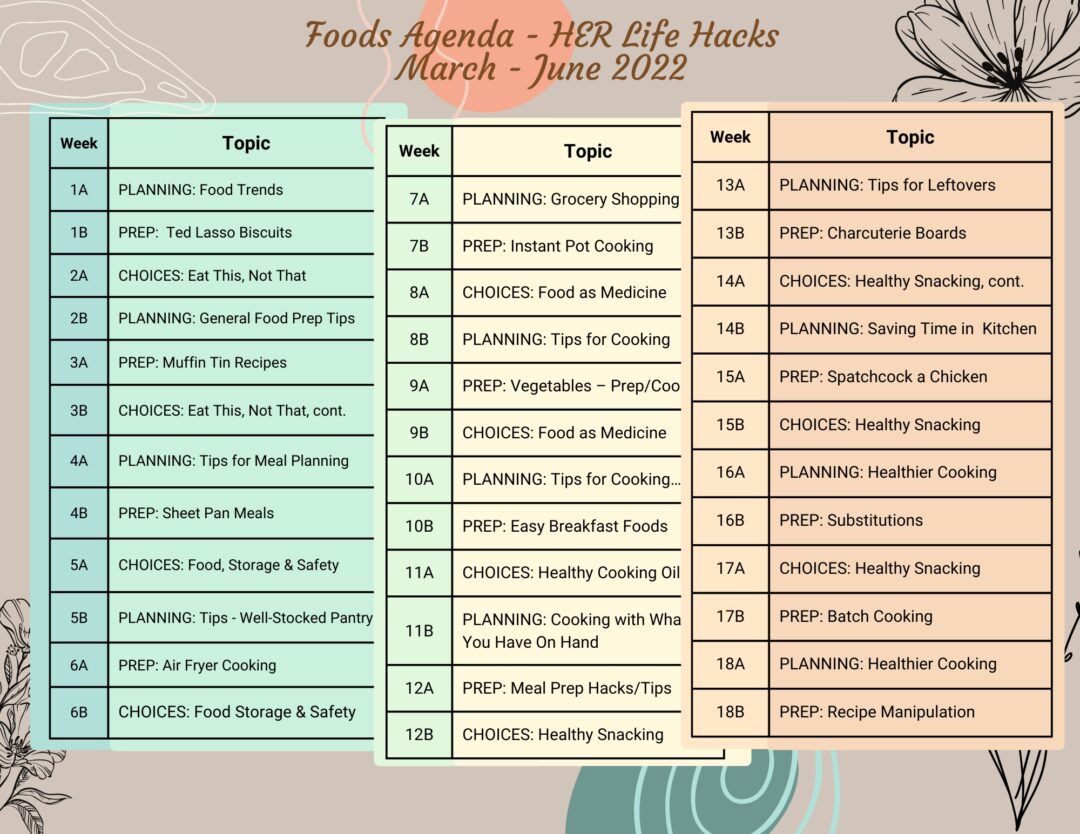
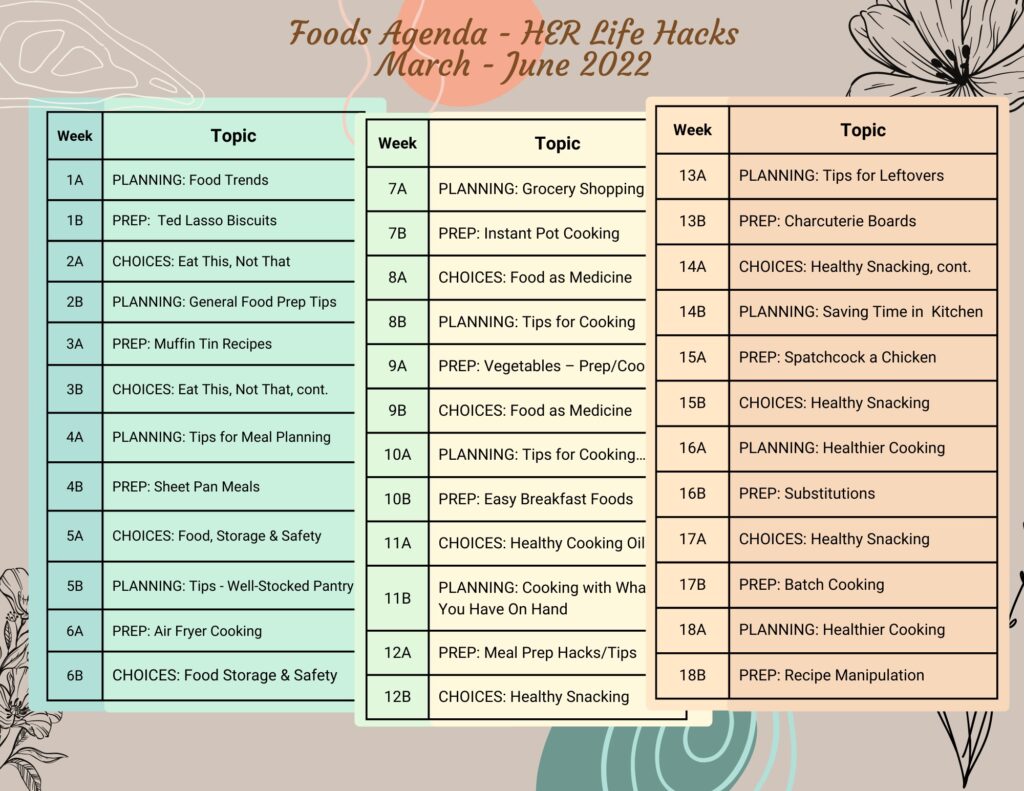
For the next four months, HER Life Hacks will be focused on FOOD. Look for new blog posts every Tuesday and Thursday. Topics will be alternated among the three category areas that you, my readers, helped me plan: Meal Planning; Meal Prep; and Healthy Food Choices.
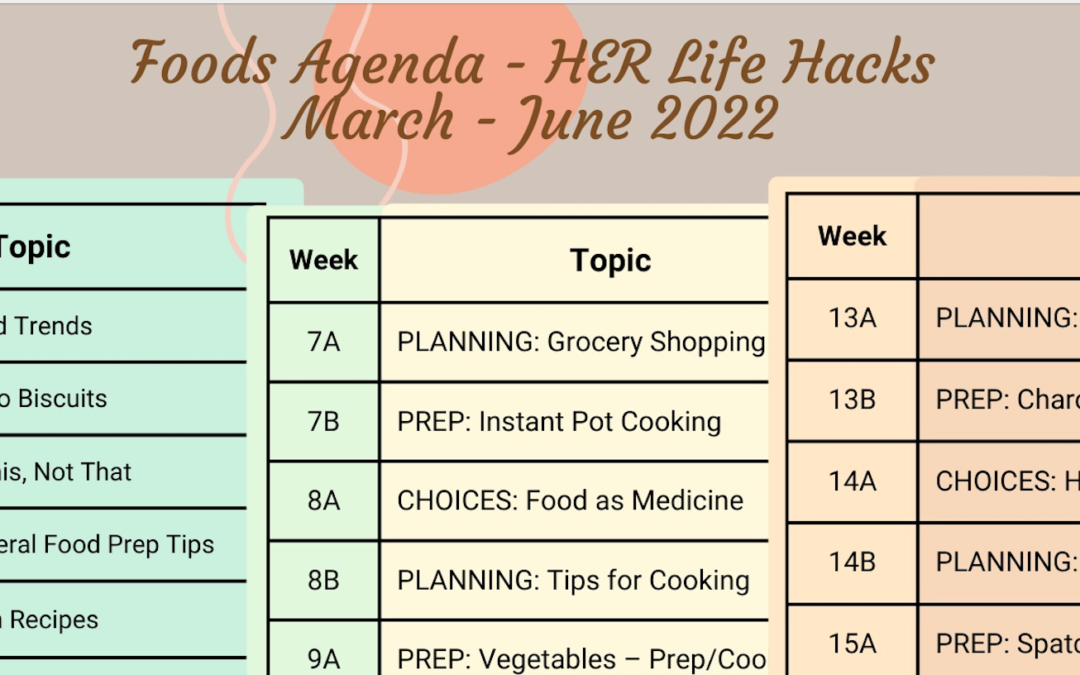
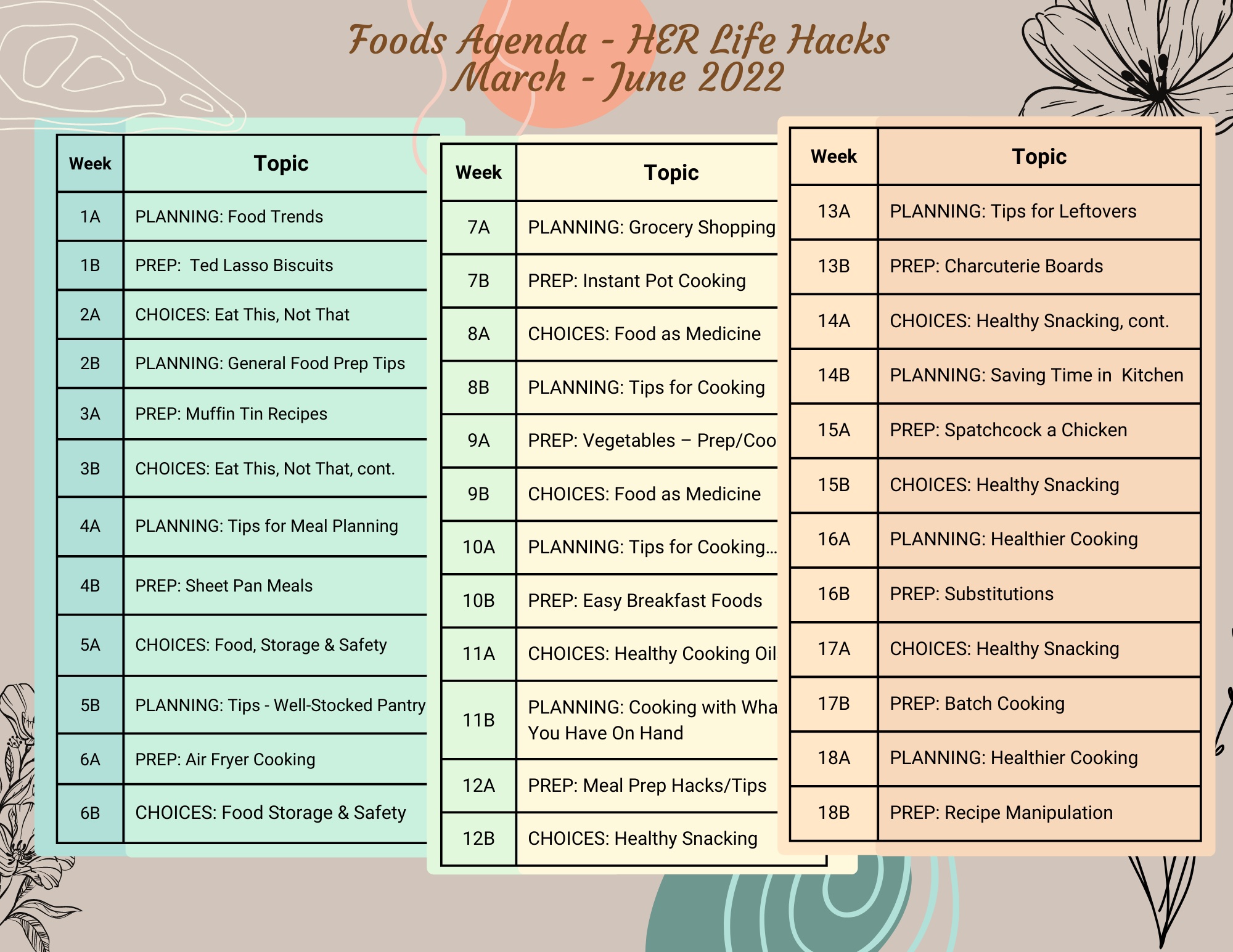
For your reference, here is the agenda scheduled for March – June 2022. This post is Week 2B. If you’d like a copy to download, you may download it HERE.
Share this post with your friends and invite them to join us as we journey through this FOODS agenda!
by Vicki Peel | Mar 8, 2022 | Food |
If I guessed that eating out for you means a dash through a fast food drive-thru, would I be correct? I would bet on it.
Since the COVID pandemic, even your favorite restaurants have turned themselves into fast food restaurants. And they did it just to survive.
What about the choices you are making at your favorite fast food restaurant? How aware are you of what you are actually eating? And think about this – how do you feel afterwards?
Eating healthier is harder than ever. As the price of food (along with everything else) skyrockets, it is understandable that your food choices reflect your desire to save money. And that means fast food is at the top of the cheaper food options. And when most restaurants closed their doors to the public, it was so much easier to just pull up to the closest drive-thru.
Even as restaurants began to reopen to the public, many people were hesitant to return to enclosed public places.
But can you really make healthy food choices at a fast food restaurant? Yes, you can. But it isn’t always easy.
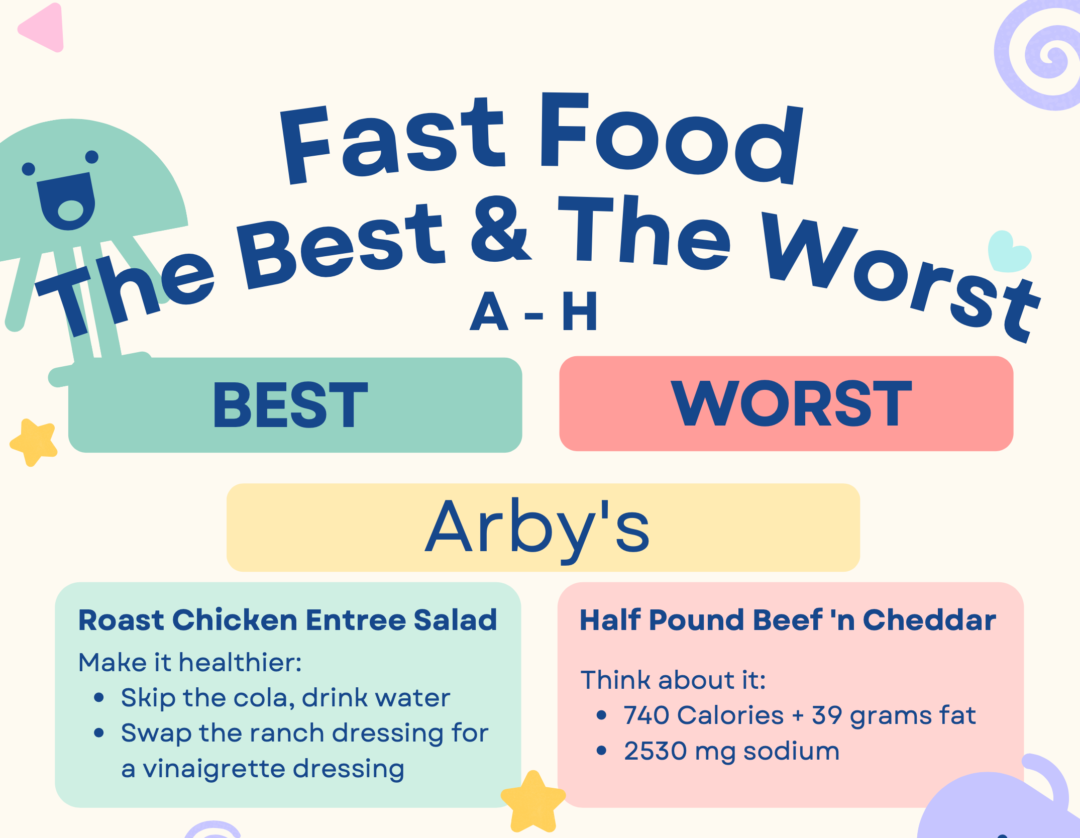
So, I created an infographic of the best and the worst foods at 10 popular fast food restaurants.
This is a look at the best and worst food to eat at Arby’s, the first restaurant of the 10 included in the infographic.
You can download your free copy of the entire infographic HERE! This one is a two-page spread, the first of which covers restaurants from A to H – Arby’s to Hardee’s. The second page covers K to W – KFC to Wendy’s.
I also created a one-page, two-column infographic, which can be downloaded HERE. I suggest that you fold it in half for a quick and easy reference. I used a glue stick to glue the back of the folded copy together so I could simply flip back and forth between A-H and K-W information.
Have your eating habits changed? Been eating too much fast food?
Use the Comment section below to share your concerns about eating habits. Are you happy with yours?
by Vicki Peel | Mar 3, 2022 | Food |
The amount of foods tossed out by Americans is staggering. Are we being safe or simply wasteful?
“Ninety Percent of Americans misinterpret the dates on labels, according
To the Natural Resources Defense Council (NRDC), and they throw out
Food that could still be consumed or frozen for later use.”
If you thought there were federal regulations on date labeling, you’d be wrong. Baby formula is the only federally-regulated food item.
So what do those date labels mean? They are often manufacturer’s best guess as to how long their food will taste fresh. They really don’t mean anything about whether it’s safe to eat. It’s about food quality, not food safety.
Here are what a few of the food labels currently mean:
- Best If Used By/Before – guarantees the date by which the product will retain its best quality or flavor
- Sell By – is set by manufacturers to alert retailers when to remove a product from their shelves
- Use By – guarantees the last date by which a product will retain its best quality
- Packed on – indicates when an item was packaged
You can take measures to maintain freshness of food as long as possible. First, store foods at the proper temperature. Refrigerated foods should be stored no lower than 40° F and frozen food should be kept at 0° F.
So, how do you tell if your food is safe to eat? The best option is to apply the tried-and-sometimes-true “sniff, taste, and see test”. How does it smell? If the food smells different from what it should, consider that one indication of safety. Of course, you can see some indications that food has gone bad. Mold or discoloration are a definitive sign. And taste will tell you when something is wrong.
Generally, canned goods can last 2-5 years. But cans with dents and bulges should be discarded.
Grains and dried goods can probably be used well past their expiration dates, but meat, dairy and eggs have shorter shelf lives.
The Cleveland Clinic suggests these general guidelines for freshness:
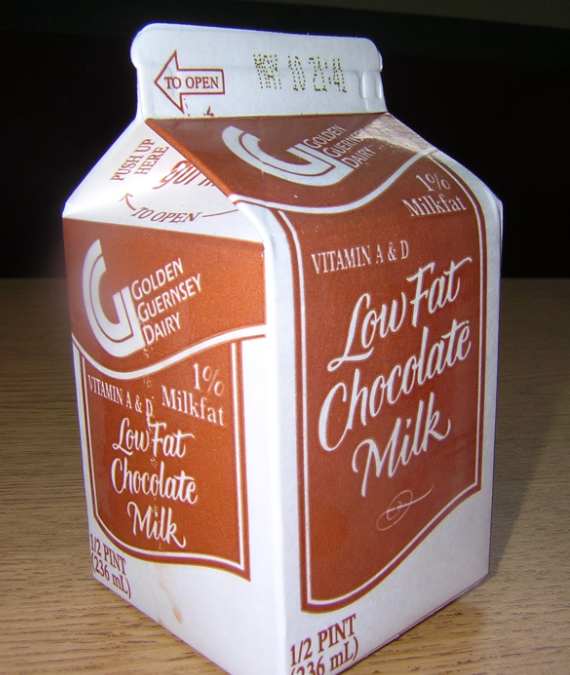
- Milk – 7 days (keep in back of refrigerator where it is the coldest)
- Eggs – 3-5 weeks (also store in back of refrigerator)
- Ground meat/poultry – 1-2 days
- Cooked meat/poultry – 3-4 days
- Lunch meat – 2 weeks unopened, or 3-5 days opened
- Dry pasta – 1-2 years
- Steaks – 3-5 days
- Fresh poultry – 1-2 days
- Canned fruit – 12-18 months; 5-7 days in refrigerator after opening
- Rice and dried pasta – 2 years; 3-4 days in refrigerator after cooking
Recommended freezer shelf life for best quality:
- Hamburger/other ground meats – 3-4 months
- Chicken of turkey (whole) – 1 year
- Soups and stews – 2-3 months
- Lunch meat – 1-2 months
As a concerned consumer, you can:
- Stay aware of the dates on your food and store them properly.
- Use your good judgment (and eyes, ears and nose) to determine whether to eat questionable foods.
- Freeze food to prolong its shelf life when possible.
- Read labels and educate yourself about what they mean.
I’m Vicki Peel, former home economics teacher and educational administrator. If you are not receiving my emails, coupons, and freebies, look for the Subscribe block (below right) and submit your contact information. I will not share your information with anyone, and all the content you will receive as part of our community is free. I may occasionally promote someone else’s paid content, offer a product for your consideration or share an item that I think might be of use to you. However, you are under no obligation to purchase anything – ever. So, sign up now so you won’t miss anything during our March – June foods extravaganza!!
https://HERLifeHacks.com
by Vicki Peel | Mar 2, 2022 | Food |
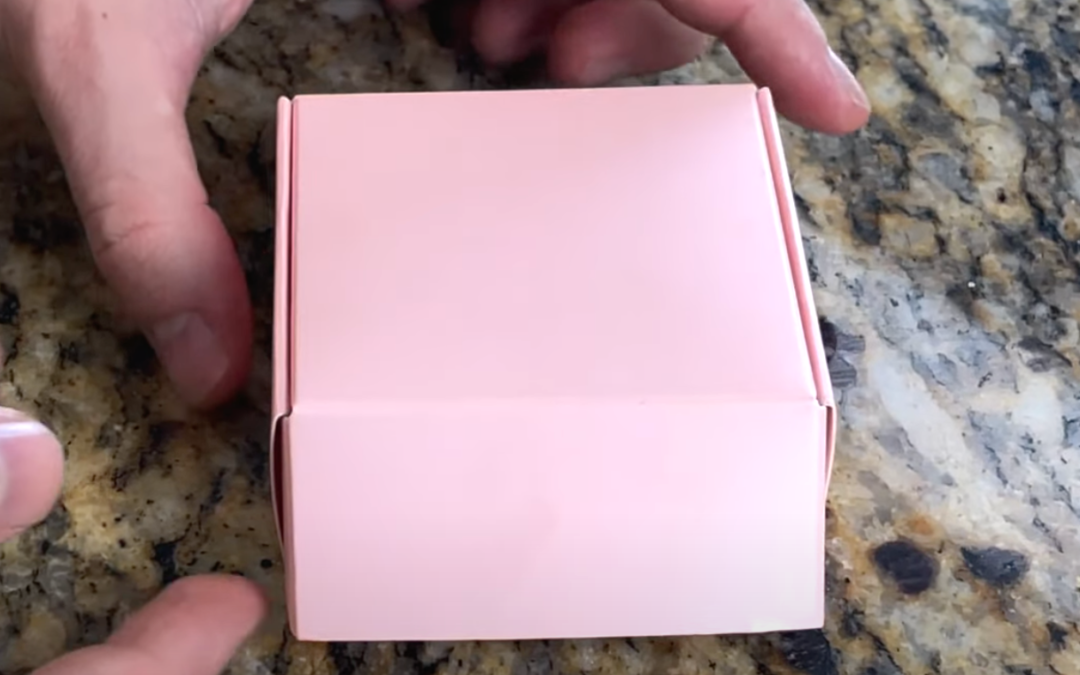
What do Ted Lasso and a meal prep post have in common? BISCUITS. Of course, not the Southern kind of biscuits like my grandmother taught me how to make. No, we’re talking about British biscuits – or cookies.
If you are a Ted Lasso fan, you know that every day Ted would take a little box of biscuits to his boss, Rebecca. Eventually, we found out that Ted made them himself. And now, Ted’s recipe has been released to the world.
And so – take a look at how to made Ted Lasso Biscuits!
Click HERE to watch video!
This makes a very tender shortbread, but it is also pretty plain. You could try other options to liven it up a bit, such as adding butterscotch or semi-sweet bits onto the hot biscuits and spread them as icing upon melting. Or you could add some vanilla or almond extract into the mixture before patting in pan to cook.
Ready to try it for yourself? Click HERE to get a copy of the recipe.
And leave your comments below about how your recipe turned out! Or email me with comments and pictures! I want to feature you in future posts or emails!
by Vicki Peel | Mar 1, 2022 | Food |
Practically everything about our lives has been disrupted since the pandemic took control, even our food acquisition, preparation, and consumption. Certainly, I have eaten at home much more, ordered groceries online, and am on a path to reducetarianism (more about that later).
According to food experts, there are several food trends predicted for 2022. Some of these trends started at the beginning of the pandemic. Others have evolved in response to economic, agricultural, and global changes. Some may be fleeting, while others may be here to stay.
In general, 2022 trends include:
- Still cooking at home;
- Snacking throughout the day;
- Eating foods to make you feel better;
- Experimenting with new flavors and textures;
- Creating new beverage rituals; and
- Choosing products that are better for the planet.
Here are 15 specific food trends that may be likely to impact you and me.
- Reducetarianism
Although you may not be familiar with the word, you’re probably aware of the concept. Reducitarians are those who are reducing their consumption of meat, dairy, and eggs without cutting them out completely.
My husband and I have discovered that we don’t need as much meat as we were used to consuming. Therefore, we often share a plate at restaurants and cook less meat at home. We also are buying better quality meats, which include grass-fed animals and organic eggs from pasture-raised chickens.
- Hibiscus
Hibiscus is an edible hot pink flower with a high Vitamin C content. It is already being used in seltzers and teas. Expect to see it coming out in fruit spreads and yogurts.
- Sunflower seeds
OK, you’re familiar with sunflower seeds, which are also found in trail mix and granola. Sunflower seeds consist of high-quality proteins and unsaturated fats, making them a hearty and healthy snack food. More foods are now incorporating sunflower seeds in crackers, ice cream, and dips.
- Tumeric
I’m sure you’re familiar with the health benefits of turmeric, which has been on the food radar for years now. But food companies are adding turmeric to soups, smoothies, and packaged foods. That expands your opportunities to include turmeric in your diet.
- Mocktails
Many people have been trying to reduce their alcohol consumption, and mocktails, which are cocktails without alcohol, allow them to do that without sacrificing the flavor.
- Plant-based protein
The increased popularity of plant-based protein correlates directly to less meat consumption. It has been touted as a healthier alternative to meat, and many are getting aboard the trend.
- Condiment obsession
People have become tired of the same old flavors, and food companies have responded with condiments that have bolder flavors, especially spicy and hot.
- New green kitchen
Buyers are spending more on environmentally-friendly products, especially now as the cost gap between those and conventional foods is shrinking. This includes things like reusable bags for food storage and composting.
- Underground ordering
When restrictions were imposed that excluded eating out in restaurants, many states loosened their restrictions to allow restaurants and chefs to sell “cottage foods”. That meant people could order specific foods via direct messaging and social media, and pick up their order at varying locations.
- Fishless fish
With our oceans in trouble environmentally, the production of plant-based seafood is growing. Aquaculture, raising farmed tilapia and catfish, did not prove to help the environment, as their emmision of greenhouse gases were as high as those for beef. As a non-fish lover, I don’t think I’ll be trying plant-based seafood!
In addition, you might also hear more about lab-grown (as opposed to plant-based) sushi-grade “fish”. Not interested in that either!
- Grocery loyalty
With increasing grocery prices and more people engaging in online ordering and delivery, national and regional grocery stores are banking on annual memberships to keep customers loyal to them. They are offering incentives and benefits that help offset the increasing grocery prices, and promoting how they are helping customers to save money.
- Cannibas
There has been a marked increase in Cannabis in many products, and chefs are also adding it into their dishes.
- Coffee alternatives
Coffee prices in October 2021 were at a 30-year high. So, naturally other options were developed and advertised. People were looking for caffeine-free products that tasted like coffee.
And Amazon sells coffee alternatives, such as Teecino Caramel Nut Dandelion Tea, which is described as rich and roasted herbal tea that’s caffeine free and prebiotic with detoxifying dandelion root.
Another Amazon product is Crio Bru Ghana French Roast, a natural healthy brewed cacao drink, which is a great substitute to herbal tea and coffee. It is 99% caffeine-free, gluten-free and advertised as low-calorie honest energy.
- Allergy-friendly food for kids
Statistics show that 1 in 13 kids has at least one food allergy. This has been a basically untouched market, which is just now becoming more commonplace. Mo’Pweeze is a 100% allergen-free and vegan bakery, which is available online. Partake Foods also sells online products such as allergy-friendly cookies and mixes.
- Eating to Support Mental Health
Hippocrates first said “Let food be thy medicine”. Science is constantly publishing information about how different foods affect your mood, mental health, and wellness in general. More people are focused on mindful eating and making food choices in line with this concept.
What about you? How has the pandemic changed your cooking and eating habits? Have you embraced any of these emerging food trends? Please respond in the comments section below. I’d love to see how you and other people are responding in this area of their lives.
by Vicki Peel | Sep 27, 2021 | Lifestyle |
Shifting to a mindset of abundance has probably been one of the hardest things for me to grasp and develop on my lifelong journey of self-improvement. When I first started reading about it, I knew I wanted it – an abundance mindset.
I grew up thinking about abundance in a very different way. Of course, as a child I didn’t think or talk about the term abundance, but I somehow knew I didn’t have it. It is something I have had to work at and be cognizant of. But it is worth it. ‘
As you read this post, stop and reflect about how you think and feel about what you read. It may be much different from typical thoughts about abundance
“An abundance mentality springs from internal security, not from external rankings, comparisons, opinions, possessions, or associations.”- Stephen Covey
When you live from a place of abundance, you feel gratitude for what you already have, are aware and constantly pursuing new opportunities in every area of your life and give to others freely.
Concept of Abundance
“The entire universe is conspiring to give you everything you want.” – Abraham Hicks
This mindset is the core of any area of your life. It focuses your attention on what you already have and all the possibilities that are available to everyone in the world. The problem, according to Covey is that most people are trapped with the scarcity mentality. They act as though they have to grab things in life before others get them, as if there is not enough abundance to go around.
The concept of abundance, or the theory behind abundance mindset then, is one of believing there is always enough for you and everyone else, that by taking risks and growing in all ways, you win and succeed in life.
Abundance: More than Wealth
Abundance is more than wealth, although that is a part of it. It is many things and can mean different things to each person. It is the internal belief that, regardless of your circumstances, situation, or skills, you are always provided for in every area of your life.
Real abundance is the physical manifestation of your true nature and how we are showing up in our world. It shows ups as:
❃ Love of family
❃ Support from friends
❃ An unexpected gift
❃ New friends
❃ A helping hand from a stranger
❃ Renewed energy and better health
❃ New opportunities to move you closer to your vision
❃ And sometimes cash
Abundance includes financial wealth, but it also includes having a rich, healthy, and fulfilling life, while living each day with purpose and passion.
🔷 Financial or Material
This can mean anything from having peace of mind that your bills are always paid to having actual financial wealth with unlimited funds. It can mean you are abundant in possessions such as homes, autos, jewelry, furniture, or other material things.
🔷 Personal Development
Being abundant in your personal development can be an abundance of confidence in your abilities, skills, and opportunities. It can be an abundance in learning and growing to be your best self. It means being fulfilled in personal enrichment activities you enjoy.
🔷 Spirituality
An abundance of spirituality means feeling a connection to your higher self often through your religious or spiritual practice. It means standing up for what you believe in and being comfortable with that.
🔷 Relationships
The variety of relationships you have that contributes to your happiness includes friends, coworkers, and of course family and loved ones. Abundant relationships enrich every area of your life.
🔷 Health
Having a health abundance starts with treating your body with love and respect by eating healthy foods, regular exercise, and physical exams. It means being at your healthiest level, free from disease and unhealthy habits.
🔷 Purpose
Although our career is often what we consider our purpose in life, it is more powerful to a think of it as a sense of belonging at whatever you do, whether great or small. It may manifest itself with a feeling of contentment with what you do in life.
🔷 Natural abundance
Abundance can be found all around you. It can be found in nature and your awareness of it.
Abundance is being able to recognize the riches of everything in your life, loving yourself, taking care of your health and doing what you are passionate about. Abundance is about feeling loved and loving others, about feeling peaceful and free.
Developing an Abundance Mindset
“Abundance is not something we acquire. It is something we tune into.” ~ Wayne Dyer
Developing an abundant mindset can be done with consistency and believing it will happen. Focus on your thoughts, actions, fears and how you react to events. Then make changes when you find yourself reacting from a place of scarcity.
The Next Step
Your thoughts, feelings and attitudes affect your ability to create the life you desire. This is your mindset. It can be one of abundance or come from a place of scarcity.
Bad things do happen in life. While you can’t control what happens in every situation, you can control how you react. You can shift your thinking and identify the positives that result from the event. At these times, it’s important that you actively to choose to focus on the positive aspects. When you learn to control and shift your mindset to abundance, you begin to recognize and experience more abundance and possibility.
In the words of Peter Diamandis, “Creating abundance is not about creating a life of luxury for everybody on this planet; it’s about creating a life of possibility.”
Is your mindset helping or hindering your creation of abundance in your life?
My ecourse, “Designing Your New Normal Mindset”, is a great place to start to examine your mindset and develop one of abundance. This course provides the guidance to help you enter the next phase of your life with awareness and confidence and ultimately, abundance. Consider how developing a new mindset can propel you to abundance by design! Check it out HERE!
Here’s to the peace and joy of your new abundance mindset!
by Vicki Peel | Sep 20, 2021 | Lifestyle |
Stress is an evil demon. No one is immune to its effects and everyone will suffer different symptoms resulting from being stressed out. One absolute fact: Stress will affect your mood, your job performance, your relationships, and your health if you don’t create a proactive plan for dealing with this devil.
I can’t imagine anyone not affected by stress in the last year. Just experiencing such drastic change over which you have no power is stress enough. But that was just the starting point for so many people who lost jobs and even worse, lost family members. I know I have worried over my children and grandchildren being exposed to the dangers all around.
But there are things we can do to manage stress, and the results mean you are managing your life, getting back on track and dealing constructively with issues facing you.
Let’s explore some of the most common stress symptoms and how to avoid the triggers that welcome stress into your life. Do any of these sound like you?
1. Inability to Relax
After a long day of work, what does your evening look like? Are you still in work-mode or can you sit down and relax while watching your favorite guilty pleasure on television? Constantly working doesn’t give your brain a chance to shut down and renew itself
2. Changes in Appetite
Some people overeat when stressed while others forget to eat because they don’t feel hungry during stressful events. Look at your own eating habits. Have you noticed a weight increase or loss? Are your clothes fitting differently? Do you notice any other physical symptoms that are affecting your productivity?
3. Feelings of Overwhelm
If you have too much scheduled on your calendar or your to-do list, you may experience an overwhelming feeling which leads to paralysis because you don’t know where to start. Overwhelming feelings of helplessness lead to stress, especially if you don’t have a strong support system of friends or family who can help you.
4. Feelings of Low Self-Worth
Stress often plays mind tricks on us, making us feel low, worthless, and incapable of great things. We may have the best idea ever but if one step goes wrong, the resulting stress makes us think we’re not cut out for this work, project, business, etc.
5. Inability to Focus
When your mind is stressed about other issues, focusing on the task at hand becomes difficult if not impossible. If you find your productivity is waning – either at work or at home – stress is weighing on your mind and you need to shift it elsewhere.
Try These Action Steps to Combat Stress
1. Avoid or Reduce Caffeine and Nicotine
Caffeine is a stimulant and when too much is ingested, can lead to heart palpitations and anxiety. Nicotine offers a quick fix to relax but that relaxing feeling soon evaporates, and you’re left with the anxiety and stress you were trying to eliminate in the first place.
I try to avoid caffeine, but if I can’t, I try to avoid it after 3:00 pm. Otherwise, I don’t sleep as well. Sometimes, it is just too hard. After all, chocolate is good for you, isn’t it? (Actually, dark chocolate in small amounts has been shown to have health benefits.)
2. Move Your Body Every Day
Daily movement helps keep your muscles toned, your ligaments flexible, your joints pain-free, and your mind more alert. Go for a walk, take an exercise class at the gym, or use some YouTube fitness videos to inspire you to move.
Use a simple timer or phone app to remind you to move at regular intervals. You don’t have to get in a 30-minute exercise routine. Just 5 minutes or stretching or 10 minutes of walking outside repeated throughout the day can work wonders.
3. Keep a Stress Diary
Similar to a daily journal, a stress diary can help you identify what triggers your stress. Whether it’s a work situation, toxic person in your daily life, or a situation at home, you’ll soon see a pattern if you jot down periodically throughout the day how you’re feeling emotionally and physically.
4. Take Control of Problems that Trigger Stress
Once you notice a trend of what stresses you out, do your best to take control of that trigger. Simple changes in routine and developing tiny habits to combat stress can make a huge difference. It doesn’t have to be a big change to impact your life.
5. Learn to Say No
It doesn’t make you a bad person to set some limits on how much time you spend doing what others want you to do. Set some boundaries for scheduling your time in ways that work for you.
Stress is present in everyone’s life but that doesn’t mean you have to be a slave to it. Take care of yourself by recognizing what triggers the stress in your life and by taking proactive measure to avoid stressful situations at all costs. Start living your best life stress-free!
If you are interested in more ways to combat stress, my friend Shirley Noah is an expert in dealing with stress. She wrote “Say No To Stress : A Practical Approach to Stress Management: The Essential Guide to Stop the Devastating Effects of Stress on Your Body”. You can get the Kindle version free on Amazon if you have Kindle Unlimited. But even if you don’t, the Kindle version is only $2.99! A small price to pay for how to “Say No to Stress”!
Another resource from Shirley is her Worry Journal Toolkit. Study proves these simple, natural remedies for anxiety will help you to dig deep and figure out how to let go of your worries and be mindful of your emotions. You can pick it HERE for only $12.99!
Shirley also writes about stress shares resources for dealing with stress on her website – https://ingoodhealthcoach.com/. You’ll find a lot of great tips there!
Take this FREE Self-Assessment: Is Stress Overtaking Your Life? Save the PDF and duplicate it to keep the original. You can complete it online and save it with a date. After implementing strategies to tackle your stress, open a new PDF and retake the assessment to see how far you’ve come!
I’m educator and blogger Vicki Peel, Ed.D. I support family members trying to live good-enough, intentional, and simpler lives by sharing life hacks and simple systems in the areas of Home Style, Lifestyle, and Food. Start by claiming your FREE report, Self-Care Hacks at https://HERLifeHacks.com
My shop in https://SimpleSystemsForLife.com continues to grow with products that support a simpler lifestyle and save you time, energy, and/or money. You can download the FREE “My One Thing Habit Tracker” on this site to help you develop and sustain tiny habits that will change your life for the better. Click HERE.
by Vicki Peel | Sep 14, 2021 | Home |
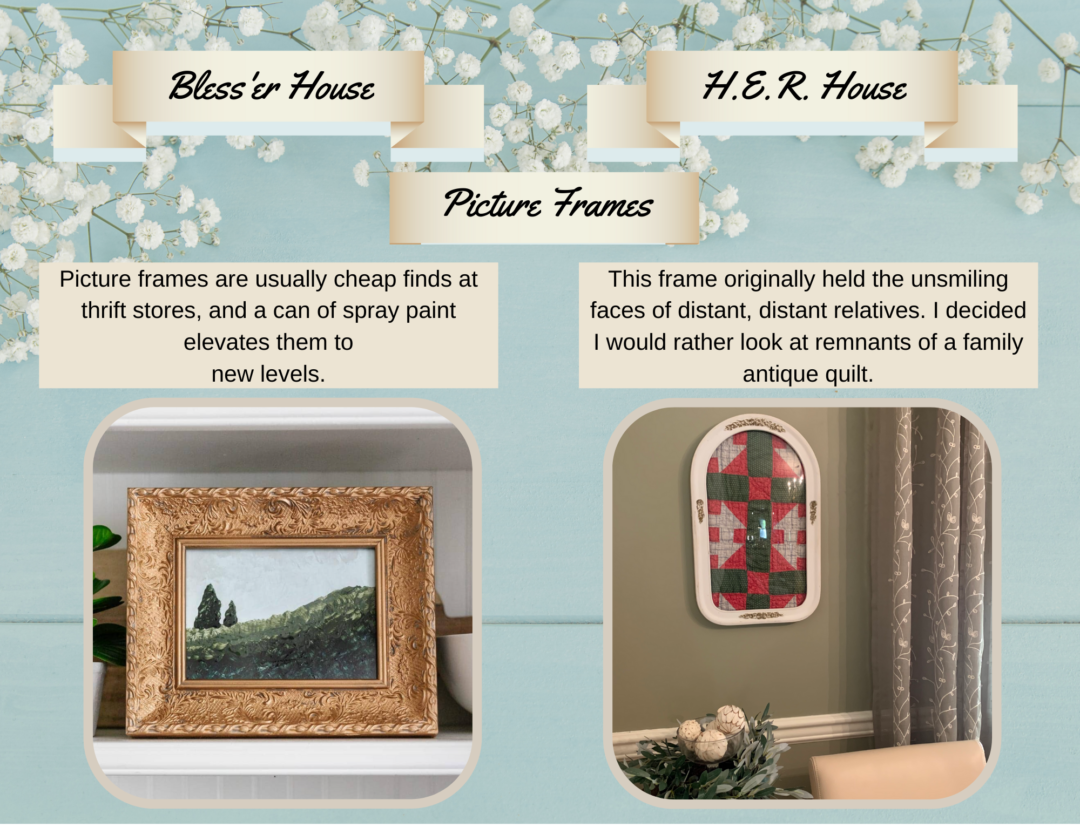
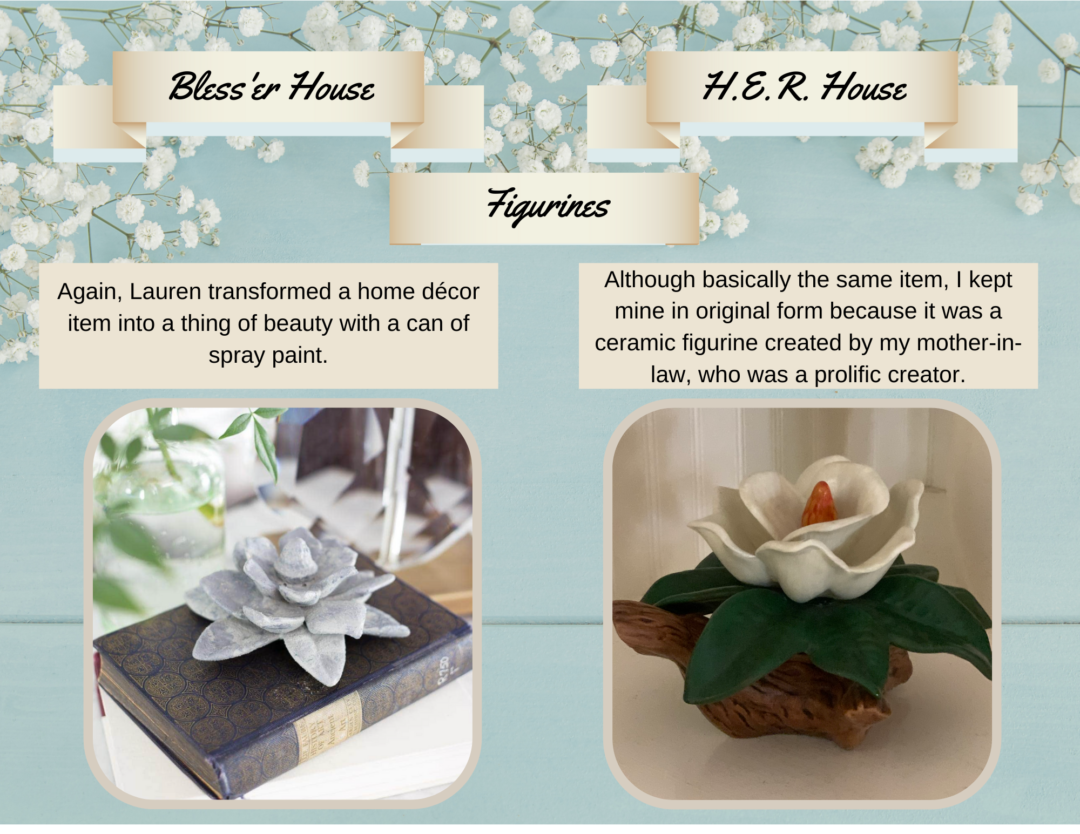
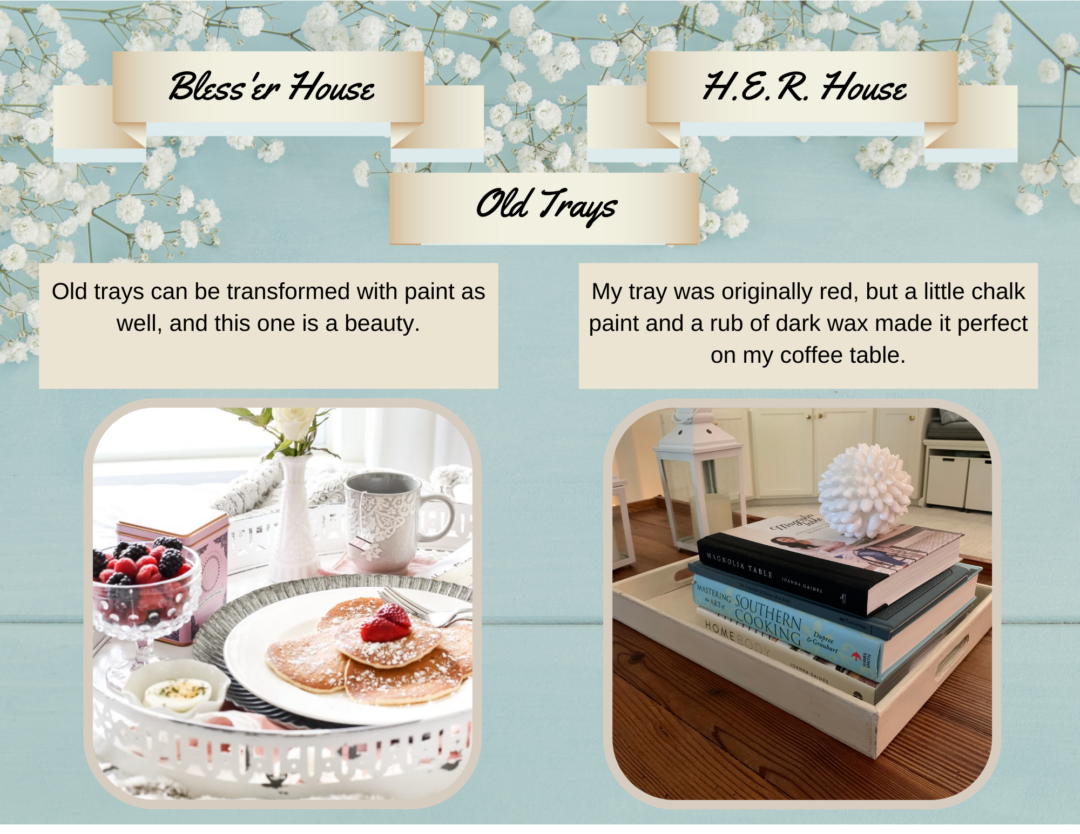
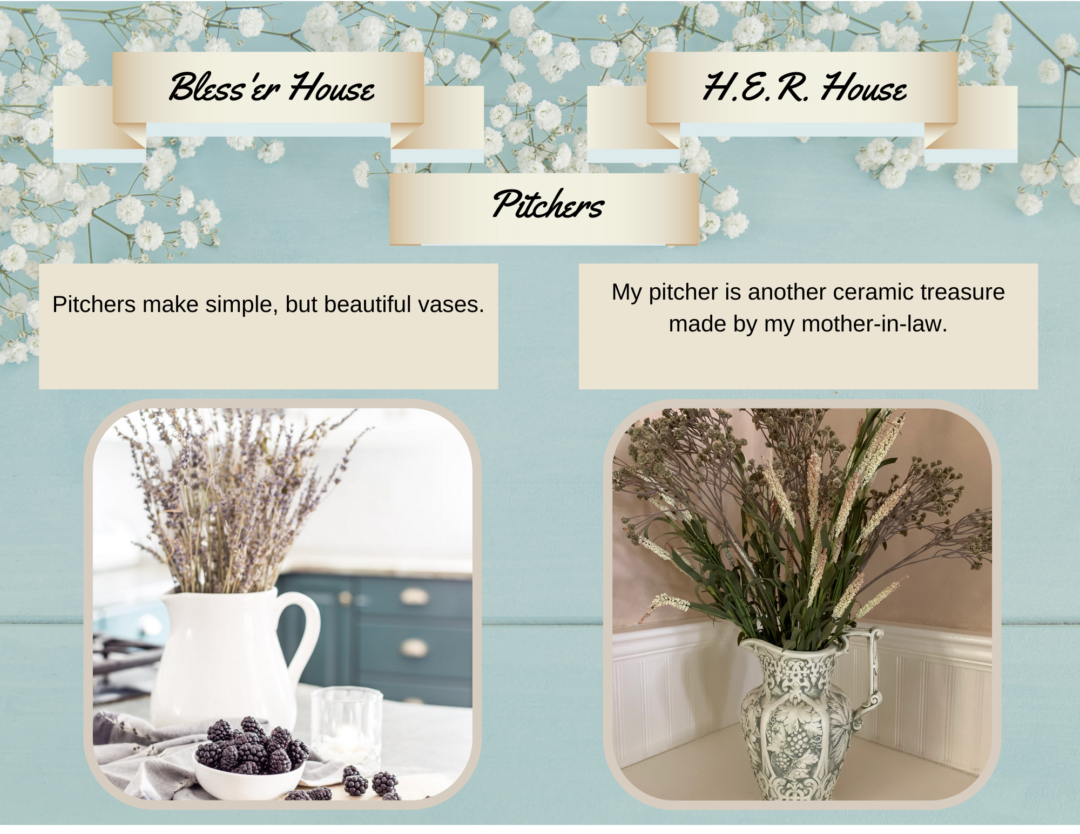
I love finding and fixing home décor items on the cheap. In fact, practically everything in my house was either something old from family members, a great sale item, or something I found and fixed up.
Even if I could afford a designer to make my house magazine-picture-perfect, I wouldn’t want to. My home is a sanctuary that reflects who we are as a family. It is comforting to look around at items that evoke fond memories and the work involved in making it my own.
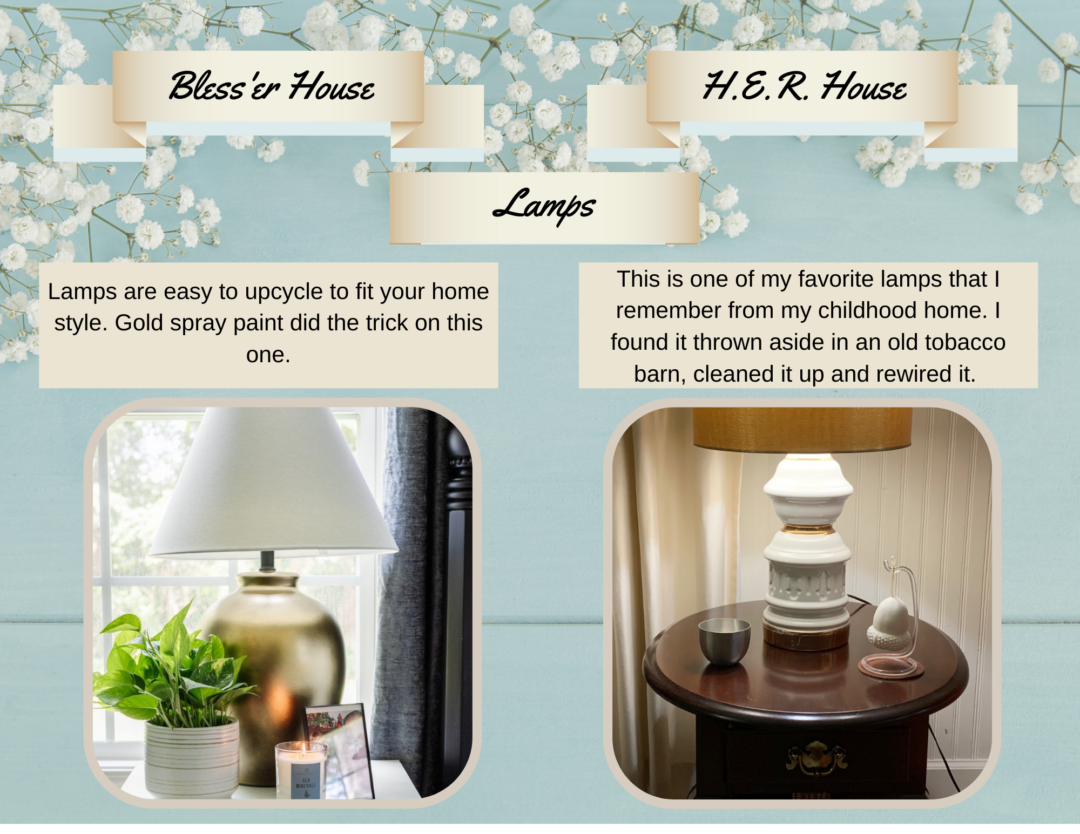
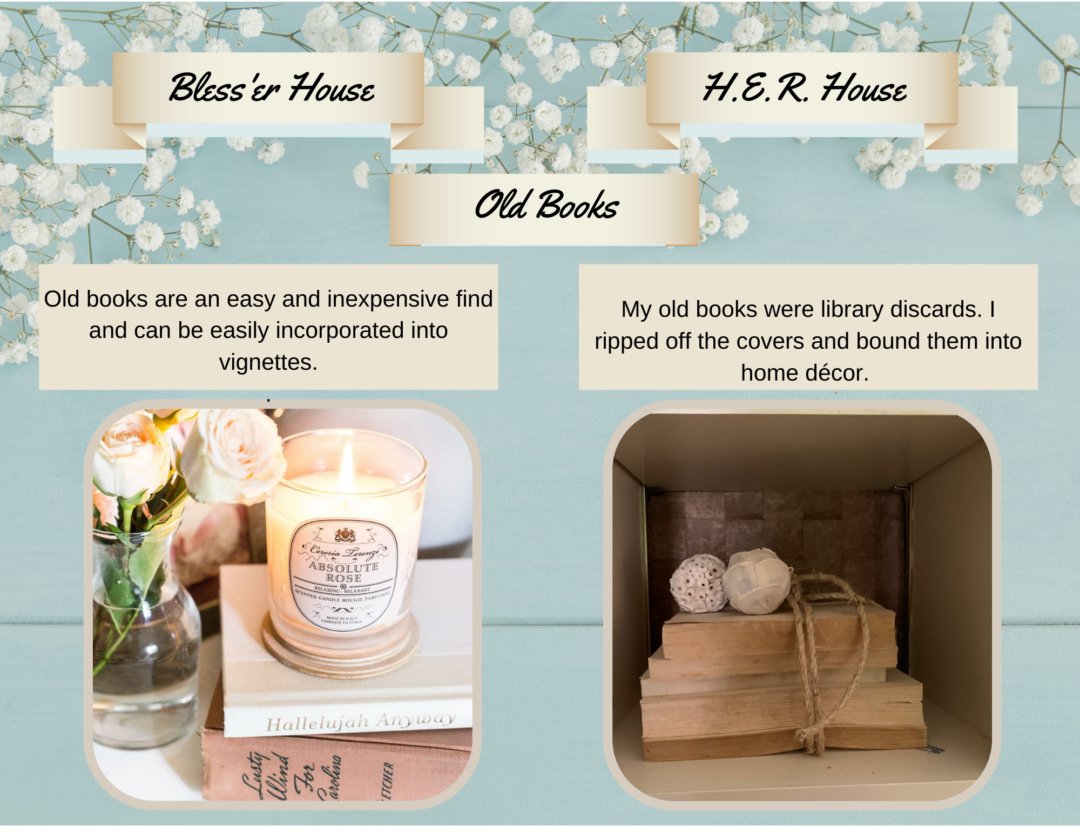
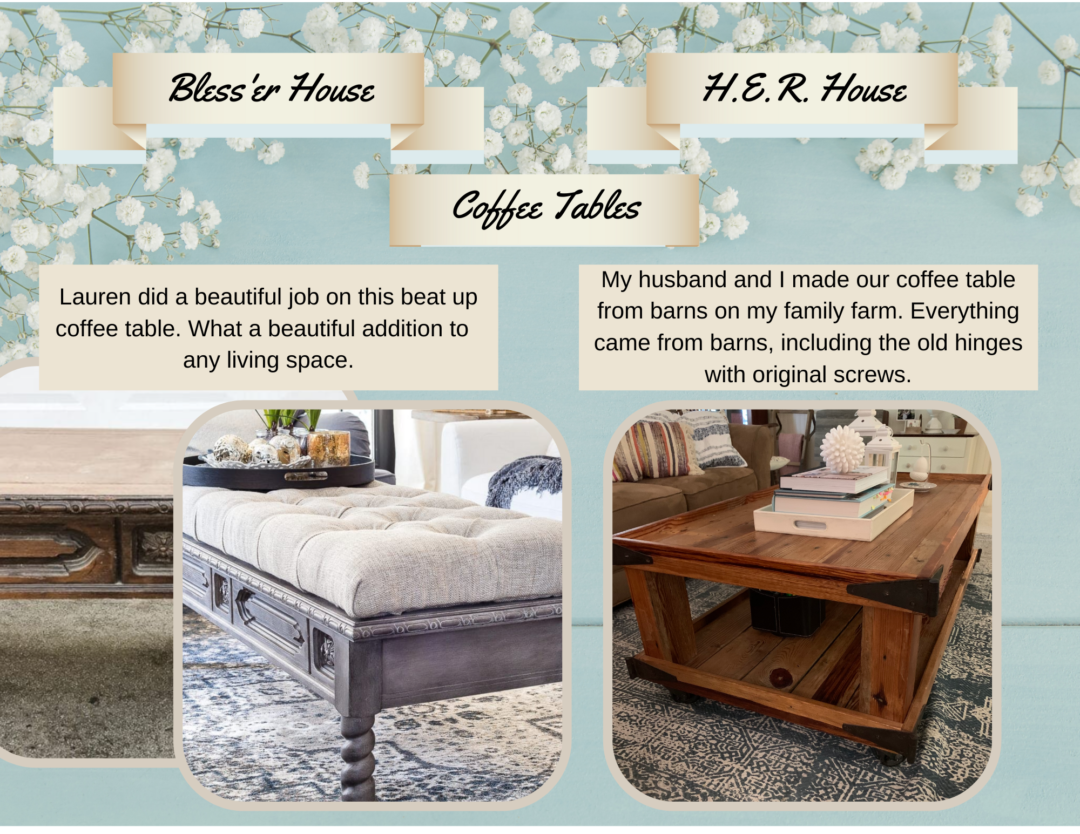
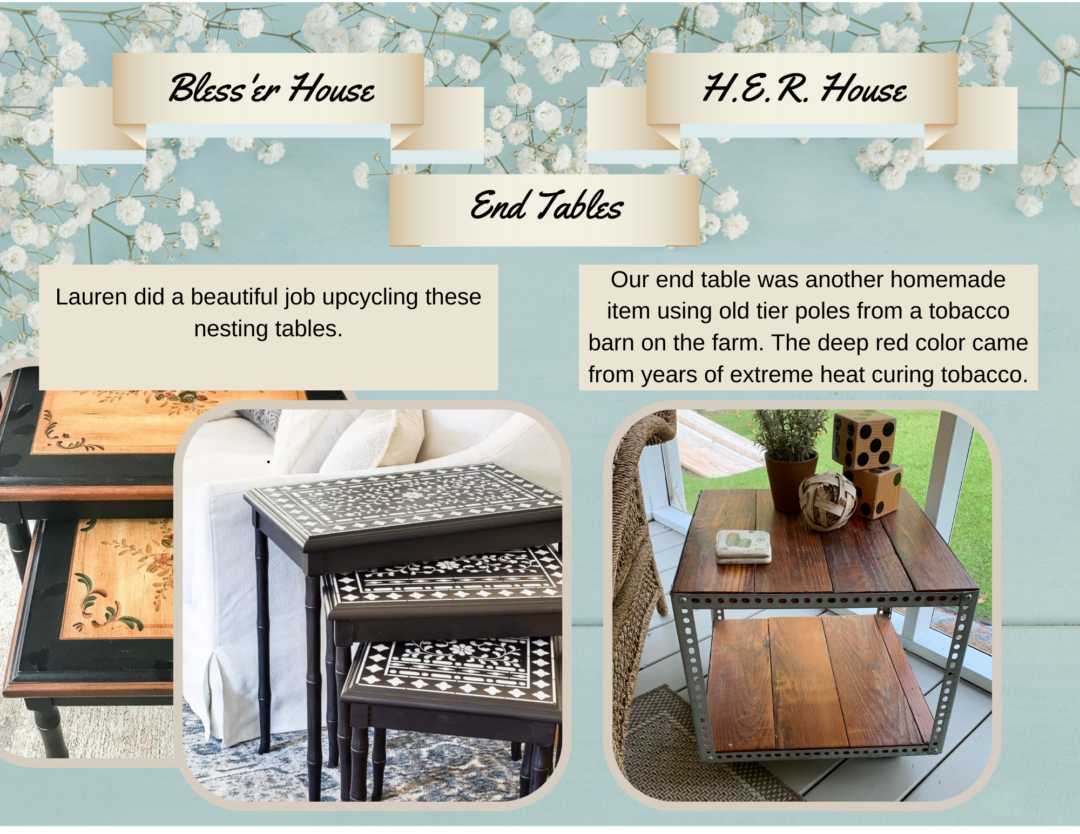
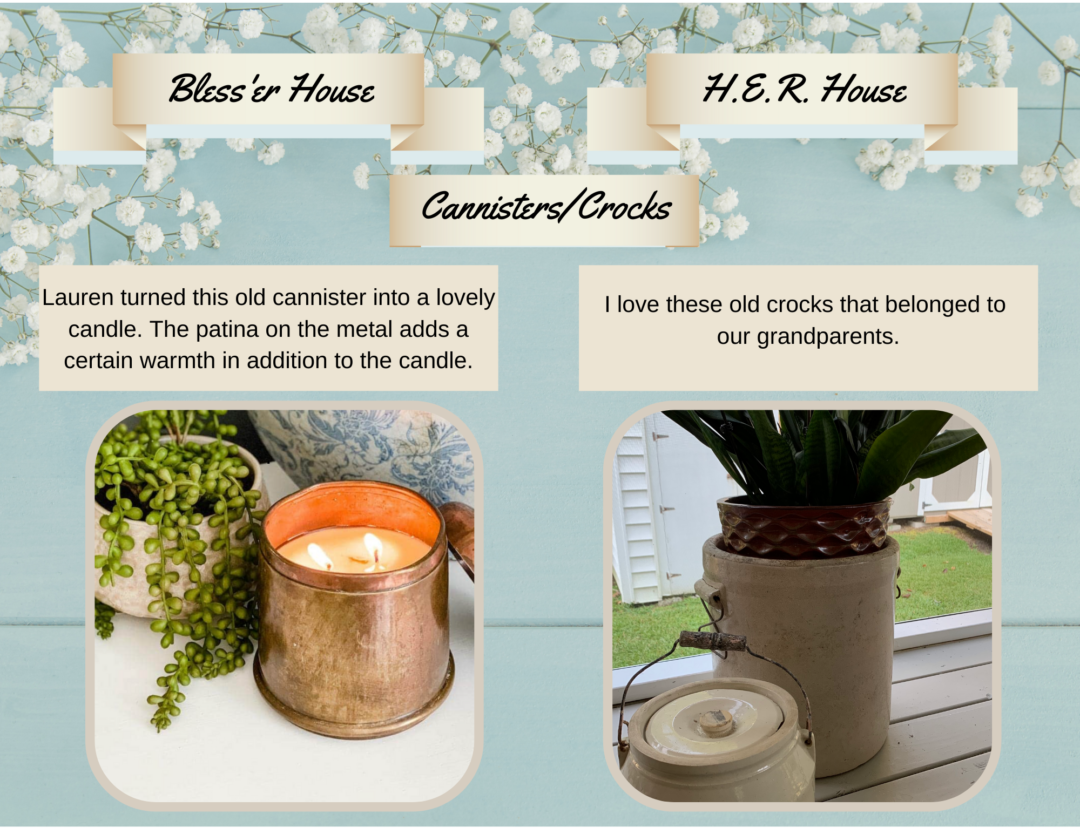
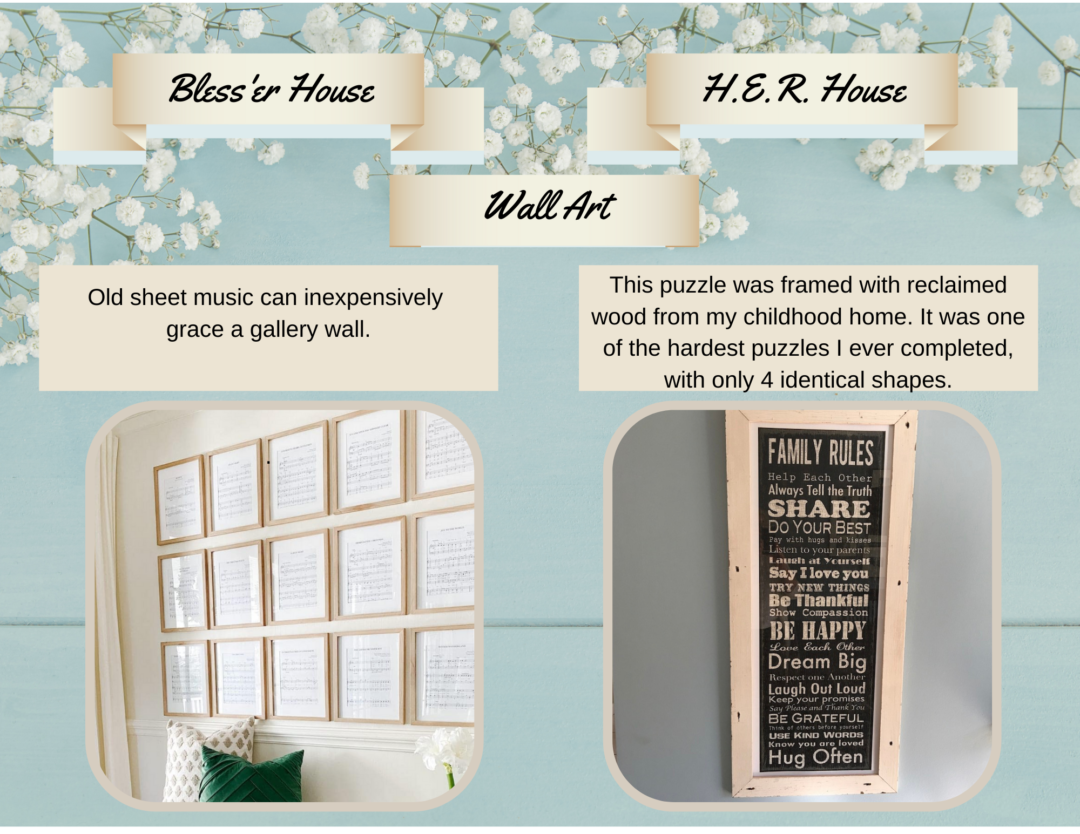
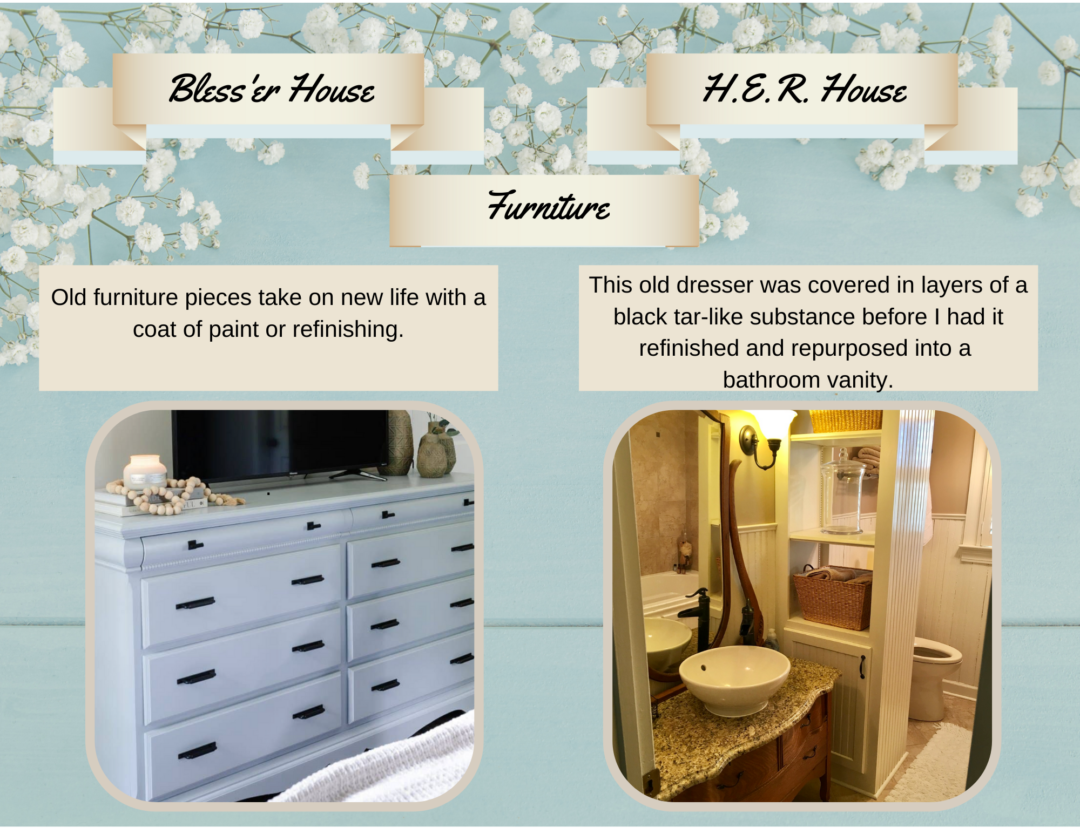
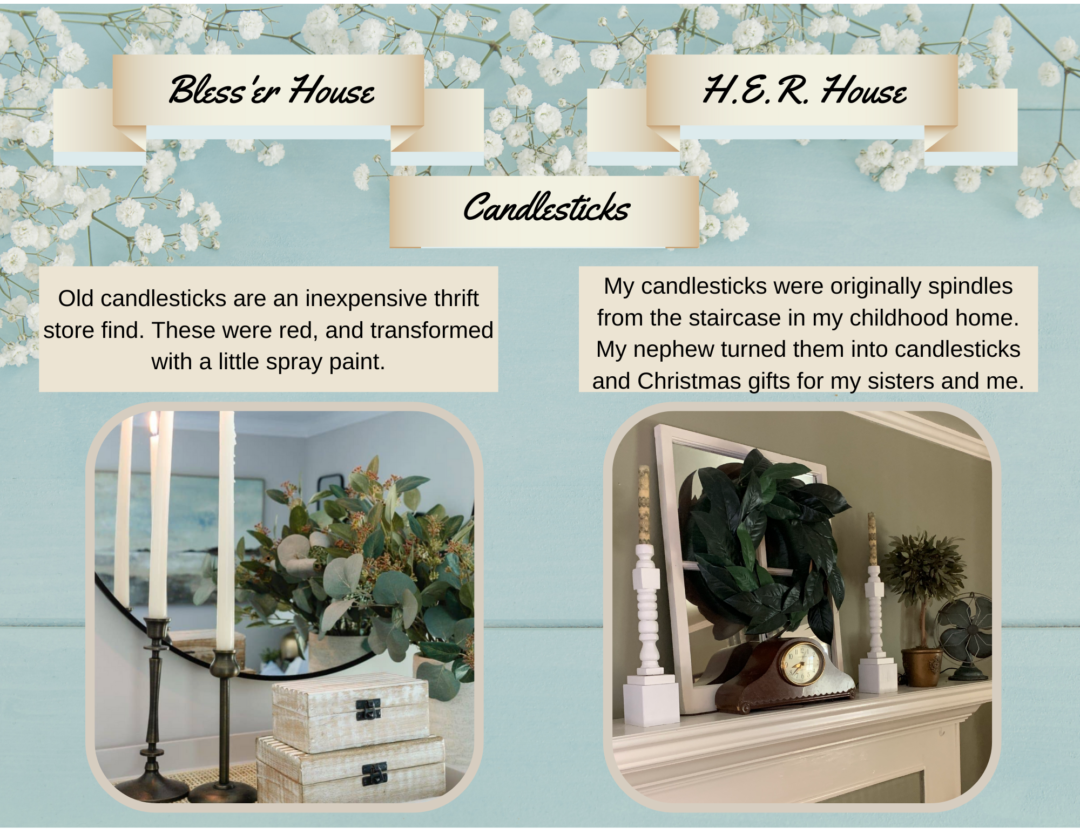
One of my favorite home bloggers is Lauren of “Bless’er House”. Lauren has a beautiful southern home that she has fixed up, thrifted and “diy-ed” into a warm, inviting place for her family. One of Lauren’s blog posts, “30 Home Décor Items You Should Always Buy While Thrift Shopping” is full of things similar to ones I have collected, upcycled and recycled for my home.
Follow along as I share some of Lauren’s items and similar ones in my home.
Whether you transform thrift store finds into beautiful home décor items or upcycle family treasures, you can easily decorate your home with meaningful and inexpensive items that reflect your personal style.
Do you have home décor that you have recycled or upcycled? What about incorporating family items into your decorating style? What treasures are part of your home décor that bring you comfort and joy? Reply to this email and tell me about them. I love hearing family stories and how you keep them alive through tangible items in your home.
Reference:
Bless’er House with Lauren
https://www.blesserhouse.com/16-must-have-home-decor-thrift-store-staples/
I’m educator and blogger Vicki Peel, Ed.D. I support family members trying to live good-enough, intentional, and simpler lives by sharing life hacks and simple systems in the areas of Home Style, Lifestyle, and Food. Start by claiming your FREE report, Self-Care Hacks at https://HERLifeHacks.com
My shop in https://SimpleSystemsForLife.com continues to grow with products that support a simpler lifestyle and save you time, energy, and/or money. You can download the FREE “My One Thing Habit Tracker” on this site to help you develop and sustain tiny habits that will change your life for the better. Click HERE.
by Vicki Peel | Aug 23, 2021 | Clear Clutter |
When you start decluttering your home, you just may recognize how so much of the clutter in your house reflects the clutter in your mind. I already know that when my home gets cluttered, I am more distracted, cranky, and prone to brain fog.
If you’re hanging onto to clothes that don’t fit, or the ugly vase your mother gave you for Christmas or the exercise bike you’re using as a clothes rack, you don’t just have a problem with too much stuff. You have a problem letting go.
Chances are you’re also hanging onto a whole bunch of bad feelings, ill-founded assumptions, old grievances and future worries, too.
If it feels good to declutter your house, it feels even better to declutter your mind. These 5 expert tips will help you make some space in your mind.
1. Meditate
You don’t have to do the full sitting on a cushion in a darkened room thing to benefit from meditation techniques. If you’re feeling overwound, some simple breathing techniques can help you calm down and focus. For a few minutes, focus only on your breathing and nothing else.
Check out some meditation apps online. I’ve found some great ones that are so soothing. They really work! Just find one that works for you.
2. Write it Down
You may have heard (or been told!) that you’d lose your head if it wasn’t screwed on tight. Certainly not the best thing to say to anyone, but the point is that it is so easy to forget important thoughts that run through your head. I know I do!
Writing things down not only helps you remember them, but it can also help you sort out worries or concerns.
Check out some free to-do apps. I’ve found several that I like and use them regularly to remember to do or buy something.
Journaling is a great way to sort out thoughts and feelings. More and more people are realizing the value of journaling goes way beyond just writing things down. It can me a kind of personal mental health journey. It can also focus your energy and free up some of that mental space!
3. Live in the Present
I’m sure you’ve heard many famous quotes about living in the present, such as:
“Yesterday is history. Tomorrow is a mystery. And today? Today is a gift. That’s why we call it the present.” ~ Eleanor Roosevelt
“Remember then: there is only one time that is important – Now! It is the most important time because it is the only time when we have any power.” ~ Leo Tolstoy
“Living in the moment means letting go of the past and not waiting for the future. It means living your life consciously, aware that each moment you breathe is a gift.” ~ Oprah Winfrey
WhiIe they are inspiring, I know that doing these beautiful messages is much harder than thinking about how true they are.
But remind yourself that brooding over the past and worrying about the future take up a lot of space in your mind and precisely achieve nothing. Let go of regret over past mistakes or resentment of past slights and move on. Keep your focus on what you can influence right here, right now.
4. Do One Thing at a Time
Multitasking is not only overrated and inefficient it also leads to greater anxiety and rarely produces the best results
Focus on doing things methodically and thoroughly. As you finish one task, move onto the next. You will be able to do things faster and better.
And even better – finish one thing at a time. This is a huge problem for me. I start so many things and often forget to come back to finishing them. I’m especially bad at having too many tabs open on my laptop! I open something and plan to come back to it, but at the end of the day, my open tabs are ruining my productivity!
5. Control Incoming Data
We talk about being available 24/7 and the 24-hour news cycle, but there is only one person who can control that. You. You can choose to switch off your computer, smartphone, and tv and control the amount of data your brain is trying to process.
Decluttering your mind will pay off in all sorts of ways you hadn’t imagined. You will be more productive, less stressed and more motivated.
The importance of taking care of your mental health is an issue that’s been newsworthy during these difficult pandemic times. From athletes to celebrities to people like you and me, mental health has been promoted as something we should prioritize for our overall health.
So, where are you going to start? Do any of these ideas resonate with you? Leave your comments and thoughts below.
And – if you need a reset of your mind, check out my new course, “Designing Your New Normal Mindset”. It’s a great way to reboot your mind. Designing your mindset is the prerequisite for designing your life. Check it out HERE. Then let me know how you benefitted.
Here’s to the peace and joy of taking care of your #1 priority!
I’m educator and blogger Vicki Peel, Ed.D. I support family members trying to live good-enough, intentional, and simpler lives by sharing life hacks and simple systems in the areas of Home Style, Lifestyle, and Food. Start by claiming your FREE report, Self-Care Hacks at https://HERLifeHacks.com
My shop in https://SimpleSystemsForLife.com continues to grow with products that support a simpler lifestyle and save you time, energy, and/or money. You can download the FREE “My One Thing Habit Tracker” on this site to help you develop and sustain tiny habits that will change your life for the better. Click HERE.
by Vicki Peel | Aug 9, 2021 | Clear Clutter |
Did you know a few bad habits could be keeping your house cluttered, usurping your time, and cluttering your mind? I’m working on some of those bad habits myself!
Letting go of bad habits isn’t easy, but so worth it if you want to keep a clean and organized home, which could save you precious time, which could improve your mindset. So, are any of these bad habits keeping you down?
Never Making the Bed
One of the most important habits you can develop to keep a tidy home, is to make your bed every day. It may seem unimportant, but studies have shown that making your bed doesn’t just keep the home tidier, but it also does wonders for your motivation levels too.
I’ve always made my bed first thing in the morning. Well, at least since I became an adult. It makes me feel good, not only starting out my day, but when I get ready to go to bed at night.
Think about it, the minute you get out of bed you’re setting your intentions for the day ahead. So, if you don’t make your bed, you’re automatically starting the day off in an unorganized and hectic way.
It takes just a couple of minutes. Really! Time it and see if it’s not worth it to start off your day feeling good about something. If you’re not committed enough to do that, you’re going to struggle to keep the rest of the house uncluttered.
Leaving a Messy Sink
The sinks in your home, particularly the bathroom sink, are used daily. Yet, many people choose to clean them just once a week.
When the sinks are messy, it makes the rest of the room look messier too. So, get into the habit of cleaning the sink after each use. Just a quick wipe down will help to keep it looking shiny, plus it removes germs frequently.
Keep what you need for a quick cleaning under each sink, and it will take you less than a minute to do it. A quick spray with a disinfectant cleaner and a quick wipe with a paper towel is all it takes.
Not Putting Things Away
This is a “biggie”. And the key to changing that is to make sure everything has a home – a place reserved just for it. If you don’t know where to put something, you end up just putting it down – anywhere. And then you find yourself moving things around, which ends up being a huge waste of time.
A rule that works for me is to store things at point of use. That means that when you need something, it’s right there for you, because you made space to store it there.
Leaving Tangled Cables and Cords in Full View
A small bad habit that can make a big difference to how the room looks, is to leave tangled cables visible. I know, during the night when no one is watching cables tangle themselves! At least it seems that way! But tangled cables and cords really leave the home looking cluttered.
Start by untangling the cables, then create a way to hide them, like running cords underneath flooring or securing them to the wall. Check out the many inexpensive products that tame tangled cables and cords.
Are any of these clutter habits keeping your home unnecessarily messy? Start with just one that bothers you the most. I’ll bet when you get that under control, you can’t wait to tackle another issue!
An organized home goes a long way in keeping you sane in a chaotic world.
Need some ideas? Have you watched “Get Organized with the Home Edit” on Netflix! I binge watched every episode! This is a good place to start getting you excited to tackle some of your home clutter problems. And you can look forward to Season 2 in the series, possibly before the end of 2021!
And you’ll find yourself talking about Clea and Joanna as if they were your best friends. I have all three of their books! If you really want some inspiration to jumpstart your decluttering mission, just click on the titles to order!
The Home Edit: A Guide to Organizing and Realizing Your House Goals
The Home Edit Life: The No-Guilt Guide to Owning What You Want and Organizing Everything
And as if their first two books weren’t enough, their new workbook guides you through the entire decluttering and organizing process! Check it out below!
The Home Edit Workbook: Prompts, Activities, and Gold Stars to Help You Contain the Chaos
If you’re like me, your biggest problem will be spending more time reading the books and admiring the pictures of organized spaces than implementing the ideas!
But – stay tuned! As I declutter and organize my own home, I’ll be sharing before and after pictures and how I developed and tweaked systems I’ve used to create order and calm. And some of those before pictures are going to be pretty scary!
P.S. If you click on any of the links and purchase a product, I will receive a small commission. But rest assured, I don’t recommend products I wouldn’t use myself. And these books are three of my favorites!
I’m educator and blogger Vicki Peel, Ed.D. I support family members trying to live good-enough, intentional, and simpler lives by sharing life hacks and simple systems in the areas of Home Style, Lifestyle, and Food. Start by claiming your FREE report, Self-Care Hacks at https://HERLifeHacks.com
My shop in https://SimpleSystemsForLife.com continues to grow with products that support a simpler lifestyle and save you time, energy, and/or money. You can download the FREE “My One Thing Habit Tracker” on this site to help you develop and sustain tiny habits that will change your life for the better. Click HERE.