by Vicki Peel | May 11, 2022 | Food |
We’ve all heard the quote attributed to Hippocrates around 400 BC – “Let food be thy medicine and thy medicine be food”. Although there is no hard evidence that Hippocrates actually said it, the significance of it cannot be ignored.
Chronic disease and disorders, such as obesity, diabetes, heart disease, gastrointestinal disorders, hypertension, and others are increasingly linked to the unhealthy lifestyles that so many of us are living. The COVID pandemic has only worsened the situation, as we increasingly became even more sedentary and tried to drown our fears in junk food.
Is this situation concerning to you? It concerns me, and I, like many others, have not been eating healthy foods or engaging in what I would define as a healthy lifestyle. I’ve spent far too much time sitting and working on my laptop, and too little time moving my body. I’ve eaten far too much junk food because I’ve been too “busy” or mentally apathetic to prepare the foods I should be eating.
What are we doing about it? At the very least, it becomes crucial that we recognize the preventive role that nutrition can and does play in improving our lifestyles and lengthening our lives.
As we are cautiously and hopefully coming through the worst of the pandemic, it is time to be more cognizant and proactive about improving our diets and ultimately our health.
I have created a free cheat sheet of some of the best foods to eat to help prevent and/or improve specific diseases or disorders. The recommended lists of foods are not by any means exhaustive. But even if a reference article listed the top 25 foods you should eat for healthier results, I only listed the first 5 or 6.
The recommended food lists are in a checklist format so you can check the ones you like and want to try. There is also a note box beside each list of foods to encourage you to think about how to incorporate each of your checked foods into your diet or how you can prepare them in ways that fit into your lifestyle.
At the end of the document, there is a list of references/resources if you are interested in finding out more about how food can help you with a specific disease or disorder. Click on the links to the resource articles to read more. The URLs are clickable even though they don’t look like it.
Please note:
The information provided in the “Food As Medicine Cheat Sheets” is for educational purposes only and is not a substitute for professional medical advice. You are urged to seek help from a medical professional or healthcare provider for medical advice, diagnoses, or treatment.
Below is a sample page from the free “Food as Medicine Cheat Sheets”.

There are 9 cheat sheet pages and 2 pages of resources/references in the document. You may download your free copy HERE!
Are you eating specific foods to help with any condition you may have? How can you use this freebie to make improvements that positively impact your health?
Don’t miss any of the posts, emails, and freebies of this March – June exploration of the world of food, which covers meal planning, meal prep, and making healthy food choices. Click on the Subscribe button on this page so you won’t miss any of the action.
I’m Vicki Peel, former home economics teacher and educational administrator. If you are not receiving my emails, coupons, and freebies, look for the Subscribe block (below right) and submit your contact information. I will not share your information with anyone, and all the content you will receive as part of our community is free. I may occasionally promote someone else’s paid content, offer a product for your consideration or share an item that I think might be of use to you. However, you are under no obligation to purchase anything – ever. So, sign up now so you won’t miss anything during our March – June foods extravaganza!!
https://HERLifeHacks.com
by Vicki Peel | May 5, 2022 | Food |
An Instant Pot is a wonderful appliance that can save you time and money. It is an electric pressure cooker, but is also a saute pot, slow cooker, steamer, rice cooker, yogurt maker and warmer! It’s versatility makes it an invaluable addition to anyone’s kitchen.
I remember pressure cookers from “the old days”! My grandmother had a large pressure cooker that was used to can string beans (green beans for non-Southerners), corn and tomatoes. She watched the pressure gauge carefully for safety reasons.
When I was first married, I had a small pressure cooker that I used for tenderizing meat and cooking it quickly. When the steam started rising from the lid, I covered the opening with a weight that helped to create the pressure. When it started “jiggling”, I would increase or lower the temperature of the range to keep the timing of the “jiggling” safe. I was always fearful that it would blow up all over the kitchen. I did not really like to cook with it.
But today’s Instant Pot is so far advanced beyond pressure cookers of my grandmother’s and my day!
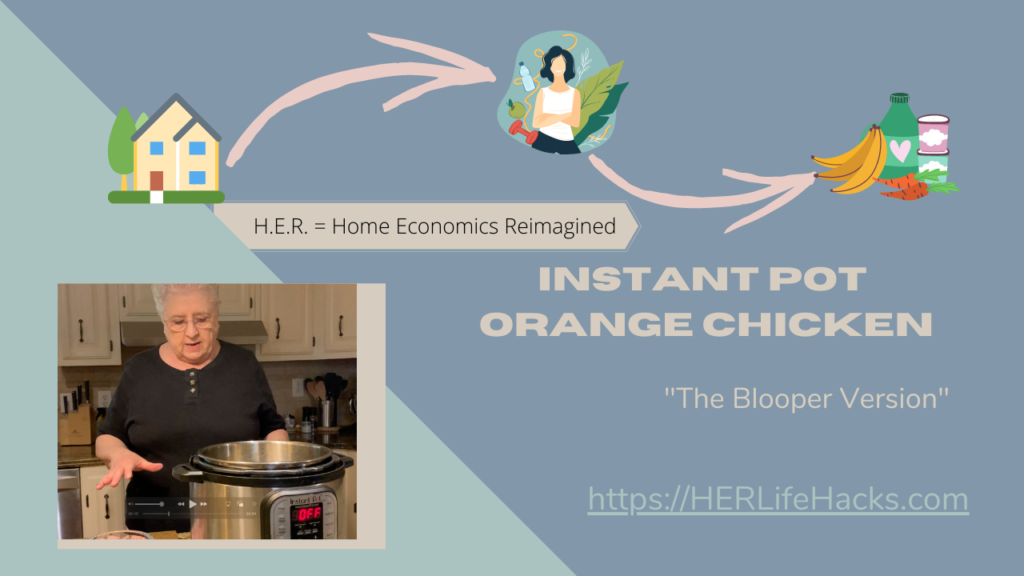
For today, we’re going to use the Instant Pot as a pressure cooker to prepare Orange Chicken.
I call this video “The Blooper Version”! You’ll see what I mean when you view it!
Check out the video below!
See what I mean by “blooper version”!! A little feedback? Comment below!
Don’t miss any of the posts, emails, and freebies of this March – June exploration of the world of food, which covers meal planning, meal prep, and making healthy food choices. Click on the Subscribe button on this page so you won’t miss any of the action.
I’m Vicki Peel, former home economics teacher and educational administrator. If you are not receiving my emails, coupons, and freebies, look for the Subscribe block (below right) and submit your contact information. I will not share your information with anyone, and all the content you will receive as part of our community is free. I may occasionally promote someone else’s paid content, offer a product for your consideration or share an item that I think might be of use to you. However, you are under no obligation to purchase anything – ever. So, sign up now so you won’t miss anything during our March – June foods extravaganza!!
https://HERLifeHacks.com
by Vicki Peel | Apr 21, 2022 | Food |
What?? Eating one hotdog can cut 48 minutes off your life?!
We all know that eating the wrong foods can affect your health, but to what extreme?
Have you ever said any of these things to yourself?
Well, I blew today – I just as well have that Dairy Queen blizzard.
I can’t look like I’m anti-social. I have to eat Grandma’s chocolate cake. It will hurt her feelings if I don’t.
I’ll eat better starting tomorrow.
I just can’t give up ice cream! (or buttered popcorn, or chocolate, or pizza – or HOTDOGS!)
But now the good news – improving your health may take less effort than you thought. You don’t have to give up everything you love to get healthier. Simple daily food swaps will reap benefits.
“Now scientists have estimated down to the minute the benefits of swapping out just 10% of your bad food choices for healthier items.” (Click underlined phrase for article.) The researchers of this study divided food into three groups: green, yellow and red food zones.
Simply substituting fruits or nuts or other foods in the “Green Zone” can get you back those 48 minutes of your life taken away by eating that hotdog!
Green zone: Fruits, vegetables, nuts, legumes, and some responsibly harvested seafood.
Yellow zone: Poultry, grains, and most dairy.
Red zone: Meat, especially red meat, and most especially processed red meat, plus sugared beverages and most processed foods.
As you become more aware of the foods you’re consuming, simply start swapping out foods in the red zone for the yellow zone and the green zone. Every time you think about and make a simple swap away from red-zone foods, you’re taking a step toward a healthier life.
And every step you take toward eating healthier has a cumulative effect. No one can eat “perfect” all the time. Cut yourself some slack. But don’t throw in the towel when you make a bad choice. Start with making more good choices (yellow and green zone foods) than bad ones (red zone foods).
Before you know it, you’re adding minutes and hours and days to your life!
Don’t miss any of the posts, emails, and freebies of this March – June exploration of the world of food, which covers meal planning, meal prep, and making healthy food choices. Click on the Subscribe button on this page so you won’t miss any of the action.
I’m Vicki Peel, former home economics teacher and educational administrator. If you are not receiving my emails, coupons, and freebies, look for the Subscribe block (below right) and submit your contact information. I will not share your information with anyone, and all the content you will receive as part of our community is free. I may occasionally promote someone else’s paid content, offer a product for your consideration or share an item that I think might be of use to you. However, you are under no obligation to purchase anything – ever. So, sign up now so you won’t miss anything during our March – June foods extravaganza!!
https://HERLifeHacks.com
by Vicki Peel | Apr 12, 2022 | Food |
Remember the GEICO commercial that it was “so easy a caveman could do it”? How about “so easy a husband could do it”?
All kidding aside, my husband started learning to cook when I had my knee replacement surgeries. And I am still amazed at how far he’s come and how interested he is in trying new things!
In this video, he demonstrates how to cook chicken wings in the air fryer and roasted potatoes in the oven. I’m also impressed with his video presentation skills!
Take a look!
Do you have an air fryer? Do you use it often? If you don’t have an air fryer, but are interested in purchasing one, download this free Air Fryers Buying Guide. I did all the research for you and highlighted the top 5 air fryers recommended by 4 sources: Women’s Health, Food Network Kitchen, Good Housekeeping, and C-NET Home.
Go ahead and download the Air Fryers Buying Guide HERE!
And leave your comments below! I’d love to hear from you!
I’m Vicki Peel, former home economics teacher and educational administrator. If you are not receiving my emails, coupons, and freebies, look for the Subscribe block (below right) and submit your contact information. I will not share your information with anyone, and all the content you will receive as part of our community is free. I may occasionally promote someone else’s paid content, offer a product for your consideration or share an item that I think might be of use to you. However, you are under no obligation to purchase anything – ever. So, sign up now so you won’t miss anything during our March – June foods extravaganza!!
https://HERLifeHacks.com
by Vicki Peel | Apr 5, 2022 | Food |
Air fryers – they appear to be the hottest kitchen appliance on the market!
They are basically convection ovens on steroids. The formula? High heat + circulating air = crispy food.
The variety of air fryers on the market is overwhelming. And the prices vary from about $40 to $300 or more. And do you even need one?
While air frying is certainly a healthier option than frying in oil, it cannot make frozen fried foods steeped in processing and chemicals a healthy choice. So, a little label reading will help determine which frozen foods are actually healthy choices. But air frying can make vegetables crisper and tastier for kids (and adults) who hate veggies.
If you have an air fryer, or intend to purchase one, here are some “to do’s and to-don’ts”.
DO:
- Preheat your air fryer unless the recipe specifically says not to.
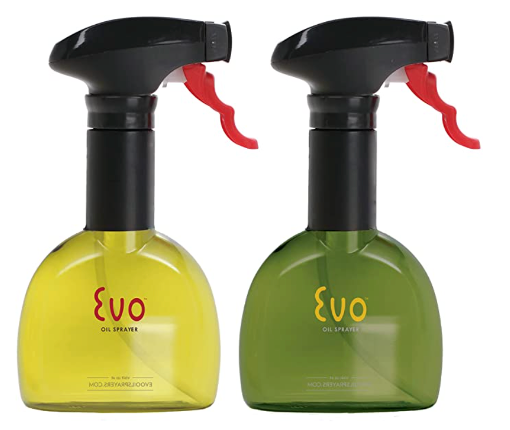
- Grease/spray oil on the air fryer basket to keep food from sticking, but DON’T spray with aerosol spray cans (like Pam), which contain harsh ingredients that may mess up the coating on baskets.*
- Use oil on food to crisp it, unless it already has some fat on it like chicken.
- Shake or turn food during cooking.
- Spritz food with oil halfway during cooking for crispier foods.
DON’T:
- Use loose aluminum foil, will fly around the basket from the air circulation. If you do use foil, make sure the food is heavy enough to keep it in place.
- Use shredded cheese, which will also fly around the air fryer and get stuck on the bottom of the fryer and not on the food.
- Set it and forget it – stopping and flipping or tossing food makes it cook more evenly.
- Crowd food. Food needs room for air to circulate.
- Use loose seasoning. Dry rubs end up like shredded cheese – all over the basket instead of the food. However, food that has been covered with oil that allows it to adhere to food is fine.
Do you have an air fryer? Do you use it regularly? What do you like about air frying? What are your concerns? I know – I’m just full of questions today! Please comment in the Comments section below or reply to any email I send to share your thoughts. As always, I really want to know. It helps me determine what you want to know and how I can help.
* Here is a good option for spritzing oil on your food. I have one like this. And this option gives you two bottles for about the price of one in other options! Click HERE for purchasing information.
My emails (blog posts) sometimes contain affiliate links. This means I earn a small commission if you click through and make a purchase, which is at no additional cost to you. Thank you!
I’m Vicki Peel, former home economics teacher and educational administrator. If you are not receiving my emails, coupons, and freebies, look for the Subscribe block (below right) and submit your contact information. I will not share your information with anyone, and all the content you will receive as part of our community is free. I may occasionally promote someone else’s paid content, offer a product for your consideration or share an item that I think might be of use to you. However, you are under no obligation to purchase anything – ever. So, sign up now so you won’t miss anything during our March – June foods extravaganza!!
https://HERLifeHacks.com
by Vicki Peel | Mar 28, 2022 | Food |
In the previous blog post, demonstration of a sheet pan meal showed just how quick and easy it is to prepare a sheet pan meal.
You don’t even need a recipe!
In this post, you will receive all the tools you need to create your own quick, easy, and delicious sheet pan meals. And you will be able to create your own sheet pan meal recipes!
All the printable instructions you need can be downloaded HERE. Just download and unzip the file. There are two sets of instructions. One has been created in pastel colors and the other has been created in gray with a gray dotted background. Both files are exactly the same. You simply have a choice as to whether you would rather print the instructions in color or in gray.
Below are examples of the downloads you are receiving. From this point forward, the individual downloaded instructions will be referred to as “printable or printables”.
The Sheet Pan Meal Recipe Template is your basic recipe to make a sheet pan meal. It guides you through the steps for preparing a sheet pan meal, and you create the recipe by adding your choice of protein (beef, pork, chicken or fish) and your choice of vegetables. The result will be your own sheet pan meal recipe!
Sheet Pan Meal Construction lists the components needed to construct your sheet pan meal, along with tips for selection and use of each part.
The Sheet Pan Meal Vegetables Tip Sheet is a list of vegetables that roast well in a sheet pan recipe, and some recommendations for vegetables that pair well for roasting.
Follow the steps for How to Oven-Roast Vegetables if you want to roast just vegetables, without the protein that makes a complete meal.
To add more flavor to your sheet pan meals, the Sheet Pan Meal Specialty Recipes printable provides four different rub recipes for your chosen meat. Use these to spark ideas and create your own rub recipes.
You can take the flavor up a notch with toppers to serve over your prepared sheet pan meal. Use prepared sauces or dressings, a favorite topper recipe, or mix your own favorite flavors to create a new topping.
In addition to the instruction printables, Sheet Pan Meal Recommended Tools includes some of my favorite tools for making perfect sheet pan meals. I use all of these exact tools, except for the sheet pan, which I already owned. However, after reviewing the specifications of the included sheet pans, I recommend either of them.
Click on the image of each tool to see product and purchase information. These are affiliate links, which means I earn a small commission if you click through and make a purchase, at no additional cost to you.
All the printable instructions you need can be downloaded HERE. Just download and unzip the file.
Now, you have everything you need to make quick, easy, and delicious sheet pan meals your family will love. If you have comments, suggestions, or requests, please leave them in the Comments section below.
And take pictures of sheet pan meals you prepare and recipes you create! Send them to me at vicki@herlifehacks.com. I want to feature your creations in a future post!
I’m Vicki Peel, former home economics teacher and educational administrator. If you are not receiving my emails, coupons, and freebies, look for the Subscribe block (below right) and submit your contact information. I will not share your information with anyone, and all the content you will receive as part of our community is free. I may occasionally promote someone else’s paid content, offer a product for your consideration or share an item that I think might be of use to you. However, you are under no obligation to purchase anything – ever. So, sign up now so you won’t miss anything during our March – June foods extravaganza!!
https://HERLifeHacks.com
by Vicki Peel | Mar 24, 2022 | Food |
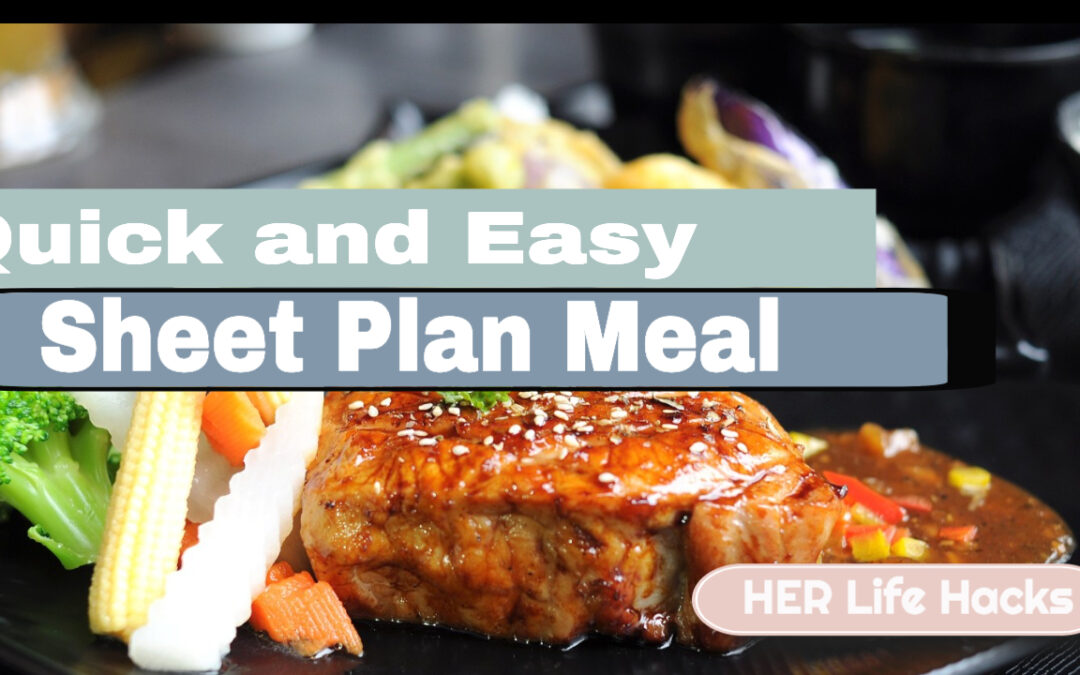
You can’t get much easier than a sheet pan meal. And there are so many ways you can change it up to make it with your favorite foods. You really don’t need a recipe. But I’ve got one to share with you, just to get you started!
This short video shows just how quickly you can get a sheet pan meal on the table. The video is only a little over 6 minutes, and the only thing left out is about 5 minutes to gather my ingredients and equipment and the 25 minutes it takes to cook!
Have you tried sheet pan meals? Do you cook them regularly? If so, let us know what you prepared and how it went. I’d love for you to share a favorite sheet pan recipe and pictures next time you make it! I want to feature you in a future blog or email.
Easy peasy! Try out my recipe or create your own! Click HERE for recipe with gray dotted lines background and click HERE for recipe with colorful abstract fruit background.
I’m Vicki Peel, former home economics teacher and educational administrator. If you are not receiving my emails, coupons, and freebies, look for the Subscribe block (below right) and submit your contact information. I will not share your information with anyone, and all the content you will receive as part of our community is free. I may occasionally promote someone else’s paid content, offer a product for your consideration or share an item that I think might be of use to you. However, you are under no obligation to purchase anything – ever. So, sign up now so you won’t miss anything during our March – June foods extravaganza!!
https://HERLifeHacks.com
by Vicki Peel | Mar 22, 2022 | Food |
Meal planning has never been easy for me. I’ve repeatedly tried to plan weekly family meals but was never able to create a sustainable process. There were too many moving parts – menus, ingredients needed, ingredients on-hand, grocery lists, time to plan, time to prepare, energy to do it all at the end of a busy day. It just never came together like I envisioned meal planning should be.
And therein lies the problem – I envisioned the end result, which was a home-cooked family meal at least once a day. I never got beyond the vision. I often found myself staring into the abyss of an uninviting and limited-options refrigerator.
But you don’t start out with anything as an expert. You start at the beginning. Preparing a meal a day is a habit. And habits start with tiny steps, repeated again and again.
To help you get started, I’ve prepared a Meal Prep Cheat Sheet of tips. You can download it HERE.
I am excited to share with you the quick and easy Level-Up Meal Planning System! You don’t start out preparing made-from-scratch home-cooked meals on a daily basis. Nobody has the amount of free time to do that, much less plan and implement it!
With my new system, you start at Level 1. You start with what you know and what you can reasonably accomplish within your available time.
The goal is one meal per day prepared and served at home.
Even if it’s not the complete home-cooked meal your mother or grandmother used to prepare. Almost any meal prepared at home will be healthier than the fast food you’re likely to pick up when you realize you don’t have a meal plan in place.
The one and only goal of Level 1 in the Level-Up Meal Planning System is to prepare and eat one meal a day at home with your family. Can you do it? Think it through
Here are some basic steps in the Level-Up Meal Planning System, Level 1:
- Look at your calendar or schedule for the coming week and consider when your family will be at home together. Your schedule may not allow you to prepare a meal at home every day. That’s okay. And you may have to deal with a staggered eating schedule for family members. That’s okay.
- Decide which meal of the day you will have time to prepare at home.
- Complete the basic Weekly Meal Planning, Level-Up 1 planning sheet. Keep it simple.
- Fill in your menu for the day.
- Identify any part of the menu that can be prepped the day before to save you time and write that in the Pre-Prep For the Following Day. For example, it may be as simple as gathering the equipment and non-refrigerated ingredients and have them ready to go when you start your meal preparation the next day.
- List any ingredients you need to prepare each daily menu on the Grocery Shopping List – Level-Up 1 checklist. It may be a good idea to list every ingredient and then check to see what you have on hand and cross those items off the list. That leaves you with a final grocery shopping list.
- Do your grocery shopping. That has become simpler with delivery and pick-up options.
- Implement your plan.
Download your Level-Up 1 Meal Planning Worksheet now to start creating your own system. You can get it HERE.
I also created a Grocery Shopping List – Level 1 for you. Download it HERE.
Here are a few suggestions to make the system work for you:
- First, don’t start out feeling like you have failed if you can’t prepare one meal a day at home, especially if you’ve not been doing so regularly.
- Try eating the same food (or a choice of 2 food options) for the other two meals of the day for the week. If you want a daily snack, plan on eating the same snack or a choice of two snacks for the week. That will simplify your planning process by keeping decisions to a minimum.
- Try planning the home-prepared meal for each day around a weekly theme. For example:
- Meatless Monday
- Taco Tuesday
- Soup and Sandwich Wednesday
- Pasta Thursday
- Stir-Fry Friday
- Pizza Saturday
- Some other options might be a night for loaded baked potatoes, breakfast-for-dinner, casseroles, leftovers. There are a lot of variations of menu items you could prepare for each themed night. Create your own nightly theme based on your family’s favorite foods.
- When time is limited and your energy is low, have a preplanned menu for a Takeout Night. By planning ahead, you will be able to make healthier choices.
You can stay at Level 1 as long as you like. If you get bored or ready to stretch yourself in the kitchen, you can always move up to Level 2. (More about that one later.)
The more you follow this system, the easier it becomes to plan and follow through. You’ll be able to serve your family healthier meals than if your lack of planning meant a quick dash at your favorite fast-food restaurant.
When you follow a system that works for your family, you are developing a habit of commitment to planning healthier food choices.
What have you got to lose? No – the question is what have you got to gain?
I’m Vicki Peel, former home economics teacher and educational administrator. If you are not receiving my emails, coupons, and freebies, look for the Subscribe block (below right) and submit your contact information. I will not share your information with anyone, and all the content you will receive as part of our community is free. I may occasionally promote someone else’s paid content, offer a product for your consideration or share an item that I think might be of use to you. However, you are under no obligation to purchase anything – ever. So, sign up now so you won’t miss anything during our March – June foods extravaganza!!
https://HERLifeHacks.com
by Vicki Peel | Mar 17, 2022 | Food |
How many times have you made a New Year’s resolution to eat healthier this year? And how many times have you failed?
I have to admit it – that’s the hardest thing I’ve ever tried to do – eat healthy! Are we so addicted to processed foods and sugar that we can’t get off that hamster wheel?
In 2019, the United States tied for 10th place (with Lithuania) among the world’s unhealthiest countries. And the reason for this is the rate of obesity and chronic health conditions.
We are doing something very wrong. And we’re not helping the next generation out of this mess.
So what can we do? First we need to become more aware – aware of what we are doing to ourselves and our children and grandchildren. I think if most of us were presented with a variety of foods, we could identify which ones were better for us to eat than others. But, we’re not choosing to eat them.
The next thing we need to do is develop tiny habits. What is one thing you can do today – one choice you can make that is a step toward eating healthier food? It’s unlikely that you or anyone will start today with good choices and be able to continue that as a habit. Just start with one thing today. Tomorrow is another chance to work on developing a healthier habit. Tiny steps turn into big results if repeated.
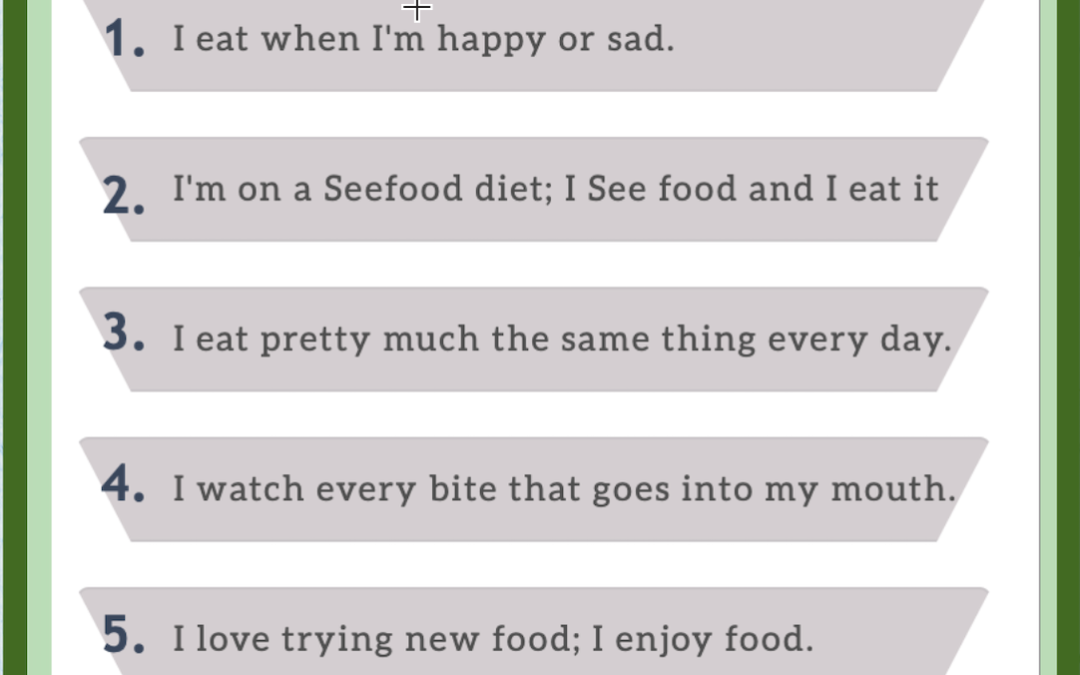
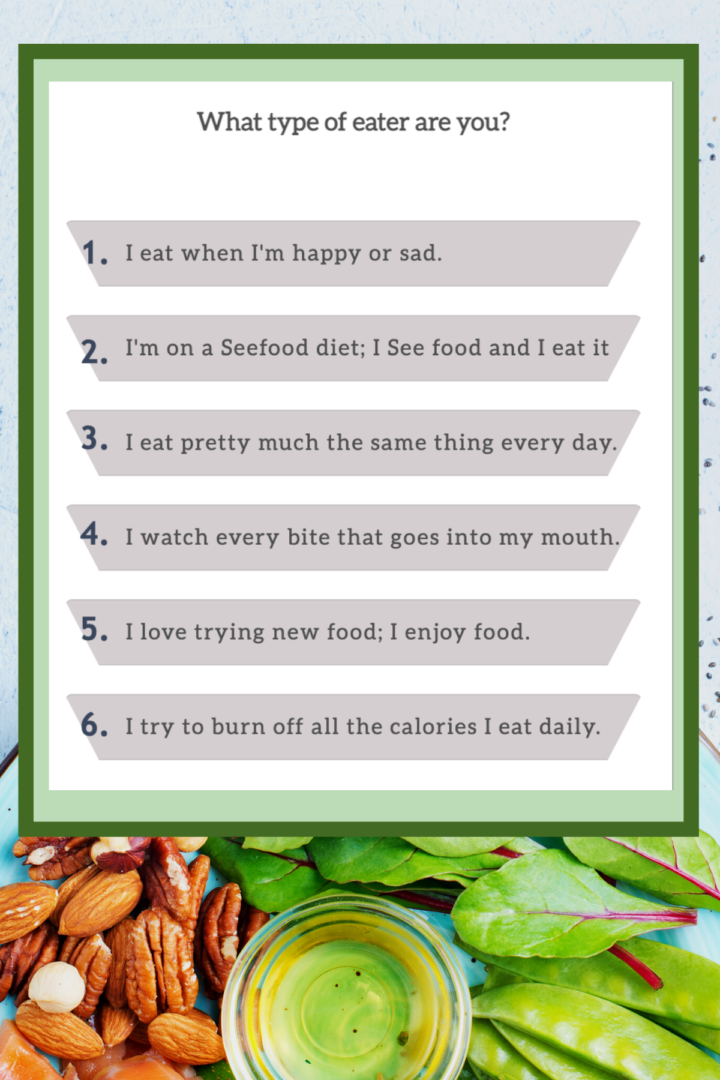
Here’s a quick and fun way to start becoming more aware. What type of eater are you?
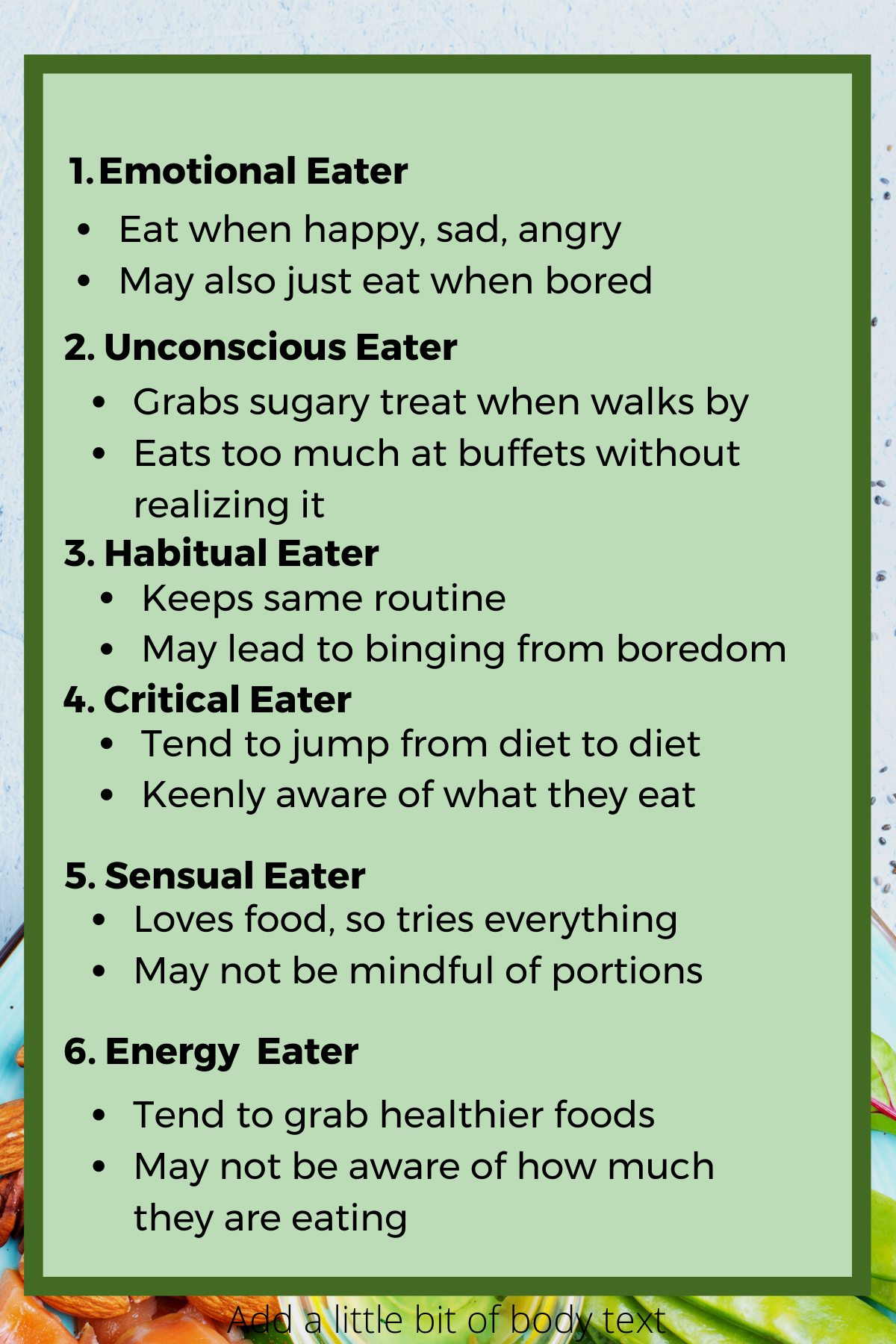
Which number did you pick? Click HERE to see what type of eater you are!
Now – what is your next thing to do? Leave your comments below!
I’m Vicki Peel, former home economics teacher and educational administrator. If you are not receiving my emails, coupons, and freebies, look for the Subscribe block (below right) and submit your contact information. I will not share your information with anyone, and all the content you will receive as part of our community is free. I may occasionally promote someone else’s paid content, offer a product for your consideration or share an item that I think might be of use to you. However, you are under no obligation to purchase anything – ever. So, sign up now so you won’t miss anything during our March – June foods extravaganza!!
https://HERLifeHacks.com
by Vicki Peel | Mar 15, 2022 | Food |
Don’t think you have time to cook a family meal? Muffin pan recipes are one solution to that problem.
Muffin pan recipes allow you to prepare meals faster because you are cooking the food in smaller amounts. The less food you cook in a muffin pan cup, the faster it cooks. It’s that simple.
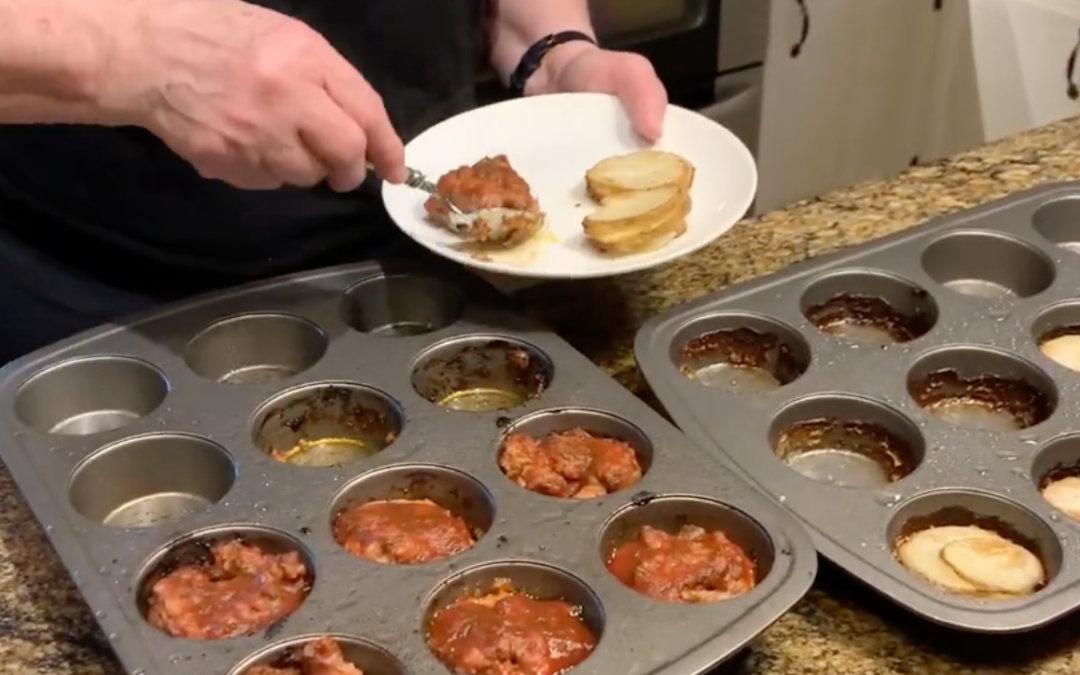
Watch me prepare two muffin pan recipes in under an hour! Of course, the video doesn’t include cooking time. I demonstrate all the preparation steps for cooking Mini Meatloaf and Mini Scalloped Potatoes. In addition to video time, add 12 minutes for assembling ingredients and equipment and 25 minutes cooking time. Under an hour!
Click HERE to view “Muffin Pan Meal in Under an Hour”
Want a copy of the recipes? Click on either of the titles below:
Muffin Pan Recipes (on a colorful fruit background)
Muffin Pan Recipes (on a gray dots background)
Please share your comments below!
I’m Vicki Peel, former home economics teacher and educational administrator. If you are not receiving my emails, coupons, and freebies, look for the Subscribe block (below right) and submit your contact information. I will not share your information with anyone, and all the content you will receive as part of our community is free. I may occasionally promote someone else’s paid content, offer a product for your consideration or share an item that I think might be of use to you. However, you are under no obligation to purchase anything – ever. So, sign up now so you won’t miss anything during our March – June foods extravaganza!!
https://HERLifeHacks.com