Thanksgiving is the holiday that’s just too good for its own
good. This unassuming holiday is sandwiched between holidays that are the two
biggest bullies of the year. Okay, perhaps that is a little harsh, but think
about it.
Halloween has become the little giant of commercialism.
Whole retail stores pop up a few months before Halloween and then disappear as
quickly as they came. I never owned a store-bought Halloween costume. Come to
think of it, I don’t remember ever having dressed up for Halloween or going
trick or treating! We did live in a very rural setting, and people just didn’t
go trick or treating on Halloween.
But now, children are asked what they want to be for
Halloween just like they are asked what they want to be when they grow up! And
adults are even worse. The retail stores are really for adults. At least I
think they are; I’ve never been in one. As you can tell, Halloween is not among
my favorite holidays.
And what about Christmas? I’ve seen homes decorated for
Christmas in early November. It’s like people are going straight from Halloween
into Christmas! I’ve even seen homes that leave up their Christmas decorations
until almost spring! Well, maybe not that long, but when 25% of the year is about
Christmas, I’m thinking that’s a little too much. And we won’t even talk about
the excessive shopping for Christmas, something that some people do year-round.
Don’t get me wrong. I’m not against Christmas. I love giving
gifts, especially for my grandchildren. And I try especially hard to give gifts
that my family members actually want, need and use. I love Christmas music. It
lifts the spirits and brings back wonderful childhood memories.
But, let’s get back to Thanksgiving, the introvert of
holidays. It doesn’t stand a chance. I
believe celebrating the true spirit of Thanksgiving helps ease you into the
spirit of Christmas. By being thankful for your blessings, you can then
approach Christmas with the joy of sharing. It’s so easy to get caught up in the
frenzy of Christmas decorating and shopping that we sometimes forget the real
reason for the season.
I’ve been keeping a gratitude journal for some time now, and
it’s been a spiritually rewarding experience. Every evening, I write five
things for which I’m grateful. I write them in complete sentences, starting
with “I am grateful for”. This practice
has made me more aware of the little things I encounter every day that are a
blessing to me in some way.
Of course, I find myself often being grateful for family
members. But I have grown from just saying I’m grateful for them to seeing
qualities, character traits or good deeds that fill my heart with thankfulness.
I’m also more aware of little things I previously overlooked that enrich my life. Now, I often pause to be thankful in the moment when I see a beautiful cardinal at the bird feeder or watch two squirrels playfully scampering up a pine tree.
All I’m saying is that if we give Thanksgiving a chance to be more than a turkey feast with family, it can enrich our lives throughout the year.
We all know that eating right is
sometimes impossible. Our busy lifestyles don’t lend themselves to cooking our
own healthy meals. Easy becomes our go-to choice, whether it is a conscious or
unconscious decision. That drive-thru is so much easier at times.
And everyone indulges now and then
with foods that would not be considered healthy. Doing this is not considered a
problem. However, when people make poor food choices as part of their regular
diet, that is problems emerge.
The foods you eat are based on your habits. It takes time to
develop these habits and requires you to
stick with them to make them work. It’s also about making a conscious choice of the ingredients that go into your foods. Do
you check nutrition labels at the supermarket?
But, just checking the labels is
not enough. You need to understand the impact of the foods and how they affect
a balanced diet. You can have too much of a good thing when eating. For
instance, eating fruit is good. Eating too much fruit could increase your sugar
levels. Even though fruit sugars are natural, they contain sugar just the same.
But where do you start to develop
good eating habits? Trying to be too restrictive in the foods you eat is often
a pattern for failure. Start with trying to create balance by eating more
healthy foods than fast food. For instance, it’s okay to eat salt, and your
body requires a small amount of it. But you shouldn’t load up on foods that are
high in sodium. The better approach is to prepare your meals with basic
ingredients. You can control the ingredients when you do this. This means you can choose how much salt or
sugar, or whatever ingredients to add.
As part of your routine, you should
also factor in portion control. This is
one of the essential attributes that can make or break a diet. If you manage
proper portion control, you will be able to eat more of the foods you enjoy,
even if a few of them are not considered great choices.
Developing good eating habits is
especially difficult if you’ve succumbed to a lifestyle of fast and easy
instead of thoughtful choices. It does take a great deal of effort to make
healthy changes when demands of your job and activities of your children are
pulling you in so many directions.
The biggest problem with eating
right is the benefits are not seen until sometime into the future. We live in a
society where instant gratification is
the norm. This makes it much harder to stick to healthy eating plans, because
losing weight, and even more importantly, feeling great, won’t start happening
until months later. This is why the early
part of forming good eating habits is so crucial to the process. Try to focus
on the benefits you will see later.
Think about it. How might the
effort of developing good eating habits impact your life, and more importantly,
the lives of your children?
While the dictionary defines happiness as “the state of being happy”, that gives you very little information about what the state of happiness feels like. I used to think happiness was about having things, but then I got older and hopefully wiser. Happiness is more about being. And it is a choice.
I taught Child Care Services several years to high school students. One of the discussion strategies I used was WHIFs. A WHIF is WHat IF a specific scenario existed and you had to respond to it. In the course, scenarios were usually around dealing with preschool children and their behavior. In other words, WHat IF a child (or children) were doing something that required a caregiver to take action. What would you do in that situation? How would you respond that would provide a teachable moment for the children or model a more appropriate behavior or even apply disciplinary action?
I think applying a WHIF to situations in your life is often an appropriate decision-making process for adults. In terms of happiness, as in most life situations, the response you choose can either add to your overall happiness or detract from it. It is especially helpful in potentially negative situations to ask yourself this question: What if I choose to _________? (Fill in the blank with a choice you could make in a situation.) Would that choice fulfill my needs or add to my peace and contentment? Or what if I choose to _________? (Fill in the blank with another choice you could make in the same situation.) What would be the likely outcome of that choice?
Your response to your WHIF has the potential to either add to your happiness and move you further toward your goals and dreams in life or move you further away from those goals and dreams and possibly the people you love the most.
Do any of these attributes or feelings apply to you? Do any of them define or contribute to your happiness? Consider how your choices impact your happiness level by applying your own WHIF.
Your Needs are Met – When a person is happy, their needs are usually being met at the level they want them to be met. It doesn’t mean that someone is not having a hard time, it’s more about how you make what you have fill your needs.
You Feel Satisfied – When you are happy, you tend to feel simply satisfied with your life. You think about your life and feel good about it.
You Feel Content – A happy person tends to feel content about their life in general. They are not in a constant state of stress. But remember happy people do have stress, they’re just better at feeling content even when things aren’t perfect.
You Are at Peace – Peace tends to go with contentment. Happy people tend to know that everything will turn out okay and are good at turning negativity into positivity.
The truth is, happiness is how you define it personally for you. It’s not about getting tons of stuff unless you want that. It’s not about finding a spouse unless you want that. It’s not about having kids unless you want that. It’s all up to you how you define happiness.
Happiness is not a destination that you get to one day and stay at. It’s a lifelong journey that will have many ups and downs and struggles. But, you get to decide how those ups and downs of life affect you. You have it in your power to be happy where you are in your life right now. So, the next time you’re faced with a potentially negative situation, apply a WHIF to consider the impact of your actions. While you do have to do more than think positively to really and truly feel happy, it does start with your thoughts. Make your choices manifest happiness through your actions.
Yes, I “kon mar-ied” my clothes! I know that’s not a word, but it just seemed appropriate as I completed the first step in the Kon-Mari process. Note the “deer in the headlights” look in the featured photo – that’s me at the beginning of the Kon-Mari process! I fully intend to have a better photo (one of me smiling!) at the end of the process.
If you read my previous post about Kon-Mari, you know it is the process of tidying as defined by Marie Kondo. Tidying is the task of transforming your home into a sanctuary of natural energy that meshes totally with your own natural energy. It should be a celebration, a special event that allows you to confront yourself and discover the balance needed to live your life in contentment and peace surrounded by the things that bring you joy. All of which is how tidying is defined by Marie Kondo.
And Marie was right – starting with clothes is the easiest starting point. For me, the process of handling each item of clothing and deciding whether it sparked joy was a relatively quick and painless process. Maybe that’s because I don’t have a lot of clothes in the first place, and I’m not emotionally attached to most of them.
So, I gathered all my clothes and put them on my bed. It really helped that I had already purged my closet within the past year. Then I held each piece and waited for the spark of joy. I did have a few joy-sparking pieces, but mostly I just felt contentment with items that covered me without drawing attention to areas that needed no attention. So I considered that a spark of joy.
The whole process from gathering the clothes to folding or hanging and putting them away took approximately two hours. I was actually quite pleased with how quickly it went. I ended up with a couple of boxes of clothes to donate, and a few went straight to the wastebasket.
I use an armoire to store most of my clothes, which was originally a china cabinet in the home where I grew up. As you can see in a picture below of the armoire, my husband did not participate in the process. Therefore, he doesn’t know what clothes he actually owns (and doesn’t care), and he ends up picking up the shirt and shorts/pants that are on the top of the pile. He claims the present system of disorganization brings him joy! My clothes are the neatly-folded ones in the clear plastic bins.
At this point, I’m very happy with the process. I can see exactly what I own, making it much easier to find what I’m looking for. And scaling back on the number/amount of my clothes keeps the process of deciding what to wear very simple. (I’m still having a hard time folding underwear, though.)
Scroll through the picture gallery below to see the results of my Kon Mari-ed clothes! Have you considered this process for yourself?
H.E.R – Home Economics Re-imagined is now my mission, sharing life hacks (i.e. shortcuts, tips and wise pronouncements) that help today’s homemakers live their lives with intention. I want individuals to recognize when their efforts are “good enough”, which is something I am constantly working on. There is no such thing as perfection, as only One was perfect. So, knowing when to award yourself the satisfaction that an effort is good enough is a worthy goal.
In addition to being a wife, mother and grandmother, I am an educator. I began as a home economics teacher, which is something of an oddity since I don’t really like to talk. But at the time, I saw that I had three options for a career: secretary, nurse or teacher. Well, I didn’t want a career in which I answered to a boss all day (i.e. secretary). And since I feel faint at the sight of blood, nursing was out. Therefore, I became a teacher. And since I loved my high school home economics teacher, I became a home economics teacher.
Along that career path, I kept working my way toward administrative positions. First, I accepted the position of a local career and technical education director, which means I was in charge of all career and technical education for my county, not just home economics. Career and technical education included agriculture, family and consumer sciences (home economics), business, career, marketing and trades and industrial education.
Then, as I approached my fifties (I am now on the cusp of my 70’s!), I decided to get my doctorate. So, at 49, I started on my Ed.D. in Educational Leadership. And now, I have a 232-page dissertation (and a diploma) to prove it
Finally, I finished my education career as a regional career and technical education coordinator for the North Carolina Department of Public Instruction. I loved that job! It was one of service to all career and education teachers in my region, assisting with curriculum, teaching methods and management of allotted funds.
When I decided it was time to retire, the transition into retirement was not easy for me. It took me about two years to stop playing games on my iPad, putting together jigsaw puzzles and playing sudoku. I really needed a project – something I would enjoy, but that also allowed me to be creative and productive.
So, my husband and I started a non-money-producing business to create furniture and home décor with reclaimed wood. We both grew up on farms with lots of old barns, which were beginning to decay. We started tearing them down board by board and turning those boards into mostly tables and picture frames. (You’ll see pictures later on My Home page)
I framed a lot of jigsaw puzzles with old barn wood and labeled the backs of the frames with plaques designating the origin and probable age of the wood. But I sold none of them. I gave them to family members or hung them in my home. I just hated to let go of something that was so much a part of me and my past.
Then, I started putting together ideas about sharing many of the things I learned through the years about living and homemaking. And thus – H.E.R. – Home Economics Re-imagined was born. And in my “perfectionist” state of mind, it took me another several years to be “ready” to launch my online presence. I have since learned that I am a procrastinator. The first step is to admit that, which I now do.
The home economics I learned when I first started taking those courses had to evolve to fit today’s lifestyles. People are too busy to make their own clothes or raise and cook all their food. But many are seeking a simpler lifestyle, while going back to the basics of whole foods that provide nutrition that promote health. And many want to slow down and enjoy their lives in a way that is more intentional. They are tired of life being something that just happens to them as they react to situations that develop along the way.
So, I hope you’ll join me on this journey of a good-enough life lived with your own defined intent.
H.E.R – Home Economics Re-imagined is now my mission, sharing life hacks (i.e. shortcuts, tips and wise pronouncements) that help today’s homemakers live their lives with intention. I want individuals to recognize when their efforts are “good enough”, which is something I am constantly working on. There is no such thing as perfection, as only One was perfect. So, knowing when to award yourself the satisfaction that an effort is good enough is a worthy goal.
In addition to being a wife, mother and grandmother, I am an educator. I began as a home economics teacher, which is something of an oddity since I don’t really like to talk. But at the time, I saw that I had three options for a career: secretary, nurse or teacher. Well, I didn’t want a career in which I answered to a boss all day (i.e. secretary). And since I feel faint at the sight of blood, nursing was out. Therefore, I became a teacher. And since I loved my high school home economics teacher, I became a home economics teacher.
Along that career path, I kept working my way toward administrative positions. First, I accepted the position of a local career and technical education director, which means I was in charge of all career and technical education for my county, not just home economics. Career and technical education included agriculture, family and consumer sciences (home economics), business, career, marketing and trades and industrial education.
Then, as I approached my fifties (I am now on the cusp of my 70’s!), I decided to get my doctorate. So, at 49, I started on my Ed.D. in Educational Leadership. And now, I have a 232-page dissertation (and a diploma) to prove it
Finally, I finished my education career as a regional career and technical education coordinator for the North Carolina Department of Public Instruction. I loved that job! It was one of service to all career and education teachers in my region, assisting with curriculum, teaching methods and management of allotted funds.
When I decided it was time to retire, the transition into retirement was not easy for me. It took me about two years to stop playing games on my iPad, putting together jigsaw puzzles and playing sudoku. I really needed a project – something I would enjoy, but that also allowed me to be creative and productive.
So, my husband and I started a non-money-producing business to create furniture and home décor with reclaimed wood. We both grew up on farms with lots of old barns, which were beginning to decay. We started tearing them down board by board and turning those boards into mostly tables and picture frames. (You’ll see pictures later on My Home page)
I framed a lot of jigsaw puzzles with old barn wood and labeled the backs of the frames with plaques designating the origin and probable age of the wood. But I sold none of them. I gave them to family members or hung them in my home. I just hated to let go of something that was so much a part of me and my past.
Then, I started putting together ideas about sharing many of the things I learned through the years about living and homemaking. And thus – H.E.R. – Home Economics Re-imagined was born. And in my “perfectionist” state of mind, it took me another several years to be “ready” to launch my online presence. I have since learned that I am a procrastinator. The first step is to admit that, which I now do.
The home economics I learned when I first started taking those courses had to evolve to fit today’s lifestyles. People are too busy to make their own clothes or raise and cook all their food. But many are seeking a simpler lifestyle, while going back to the basics of whole foods that provide nutrition that promote health. And many want to slow down and enjoy their lives in a way that is more intentional. They are tired of life being something that just happens to them as they react to situations that develop along the way.
So, I hope you’ll join me on this journey of a good-enough life lived with your own defined intent.
Yep – that’s it. The entire recipe for Chicken Salad – which is why you might want to watch the video.
When I was growing up, it would take several hours to make Chicken Salad. It took over an hour to boil the chicken. Then we had to wait for it to cool enough to handle the chicken. Then you had to debone the chicken, followed by cutting the meat into bite-sized pieces with kitchen shears. The celery and pickles had to be chopped by hand.
Because it was so labor intensive, we only had Chicken Salad on special occasions, like a church homecoming dinner, family reunions or holidays.
But now, a food processor makes quick work of Chicken Salad. And there are several ways to prepare/purchase the chicken. Rotisserie chicken from the grocery store adds extra flavor. Crockpot chicken can be cooking all day or night while you are doing other things. Or you could bake the chicken in the oven. However, the tried and true method is to boil the chicken in a large pot until tender. The additional value in boiling is that you now have broth for chicken rice soup!
If you’ve never made Chicken Salad before, try your hand at it. And let me know about your experience. Don’t forget to watch the video!
This page is more of a personal journal than a blog with tips for readers, although I will share tips as I write about my home remodeling and redecorating.
It is a way for me to chronicle my personal heritage and give homage to it and how it has shaped me through the years. It is also a place for me to create an archive of the evolution of my own home.
Henry Ward Beecher wrote, “There are only two lasting bequests we can hope to give our children. One of these is roots…the other, wings.”
My roots continue to guide me to this day. The house in which I was reared is gone now, but parts of it live on in me and my current home. This section is more of a personal journal than a blog with tips for readers. It is a way for me to chronicle my personal heritage and give homage to it and how it has shaped me through the years.
That is my grandfather standing in front of the home where I grew up. He was born in 1900 and at the age of 75, he painted the exterior of the entire house by himself! Hard work was no stranger to everyone in my family, which was one of the “roots” I learned as a child.
My parents and I (and eventually three sisters) lived with my paternal grandparents. The house had four bedrooms downstairs and four bedrooms upstairs. There were three wood heaters (which was later changed to oil heaters). One was in the living room, one in the dining room and the third one in my parent’s bedroom. To get heat to the upstairs bedrooms (only two of the four), a metal grate was installed in the floor so heat could rise up from the downstairs heater. It was never enough! In the winter, my sisters and I would warm a small blanket on the heater, then ball it up to keep it warm, run upstairs and wrap it around our feet as we snuggled under many layers of homemade quilts.
There was only one full bathroom, which was upstairs, and it was unheated. We looked forward to summer, when we could take a bath in the bathtub. In the winter, we used a pan of warm water placed on top of the heater and took what we called “bird baths”.
The kitchen and dining room were only accessible from a back porch. Also, on that back porch was a half bath, which was also unheated. Needless to say, you didn’t waste time in there in the wintertime!
As I write about the circumstances of that beloved home, I realize how poor and difficult life sounded back then. However, that is not how I remember it. Instead, I remember the love of both parents and grandparents, the freedom to roam through the farm and forests, the things we did together as a family and the great meals my grandmother cooked.
Summers were especially fun. Naturally, we didn’t have air conditioning, but if there was a breeze stirring, you could find it on the corner of the front porch. We would often have suppers on the porch, with lemonade and sandwiches. As the day turned to night, my father and grandfather would entertain us with stories of the “good ole days”.
I learned how to cook and sew from my grandmother. The first time I made biscuits, I burned them and hid them behind the heater in the dining room. Since my grandfather ALWAYS had biscuits with his meals, he asked about his biscuits. He ate those burned biscuits and told me they were “just right”. But I got better at making biscuits and learned to cook other things as well.
I remember when I was about 10 years old, my grandmother set up her sewing machine on the porch and taught me how to make a gathered skirt. I sewed three rows of rick rack around the bottom. Rick rack is a zigzag trim to accessorize home-sewn items. I also remember that my rows of rick rack were about as crooked as the trim itself!
The “roots” I developed as a child have served me well through the years. I cherish my childhood memories and those of the wonderful parents and grandparents I continue to try to emulate. I have tried to pass both the “roots and wings” I developed as a child on to my children and grandchildren.
As for my childhood home, it was torn down after my grandparents died and my parents moved to a smaller home next door. But, you can see remnants of it in future posts and the impact it had on my life.
I know – sounds crazy, right? What can a jigsaw puzzle teach anybody? But it did, so stay with me and I’ll share everything.
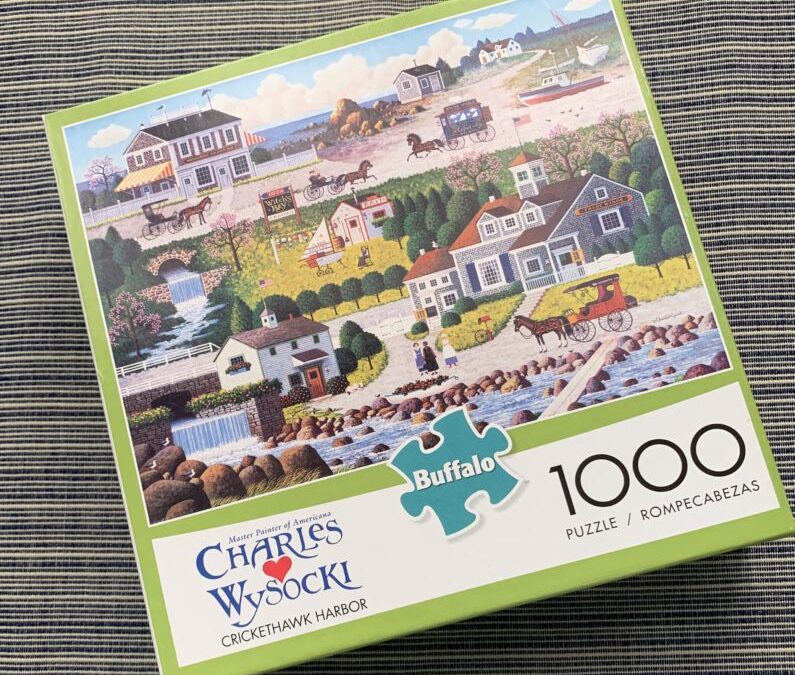
I love puzzles, but haven’t put one together in quite a while. That’s because I know myself, and I know that once I open the box and start spreading out the pieces, I won’t do anything else – no working on my business, no housecleaning, no cooking, nothing! So, I’ve been avoiding the cabinet that houses at least five or six unopened puzzles. (I love Charles Wysocki Americana-style puzzles!)
But, one recent, rainy Sunday afternoon, I just couldn’t resist any longer. I opened a 1000-piece puzzle. And then it began to unfold its magic for me.
Lesson #1: Puzzles are therapeutic.
As soon as I opened the box, I started to feel more relaxed. I forgot about everything else that had been on my mind. I just focused on the puzzle and all stress and worries melted away.
Lesson #2: Devising and implementing a system solves many problems.
Spreading out 1000 puzzle pieces is a daunting task. So, I had previously made puzzle boards. You can buy some on Amazon, but I cut large cardboard boxes into manageable sizes (less than 2′ x 3′) and hot-glued felt to them. Voila! I now had room to spread out the puzzle pieces so they would not slip off the surface, and they could be stacked as well for ease in accessing.
The next part of my system was to sort individual pieces by placing them on the puzzle board evenly in rows, while separating the edge pieces. This immediately felt so satisfying, like there was truly order in my life!
Next step was to complete the border of the puzzle, followed by starting on small sections for which the colors were clearly defined and could be easily seen and selected from the puzzle boards. As I began to look for puzzle pieces that fit, I referred often to the picture of the puzzle, always orienting it the same way as the puzzle frame. (I work on all sides of the puzzle, so I can see things from a different, and closer angle.)
Lesson #3: When you are faced with a problem that seemingly has no applicable solution, leave it alone for a while and come back to it later with a fresh view of the situation.
For instance, many times I was sure that a certain puzzle piece would be so easy to find, either by it’s distinctive color or shape. But having scanned those puzzle boards several times, it still didn’t show up. So – I just moved on to another section of the puzzle and later that specific puzzle piece happened to be right there in front of me! Perhaps, one could call me a procrastinator sometimes, but I prefer to say that I’m “waiting for a vision”!
Lesson #4: When you’ve exhausted all options to solve a problem, regroup.
After about one-third of the way to puzzle completion, I noticed puzzle pieces were getting harder to find. So, I took a few minutes to re-organize each puzzle board. I put like puzzle pieces together – such as dark green leafy pieces, white sand ones, buildings and animals. Then I could focus on the specific attribute of the puzzle piece for which I was looking. Worked like a charm! I started seeing the pieces easily. Then, I started consolidating the pieces onto fewer boards to make the search easier.
Lesson #5: Finishing a project is a joy in and of itself!
One (among many) of my shortfalls is excitedly starting many things, only to fizzle out before they are finished. But putting that last piece into the puzzle “sparks joy”, as Marie Kondo would say!
So – the final lesson to my puzzle story is this: when you find yourself stressed out and unable to see the next steps you need to take, stop and complete a jigsaw puzzle. It will make everything clearer!
Does the term “spark joy” mean anything to you? It does if you know about Marie Kondo, the tidying queen. Marie has published two wildly popular books, The Life-Changing Magic of Tidying Upwith Marie Kondo and Spark Joy. She also has a Netflix series, Tidying Up with Marie Kondo. Of course, I’ve read the books and watched the Netflix series in a couple of sittings!
WHAT IS TIDYING?
Tidying is the task of transforming your home into a sanctuary of natural energy that meshes totally with your own natural energy. It should be a celebration, a special event that allows you to confront yourself and discover the balance needed to live your life in contentment and peace surrounded by the things that bring you joy.
That is tidying according to Marie. Sounds like a lot to expect of a little cleaning up! But, I do want some natural energy in my home. My biggest concern at this point is how much energy am I going to have to expend to acquire that natural energy of which Marie speaks. I think it’s worth a shot, but I expect to be exhausted before the joy sets in.
WHAT IS THE GOAL OF TIDYING?
The goal of tidying is the realization of joy in your life. To experience that joy, you need to visualize the lifestyle you want as a result of a clutter-free space. Then, through the Kon-Mari method of tidying, you can achieve that goal that allows you to become the person you want to be. Tidying is a one-time event that, once completed, frees you to be the person you want to be.
Wow! That’s one big promise. Since I’ve never really discovered joy in cleaning up, I’m a little skeptical about such a huge transformation in my life just by “tidying”.
WHAT ARE THE MAJOR CONCEPTS BEHIND THE TIDYING PROCESS?
The Kon-Mari method begins with discarding, followed by organizing the space. The emphasis is not on the discarded items, but on identifying items you want to keep – those that spark joy in your life. Each possession must be handled one by one to identify whether the item sparks joy for you. This happens in a marathon event of tidying that culminates in finding a home for each item kept.
Discard – not organize. Sounds like I’m going to make a bigger mess than I started with. And then, within that mess, I’m going to find joy. I do have some things in my home that “spark joy”, but I’m not sure if I’ll find it in my clothes, which is the first category to address in the process.
WHAT ARE THE OUTCOMES OF TIDYING?
Finally, Marie promises a life transformation with feelings of serenity, purpose and joy. Your home should now embrace you with order and calm.
That’s a lot to ask from what everyone else calls “decluttering”. However, I do dream about all my possessions having a place to put them – “a place for everything and everything in its place: So, I must admit, I’m curious. And for the sake of “science”, I’m going to implement the Kon-Mari method in my home, and you’re going to be the judge of the results. See you next time!
Does the term “spark joy” mean anything to you? It does if you know about Marie Kondo, the tidying queen. Marie has published two wildly popular books, The Life-Changing Magic of Tidying Upwith Marie Kondo and Spark Joy. She also has a Netflix series, Tidying Up with Marie Kondo. Of course, I’ve read the books and watched the Netflix series in a couple of sittings!
WHAT IS TIDYING?
Tidying is the task of transforming your home into a sanctuary of natural energy that meshes totally with your own natural energy. It should be a celebration, a special event that allows you to confront yourself and discover the balance needed to live your life in contentment and peace surrounded by the things that bring you joy.
That is tidying according to Marie. Sounds like a lot to expect of a little cleaning up! But, I do want some natural energy in my home. My biggest concern at this point is how much energy am I going to have to expend to acquire that natural energy of which Marie speaks. I think it’s worth a shot, but I expect to be exhausted before the joy sets in.
WHAT IS THE GOAL OF TIDYING?
The goal of tidying is the realization of joy in your life. To experience that joy, you need to visualize the lifestyle you want as a result of a clutter-free space. Then, through the Kon-Mari method of tidying, you can achieve that goal that allows you to become the person you want to be. Tidying is a one-time event that, once completed, frees you to be the person you want to be.
Wow! That’s one big promise. Since I’ve never really discovered joy in cleaning up, I’m a little skeptical about such a huge transformation in my life just by “tidying”.
WHAT ARE THE MAJOR CONCEPTS BEHIND THE TIDYING PROCESS?
The Kon-Mari method begins with discarding, followed by organizing the space. The emphasis is not on the discarded items, but on identifying items you want to keep – those that spark joy in your life. Each possession must be handled one by one to identify whether the item sparks joy for you. This happens in a marathon event of tidying that culminates in finding a home for each item kept.
Discard – not organize. Sounds like I’m going to make a bigger mess than I started with. And then, within that mess, I’m going to find joy. I do have some things in my home that “spark joy”, but I’m not sure if I’ll find it in my clothes, which is the first category to address in the process.
WHAT ARE THE OUTCOMES OF TIDYING?
Finally, Marie promises a life transformation with feelings of serenity, purpose and joy. Your home should now embrace you with order and calm.
That’s a lot to ask from what everyone else calls “decluttering”. However, I do dream about all my possessions having a place to put them – “a place for everything and everything in its place: So, I must admit, I’m curious. And for the sake of “science”, I’m going to implement the Kon-Mari method in my home, and you’re going to be the judge of the results. See you next time!