“Three Rules of Work: Out of clutter find simplicity; From
discord find harmony; In the middle of difficulty lies opportunity.” –
Albert Einstein
Do you have a place
for all your stuff? Or is your stuff stuffed into places where you can’t find
it? Could you describe a lot of your stuff as clutter?
Decluttering has been
a popular, or should I say prevalent, term in recent years. If you have stuff
that you need to get rid of, then you have clutter. When your home is filled
with clutter, trying to tackle a mountain of stuff can be quite overwhelming. In
fact, it can be paralyzing. You know you need to do something, but you think
there must be a commonly known place to start that everybody knows but you. So,
you don’t do anything.
Here’s my
advice: start with just five minutes. Baby steps are important. Sure, five minutes won’t barely make
a dent in your managing all your stuff, but it’s a start. Celebrate when you’ve
made that start!
Then take another five minutes tomorrow. And
another the next day. Before you know it, you’ll have cleared a whole closet or
a room and then half your house and then … who knows? Maybe one day you will
have completed decluttering and you can describe your home as uncluttered!
For those who are overwhelmed by their
clutter, here are some great ways to get started, five minutes at a time.
Designate a spot for incoming papers. Papers often account for a lot of our clutter. This is because we put them in different spots — on the counter, on the table, on our desk, in a drawer, on top of our dresser, in our car. No wonder we can’t find anything! Designate an in-box tray or spot in your home (or at your office, for that matter) and don’t put down papers anywhere but that spot. Got mail? Put it in the inbox. Got school papers? Put it in the inbox. Receipts, warranties, manuals, notices, flyers? In the inbox! This one little change can really transform your paperwork.
Start clearing a starting zone. Clear one area. This is your no-clutter zone. It can be a counter, or your kitchen table, or the three-foot perimeter around your couch. Wherever you start, make a rule: nothing can be placed there that’s not actually in use. Everything must be put away. Once you have that clutter-free zone, keep it that way! Now, each day, slowly expand your no-clutter zone until it envelopes the whole house!
Clear off a counter. Your goal is that all flat spaces are clear of clutter. They could still have useful or decorative items on them, such as a toaster or maybe a candle, but not things that don’t belong. Only you can decide what belongs. So start with one counter. Clear off everything possible, except maybe one or two essential things.
Pick a shelf. Now that you’ve done a counter, try a shelf. It doesn’t matter what shelf. It could be a shelf in a closet, or on a bookshelf. Don’t tackle the whole bookshelf — just one shelf. Clear all non-essential things and leave it looking neat and clutter-free.
Pick up 5 things and find a home for them. These should be things that you actually use, but they just seem to be put down anywhere, because they don’t have a home. If you don’t know exactly where things belong, you have to designate a place for them. Take a minute to think it through — where would be a good spot? Put them close to where they would be used. Then always put those things in those places when you’re finished using them. Now they have a home, which is the ultimate goal for everything you own. That is how you can actually end the decluttering process. Do this for everything in your home, a few things at a time. If everything has a home and you put everything in its home, you will not have clutter and therefore will not need to declutter!
This should give you a starting point. Just pick one hack that seems doable to you and get started! Once you get going, the whole process may unfold as you decide what you want things to look like and how you want to live in your space.
Next
time, I’ll list a few more hacks that may help you conquer the overwhelming
task of decluttering. I also have some ideas for stuff for storing your stuff!
Sometime around the first of each year, I get stingy. Maybe
it’s the fact that I overspent on Christmas gifts for my family, which seems to
be a personal weakness of mine. Or maybe it’s that I subconsciously make a New
Year’s resolution to be more thoughtful in my purchases. That means I plan to
not get excited about every new trend that I’m sure will make my life easier
and more enjoyable and therefore give in to my uncontrollable urge to buy it!
So, in my quest to be more frugal with money and at least make
my purchases a “bargain”, I researched the best times of the year to buy just
about anything. You know a bargain is not a bargain if you don’t need it. My
husband always gets worried when I tell him how much money I saved on
something! Of course, not purchasing something saves you even more!
If you actually plan purchases you need, there is little
reason to purchase anything unless it’s on sale. Sales are an everyday
occurrence. However, you can save a lot of money just by knowing when the
lowest sale price for an item is most likely to happen. This is especially true
for big-ticket items.
I researched the best months to buy things from five
different sources.
Forbes.com
The Krazy Coupon Lady
Money Under 30
Nerd Wallet
The Penny Hoarder
And these sites researched other sources, such as Consumer
Reports, which is probably the most credible and least biased organization that
reviews and rates products. Other sources of the sources included Lifehacker,
Freeshipping, Wisebread, Finder.com and Deal News.
From this research, I compiled an annual calendar for The Best Time to Buy Anything. Holidays and annual sales drive many of the best times to purchase some items. For instance, the Consumer Electronics Show in January unveils many new models of electronics, which makes early January a good time to buy TVs, especially if you’re willing to consider older models. January is also known for white sales on bedding and linens.
The best use of the buying calendar is that it allows you to
plan purchases, especially for expensive items.
The experts don’t always agree on the best months to get good deals on products, so you’ll see some of the same products listed in several months of the year. And clearance sales of some larger items occur several times a year because retail stores need the space for newer inventory.
You can download your free copy of The Best Time to Buy Anything annual calendar below:
In a previous blog post, I talked about the basics of an
Instant Pot. Today, I’m sharing my most recent experience of cooking in an
Instant Pot. Porcupine Meatballs is a family favorite – meaning my husband
likes it!
I whole-heartedly recommend reading the user manual first.
In my experience, that will pay off and save you time in the long run. Did you
guess that I didn’t heed my own advice? If so, you are correct! I thought I
could remember what to do; surely the controls were intuitive. Not necessarily.
PORCUPINE MEATBALLS
Preparation Time: 30 min
Cooking Time: 8 min
HighTemperature
INGREDIENTS
½ cup long-grain white rice (uncooked)
¼ cup finely diced yellow onion
¼ cup beef broth
1 teaspoon Worcestershire sauce
¼ teaspoon garlic powder
1/8 teaspoon allspice
1 ¼ teaspoons salt
¼ teaspoon pepper
1 pound ground beef or turkey
2 tablespoons vegetable oil
1 (16-ounce) jar chunky spaghetti sauce
2/3 cup beef broth
3 teaspoons sugar
DIRECTIONS
In a mixing bowl, combine uncooked rice, onion, beef broth, Worcestershire sauce, garlic powder, allspice, salt and pepper. Add the ground beef (or turkey) to the bowl and mix well.
Form the meat mixture into 1 ½ inch balls.
With the cooker’s lid off, heat oil on HIGH or “Saute”, until sizzling.
Brown meatballs in the oil on at least 2 sides. You may need to work in small batches to brown them all. When finished, return all meatballs to the cooker.
Mix spaghetti sauce, beef broth and sugar and pour over meatballs in cooker and securely lock the pressure cooker’s lid. Set for 8 minutes on HIGH.
Let the pressure release naturally 10 minutes before performing a quick release for any remaining pressure. Set cooker to LOW or “warm” and serve.
Before I started making the meatballs, I started rice cooking in a double boiler, so I could serve the meatballs over the rice. A simple salad is a good way to complete the meal.
Assemble all ingredients first.
Then, I assembled all ingredients and chopped the onion. As I measured the first 8 ingredients in Step 1, I added them to a mixing bowl.
I usually do Step 3 first or at least before Step 2, which included adding the oil and turning on the Instant Pot to Sauté, so it can be heating.
I mixed the ground beef with my hands, trying not to overwork the meat. In Step 4, I added the meatballs to the oil to brown, using silicone tongs to carefully turn the meatballs as they brown. Browning on all sides as much as possible adds flavor to the dish.
Turn meatballs gently to brown on all sides.
I was able to brown all meatballs in the same batch.
However, if your meatballs are crowded, cook them in batches until all are
browned.
In Step 5, mix remaining ingredients and pour over the meatballs. To secure the lid, align the upside-down triangle with the vertical triangle “Open” on the cooker housing rim. Turn clockwise to lock in position.
(As in reading the manual, I found this process is faster if you actually locate the above marks and align them to lock the lid!)
Setting cooking time involves the Manual setting and
adjusting the time to 8 minutes. The temperature should come on the high
setting. About 10 seconds after you complete the settings, the LED light should
indicate ON. This means pressure is building to the appropriate temperature and
pressure, which also means you need to allow enough time for this to happen.
When this is complete, the light should change to the cooking time and count
down until cooking is completed.
After cooking is completed, the Instant Pot switches to WARM to keep the food warm and allow time for pressure to go down. Allow this to occur naturally instead of doing a Quick Release. At the end of 10 minutes, you should be able to turn the steam release handle to Venting to complete the release process. Be sure to stay away from the steam release handle to avoid burning yourself from remaining steam. Before opening the lid, make sure the float valve next to the Steam Release Handle has dropped down.
Ready to eat! Serve with or without rice and enjoy.
OBSERVATIONS AND/OR TIPS: (The products listed below in italics are clickable links for ordering. Hover over a product to see if there is a clickable link.)
If you don’t have an Instant Pot, this recipe could easily be cooked in a Dutch oven on the range. You would need to allow enough time for the rice to cook or add quick-cooking rice instead of long-grained uncooked rice.
Ground beef that is 80-20 is a good ratio of lean meat to fat, because it does not render so much fat that you need to drain it. Also – if you could get pasture-raised, grass-fed beef, it would be healthier.
Most vegetable oils are not the healthiest choices. I used avocado oil in this recipe. It can be heated to higher temperatures without breaking down like olive oil. Coconut oil (organic, unrefined cold-pressed is best) will also work.
You can vary the taste by selecting any type of chunky spaghetti sauce you like.
I also prefer brown sugar to white sugar. I often use a small amount of brown sugar to reduce the sharpness of my homemade spaghetti sauce.
The cookbook I referenced, Great Food Fast by Bob Warden, has some great-sounding recipes. I’ve already selected several to try next. If you’d like a copy of the cookbook, you can order it here.
If you try out this recipe in your Instant Pot, comment about your experience! Or let us know about other recipes you’ve tried and your own Instant Pot hacks!
Disclosure: Bear in mind that some of the links in this post are affiliate links and if you go through them to make a purchase I will earn a commission. Keep in mind that I link these companies and their products because of their quality and not because of the commission I receive from your purchases. The decision is yours, and whether or not you decide to buy something is completely up to you.
I
am taking this opportunity to tell you something very personal and actually
very scary for me. I have started a blog and all my posts will be to that end.
If
you know me well, you know that I am an introvert – an extreme introvert.
(Sounds like a confession of sorts, doesn’t it?!) What that means for me is
that my energy comes from within. Interaction with others has always been on a
surface level until I get to know you very well. Even then, I don’t share a
great deal of myself on a personal level. Therefore, this blog is a huge leap
of faith for me!
My
blog is H.E.R. Life Hacks at https://herlifehacks.com. H.E.R.
stands for Home Economics Reimagined. As you may know, my career began as a
home economics teacher. Currently, the term Home Economics is no longer used.
It is now Family and Consumer Sciences (FACS). However, since I was a home
economics teacher, I chose to keep that terminology and add the term
“reimagined”, because the skills I learned throughout my education and career
have continued to grow and evolve with changing times. And at this point in my
life, I believe I have something to offer to others who are doing their best to
juggle personal lives and careers, manage family responsibilities and live their
lives with intention in an increasingly noisy and complicated world.
Home
economics (or Family and Consumer Sciences) is so broad and encompasses so many
facets of life that it is difficult to narrow the focus of my blog. On H.E.R.
Life Hacks website, blog posts are categorized as Home Style, Lifestyle and
Food. My goal is to address topics and tips that help you save time, money and
energy.
I
am looking to you, my readers, to help me narrow the focus to specific topics
that meet your needs. That will help me write and share posts that will
eventually define H.E.R. Life Hacks. Your continual feedback is needed to get
to that point. If something doesn’t hit the mark for you, I’m asking you to
share your thoughts with me. In addition, if a post addresses your needs, let
me know if you’d like to see more of a specific topic.
If
nothing about H.E.R. Life Hacks speaks to you and your needs, feel free to
unfriend me. But if you see the beginnings of helpful information in H.E.R.
Life Hacks, please go to the website, https://herlifehacks.com and join
H.E.R. community.
There
are three places you can sign up to join H.E.R. community on the home page.
Click on Join H.E.R. Community underneath my picture or at the bottom of the
home page. Or Claim Your Special Report on Self-Care Hacks in the right sidebar
by submitting your name and email address.
Joining
H.E.R. community is no cost to you. Joining simply means you will receive
notices when articles are posted and free downloads are available.
And
– if you enjoy what you read on H.E.R. Life Hacks, please share with your
friends and family to encourage them to join H.E.R. community.
Thank
you for reading this far! I look forward to getting to know you better and
making H.E.R. Life Hacks a valuable resource to you.
Raise your hand if you got an Instant Pot for Christmas OR already had one. How often have you used it?
I’m sure it has already transformed your life. You’re cooking more healthy family meals at home and are constantly finding new ways to use it. (LOL!)
Truth? I’ve had one for about a year now, and I’ve only cooked a few things in it. I do have one recipe I like and have cooked it several times. Seems like I don’t have the time to find a recipe I want to try, have all the ingredients on hand or the time to learn the controls of my Instant Pot. My husband says I’m always surprised that mealtime comes around so regularly!
And I have another confession to make – one that is going to determine what I share with you. I’m really a very picky eater. I like my food plain and predictable. I’m not very adventurous when it comes to trying out new foods. And that presents a problem. There are lots of Instant Pot recipes out there, but most contain ingredients I don’t regularly buy and would never eat in the first place!
So – let’s talk a little about features of the Instant Pot first and meal situations for which it would be a good idea to use it. Then we’ll talk about recipes.
As you probably already know, the Instant Pot (and by the way, that’s not the only brand on the market) uses pressure and heat to cook a wide variety of foods more quickly than other methods. The pressure also tenderizes meats well. Most instant pots are programmable, with settings to sear, sauté, steam, slow-cook and simmer. All the settings and programming alone can confuse you and leave you saying “I’ll try it out when I have more time to actually read the manual”, and you never do.
If your recipe calls for the food to be crispy or crunchy, don’t use an Instant Pot. But for many other foods, it works great. It is especially good for meats (pot roast comes to mind). You can also cook vegetables, mac and cheese, soups, chili, and the list goes on and on.
If you want the CliffsNotes version (do they still have those??) of the article, here it is.
Start out using the Manual setting and leave the programming to learn later
Even though cooking time is greatly reduced, you need to add time for preheating and pressure release.
Don’t let it scare you. Instant Pots are much safer than the old “jiggling-top” pressure cookers. (I had one of those and was always nervous when it started jiggling too much!) Just be careful with the quick-release function and avoid the rush of escaping steam.
The Instant Pot is great for quick cooking, but if want the flavors of the recipe to develop more, use the slow cooker instead.
At least start out using recipes that are designed for the Instant Pot.
Just in case you go out on your own without a recipe, at least include some liquid.
Have a great Instant Pot recipe to share? Let us know about your experiences and tips in the comments section.
In the next post, I’ll start sharing some recipes I like and tips for success with them. See you then!
And, just in case you’re one of the few people who didn’t get an Instant Pot for Christmas, you can order yours here: https://amzn.to/2Rzop0h. It’s on sale now at Amazon!
Disclosure: Bear in mind that the above link is an affiliate link and if you go through it to make a purchase, I will earn a commission. Keep in mind that I link companies and their products because of their quality and not because of the commission I receive from your purchases. The decision is yours, and whether or not you decide to buy something is completely up to you.
Do you feel bombarded by all the emails, social media posts and articles about how to make 2020 your best year ever? I’ve got to admit, I’m a little stressed out about all the information about how I can improve myself in some way. Obviously, I’m not good enough as I am!
Here are a few of the email subject lines showing up in my inbox lately: “New Year, New You; Will You Accept the Challenge?; Don’t Miss Out On……; It’s the Magic Formula; Get a Head Start on …..; 5 _____ Mistakes You Don’t Even Know You’re Making”! The list could go on and on with subject lines and titles that imply I need to know more, do more or be more.
Even the title of the article I’m sharing with you today implies I should have done something that I didn’t do – “Why Didn’t I Think of That?” Well, the reason I’m reading the article is to get tips that I didn’t think of! And if I had already thought of them, I wouldn’t need to read the article.
You are enough. Just the way you are. (Wow, I’m sounding a little like Mr. Rogers here!) But my best advice to you this new year, new decade is not to try and reinvent yourself. I cannot think of one year in which I made New Year’s resolutions that I actually accomplished . Most of my past resolutions never made it into February! So that means I started off that new year as a failure.
I don’t mean for you to sit back and do nothing to improve yourself. But be selective and make choices that help you improve the quality of your life or make life a little easier or more efficient for you. And that’s where I aim to help.
My goal is to offer tips and hacks that you can use with little or no effort. I hope to provide a smorgasbord of ideas from which you can choose to implement if they meet your needs.
And that brings me to my request of you. How can I help? As I offer Home Economics Reimagined to you, what are the things you need to make your life a little easier? Comment and let me know what you need to know. Or click on the Contact Me page to email me. I will respond to each and every suggestion.
In the meantime, check out this article of simple tips to make life simpler: https://vickiloves.me/handytips. Number 7 alone is worth the read!
Do you really think homemade sweet pickles can be made in 10 minutes? I can do that! Well, maybe not completely in 10 minutes (and maybe semi-homemade), but I can certainly finish the making part. The sugar takes longer to do its part. Let me show you how I do it.
Recipe – Sweet Cucumber Pickles
Ingredients:
Sour pickles
Sugar
Directions:
Drain liquid from jar of whole sour pickles
Trim off ends of pickles
Slice pickles (in food processor, with a mandoline or by hand with a knife)
Return pickles to original jar.
Spoon sugar on top
Replace jar lid
Keep adding sugar daily until syrup covers pickles and they are sweet to your taste
I usually let the pickles sit on the counter for several days and keep adding sugar until they are sweet enough. And that is the easiest and fastest way to make semi-homemade pickles! Check out my video for how to do it. It’s just a little over 5 minutes.
My two gallons of pickles were sweet enough for me in about five days. And I use a LOT of sugar!
In a previous post entitled Roots and Wings, I spoke of Henry Ward Beecher’s beautiful quote, “there are only two lasting bequests we can hope to give our children. One of these is roots…the other wings”. The roots of my childhood made me who I am today. This post addresses those roots and how they are reflected in my current home.
I have many tangible examples of those roots throughout my home. I really did not realize how much my home was filled with these items until I began to list and take note of them. Some have been updated to fit in my personal style. Others are displayed as sentimental reminders of special family members on both sides of our families.
As I chronicle the expression of my personal roots through items in my home, I will be revealing them categorically by the room in which they are found. In this post, I am sharing general items that reflect my (and sometimes my husband’s) roots, which include doors, items in hallway and porch posts.
Welcome to me and
my home as you enter
through the front door.
Welcome to me and my home as you enter through the front door. Even as a child, I thought the exterior doors of our home were especially beautiful. They were finished with an almost black tar-like substance, which also covered many of the pieces of furniture. I did not realize how pervasive this finish was until I began to refinish the doors.
The front door of my current home was also the front door of my childhood home. From what I know about my grandparents and when they were married, I assume my childhood home was built in the early 1900s. Therefore, I imagine this door was made prior to 1920.
I love the detail and design of the door. The outside has raised carvings and a small ledge just below the glass. I wish I could remember when I refinished it, but I’m sure it was long before we built my current home. My guess is that would be approximately 50 years ago, probably just before or soon after my wedding.
I do remember it took hours of scraping off the tar-like finish. It took many coats of paint remover and hour upon hour of sanding, which was all done by hand. The wood turned out to be a reddish-brown color, most likely permanently stained by the original finish that had been applied to it. So, I left it the color that emerged and simply applied some type of oil to protect the wood. I’m not sure what I originally used, but now I occasionally wipe it down with Danish or teak oil.
This door became the front door of my home in the mid-’90s during the first remodel of our home. I commissioned a local artist who created stained glass items to design, create and install a new glass insert. We also installed a lock. None of the doors in my childhood home had locks. We never even thought about locking a door. The porch doors had a simple latch that was used mainly to keep the screen doors from blowing open by the wind. But we seldom secured them.
When we built our home, our front door was a double door. When we changed to this single front door, we installed sidelights to fill the remaining space. The local artist also created matching glass inserts for the sidelights.
I love the imperfection
in those doors…
a reminder of the
imperfection in all
of us.
These double doors are the entrance to the study. In my childhood home, they were exterior doors near my parent’s bedroom, opening onto the left side of the large wrap-around porch. They also were finished with the black tar-like substance on the exterior side of the doors.
However, unlike the front door, I paid a furniture refinisher to remove the original finishes. An interesting fact I discovered afterward was that one of the doors was originally installed backward. If you look closely in the picture, you can see that the molding on the panels of one of the doors is raised and it is inset on the other door. Apparently, when they were first hung, one of them was installed backward! I don’t think my parents or grandparents ever recognized that fact. And I don’t think I would have recognized it had it not been for the removal of the original finish, exposing the wood in its natural state. But I love the imperfection in those doors, making them all the more dear to me – a reminder of the imperfection in all of us.
I commissioned the same artist who created the glass insert for the front door to create matching glass inserts for these doors to replace the original plain glass.
You had to go
through this door
onto the porch
to get to the kitchen.
The above door was an interior door in my childhood home. It opened from the hallway that connected the front entrance with the back porch. You had to go through this door onto the porch to get to the kitchen. In the wintertime, it was a very cold trek through this door onto the porch and to the kitchen. But the hallways were also unheated, so there was a lot of rushing to get from one heated room to another!
This door needed a lot less work to refinish. Since it was an interior door, it did not have the tar-like finish on either side. However, it was not tall enough to fit the exterior door opening in my home (from study to the side of the wrap-around porch). So, my contractor, who was my next-door neighbor, added about 6 inches of wood to the bottom, which I stained to match the door and had covered with a brass kickplate on both sides. Unless you examined the door very closely, you would never know it had been altered from its original state.
I requested that
particular post be
placed at the front
entrance and the
words of its origin
kept unpainted.
The above picture illustrates something I really treasure. When my childhood home was torn down, my father saved the front porch posts. When we remodeled the exterior of my home in the mid-’90s, we added a wrap-around porch and used those original posts. As we examined the posts to pick out the least damaged ones, we found an inscription on one of them where the paint had worn off. It read “Lilley Bros. Williamston, NC”. Those porch posts and I assume all the lumber and doors in my childhood home, had been cut at a sawmill owned and operated by three brothers, one of which was my great-grandfather! What an exciting find!
When the posts were added to my new front porch, I requested that particular post be placed at the front entrance and the words of its origin kept unpainted.
Also, the porch posts were too short for my porch, so we had to add a block of wood at the bottom, which we hid with molding. As with the side exterior door, you would never know the entire post was not original.
The shelves were
originally one long
board that was
13.5″ wide and
almost 2″ thick.
The above bookshelf needs a detailed explanation, partly because I want to record what I can remember about its origin and partly because I want my children and grandchildren to know the story.
There were many barns on our farm, and they were named according to their use. The Mule Barn, of course, was home to our mules. I can remember having seven mules. I can only remember the names of two of them, Molly and Big Red. During the day, they roamed and grazed in the “lot”, which was fenced off behind the house and barns. There was no fence on the back side of the lot, because it was naturally fenced by a creek.
In the evening, my grandfather would open the gate to allow the mules to go into their stalls in the barn. They would first stop at the water trough, which was the front of the pump house (this housed the water pump for the entire home). My grandfather and I would stand between the water trough and the road to direct the mules into their stalls. But each mule knew where to go, and they would obediently enter their assigned stall after a long drink of water.
My grandfather and I would then lock the doors of the stalls and climb the stairs to the upper loft of the barn where peanut hay was stored in bales. We opened the bales and dropped the hay into holes in the floor. The mules then ate it from triangular-shaped, slatted bins in their own stalls. In the morning, we would reverse the process by opening the gate and then the stall doors and the mules stopped by the water trough on the way to the lot for the day.
Now, to get back to the bookshelf in the picture. In the first stall on the left side of the barn was a long trough at the front of the stall. Although the details are a bit fuzzy in my mind, I think we put additional hay in it for the mules.
So, many years later, my husband and I removed the thick heavy board that was the front of that mule trough. It was so thick and heavy that we needed a chainsaw to cut it out.
We made this bookshelf from that piece of wood. The shelves were originally one long board that was 13.5 inches wide and almost 2 inches thick. Although I sanded and sanded the board, it never got completely smooth, because I assume it was rough-hewn. So, I’m guessing that particular piece of lumber was cut in the early days of the brother’s sawmill.
We used black industrial pipe and flange fittings to create the unit. Although we are happy with the results, especially being able to save that historic piece of lumber, it was not as easy as we thought it might be!
It was originally
the stair railing
of the home
in which my
father-in-law grew up.
When we built our home, we had this special stair railing installed. It was originally the stair railing of the home in which my father-in-law grew up. I love how smooth it feels to run my hand down it as I descend the stairs. And it means a lot to know our home has historic roots for my husband as well as me.
I realize this was a long post, but I wrote it for myself and my children and grandchildren. The My Home page of my blog is where I chronicle my story starting with my historical roots and going through the planning and building of my home and the many changes I’ve made to it to its current status.
Every Christmas season, friends and neighbors talk about the
beauty of our home. As you can see from the above picture, our decorations are a
simple and traditional Southern farmhouse style. They are also relatively inexpensive
and can be done quickly and efficiently.
Our exterior decorating consists of garland around the front
porch, wide ribbon and other touches of red, wreaths on the windows, a tree on
the gazebo corner of the porch, Christmas topiaries by the front door and
candles in the windows. It’s a classic look that never goes out of style.
We bought the artificial garland for half price after
Christmas several years ago. My husband has it labeled in large plastic
containers, so he knows exactly where to start. Within 30 minutes, he has the
garland in place, and I finish up with touches of red. I layer wide red ribbon
on top of the garland, held in place by occasional twists of garland. At each
porch post, I insert dollar store poinsettia stems and stems of red berries. At
the porch steps, I wire hand-tied red bows with ribbon streamers around the stair
railing.
The red tree with red lights on the gazebo corner of the porch
shows up beautifully from the road so it doesn’t need ornaments. The two
smaller trees flanking the larger one are old topiaries that needed to be
discarded. However, I wrapped them in red dollar store tinsel and red lights
and they also show up well from a distance.
Wide red velvet ribbon frames the front door, held in place with clear packing tape. I made the Christmas topiaries last year and they are assembled within minutes. You can see how I made them at https://youtu.be/sRVHGPTV2Cw .
Long strips of red velvet ribbon hold up the artificial
wreaths (also over half-price) by securing them in the top frame of each
window. For more color, I wired inexpensive red balls on each wreath. Candles
in the windows are set in the middle of the wreaths for a final touch.
If predictions are for colder weather than normal, I might
insert pine boughs or cedar in the garland to make it look fuller and more
natural. In colder weather, the natural additions will last through the
Christmas season. But often, we experience spells of warm weather in December, and
the natural elements dry out too quickly.
All of this decorating takes less than half a day and
everything was purchased at the dollar store or at least half price at a craft
store. All decorations are kept in labeled large plastic containers, which were
purchased at after-Christmas sales and stored in our barn. We have a system for
decorating the house exterior and a system for removing and storing the
decorations. Beautiful Christmas decorating doesn’t have to be expensive or
time-consuming. Keep it simple, shop the sales and develop a system for
decorating and storing the decorations.
It’s the most wonderful time of the year – or so a familiar Christmas song says. But it’s also a time of hustle, bustle and stress, with so much to do and so little time to get it done. Some people revel in the shopping experience, getting to stores early to get that special deal of a doorbuster. I’m not one of them. I prefer laptop shopping.
For either way you like to shop, you probably need some method of keeping up with all you have to do and all you’ve already done. I use a phone app called Santa’s Bag. My daughter introduced me to this free app last year and it has replaced my little notebook with scribbled and crossed-out lists.
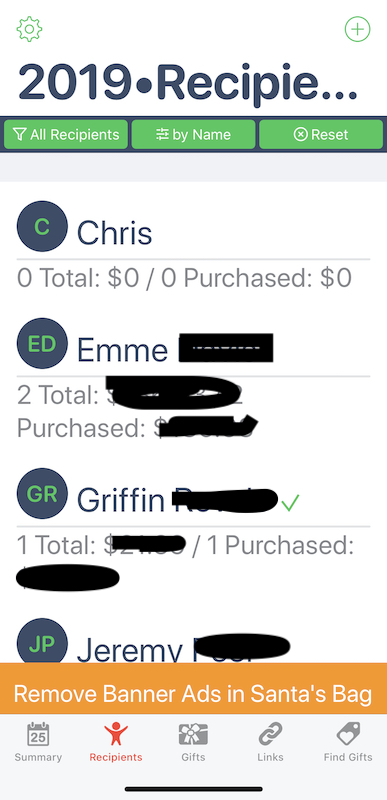
First, I enter the names of everyone for whom I need to purchase a gift. You can set up an overall budget and/or individual budget. Unfortunately, I have great difficulty sticking to one, so I just try to keep a close look and make sure I’m equitable with purchases. When I purchase a gift for a recipient, I enter the name of the gift, the store from which it was purchased and the purchase price.
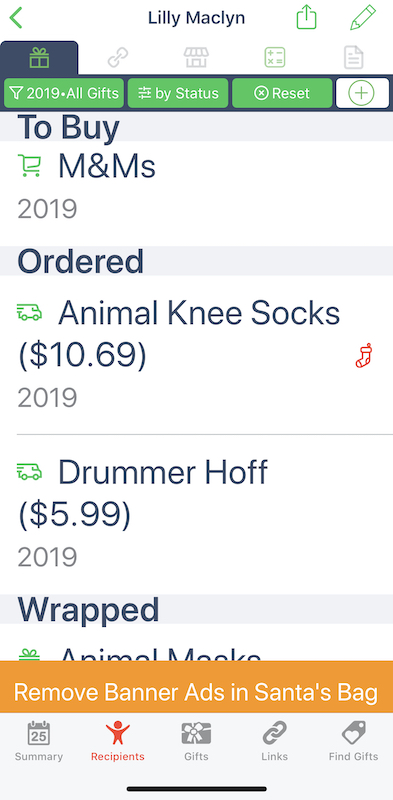
Once the name of a gift is entered for a recipient, there are several icons to select that put the item in a list that tells you the status of what you have completed and what you still need to do. Those include: Idea; To Buy; Ordered; To Wrap; Wrapped; To Send; and Given. An additional icon identifies a gift as Stocking Stuffer. I request wish lists from family members and label the items as Ideas. Then, when I purchase a gift, I select the Ordered icon. When the gift arrives (I am well acquainted with the UPS and FedEx delivery people!), I
change to the To Wrap icon. The last icon I use is Wrapped, and then the gift goes under the tree
You can use none, any or all of the icons. When you click on the appropriate icon for a gift, it creates a to-do list by moving all similarly labeled gifts together. Then at a glance I know what has been ordered, what I need to wrap and the final list I work toward is Wrapped.
I like the simplicity of Santa’s Bag. It is intuitive and easy to set up and use. I can use as many or as few of the many features as I need. Screenshots of some of the features and layout are below.
Budget Page
Recipient List
& Status
How to Sort Lists
Gifts for
Individual
Additional Features
Gift Ideas Search
Some other gifting apps available and their main features include:
Christmas – similar features to Santa’s Bag; matter of preference as to whether you like Christmas or Santa’s Bag
Giftry – this app is more of a year-round gift planner; can select favorite stores and enter or search for possible gifts
Giftster – is an online gift registry connecting family and friends; gives options to create groups and lists and share wish
lists with others in your group; use for all types of events and holidays
Gifted – keeps track of gifts, people and events; can add or import people; add birthdates, anniversaries and other
events; then add gift ideas; has progress slider to keep track of each gift; has profile pages for each person
GiftPlanner – similar to other apps for gift planning. Upgraded paid version allows you to import gift ideas from the web
In addition to Santa’s Bag, I use one other indispensable online shopping app – Rakuten. Formerly known as Ebates, Rakuten allows you to earn cash back from online stores. During the Christmas holidays, cash back percentages are often doubled or even tripled. Since I have been using Rakuten, which has been several years now, I have received close to $2000 back in ebates! I never shop online without checking Rakuten for stores offering cash back. You can earn additional cash back by referring friends to Rakuten.
A few other must-have shopping apps include:
Honey (joinhoney.com) – best for online coupons and price alerts
Fakespot (fakespot.com) – best for choosing what and where to buy by spotting fake reviews and flagging most helpful reviews
PriceBlink (priceblink.com) – best for price comparisons for an item among other stores; PriceBlink does not have a mobile app, so you could use the ShopSavvy mobile app instead
RetailMeNot (retailmenot.com) – best for in-store coupons and sales
For your best shopping experience, consider your priorities and what you want an app to do for you. There are a lot of choices out there. I hope these few get you started.
To your less stressful and more enjoyable shopping experience!