by Vicki Peel | Mar 10, 2022 | Food |
Simple home cooking. Is that your daily routine or does it sound like a pipe dream to you?
When I was growing up, we rarely ate out. My grandmother and mother cooked three meals a day – every day. And while I recall being served biscuits and green beans – we called them string beans – at every meal except breakfast, remembering the whole family gathering around the table brings back warm and comforting memories.
Fried chicken was about as fresh as you could get it. Grandmama raised chickens, so we never had to go to the grocery store for that! And fresh eggs daily were as close as the chicken coop.
Cooking at home is one of the healthiest things you can do for your family. It’s much easier to make healthier choices at home. Eating more vegetables and far less sugar and salt than takeout means better overall nutrition for the people you love.
Home cooking brings us together as a family. It’s a chance to create new memories, find out what’s going on in the lives of our family members, and share things that strengthen family bonds.
I want to cook more meals at home. I know I can save money and eat much healthier. Does that resonate with you?
But it’s hard to do. It requires planning, planning, planning. And preparation time. So, at the end of another busy day, it’s so much easier to order a pizza or pick up a family meal at your favorite fast food restaurant.
Let’s start with a few general meal planning tips.
- If you’re not sure where to start with planning your meals, you can make it easy by taking stock of what is in your kitchen. Take note of everything in your pantry and refrigerator, write it down, and see what meals you can make from those ingredients.
- Start small by preparing home-cooked meals only a few times a week. You’ll start to get the hang of it and want to cook more often once you realize what a time saver it really is.
- Make extras. Plan for leftovers and how you’ll use them in another meal. And instead of making one casserole, or enough soup for one meal, make enough for two or even three and then freeze the extras.
- Enlist the help of family members. When I had my knee replacement surgeries, my husband was forced to learn to cook. And to my surprise and delight, he really got interested in preparing new dishes and looking for recipes to try.
- Be open to new ideas and new ways to prepare meals. And document what you do along the way. Instead of sharing pics of your meal at a local restaurant, take pictures of the meals you prepare and share them with me. I want to include you in my posts and emails!
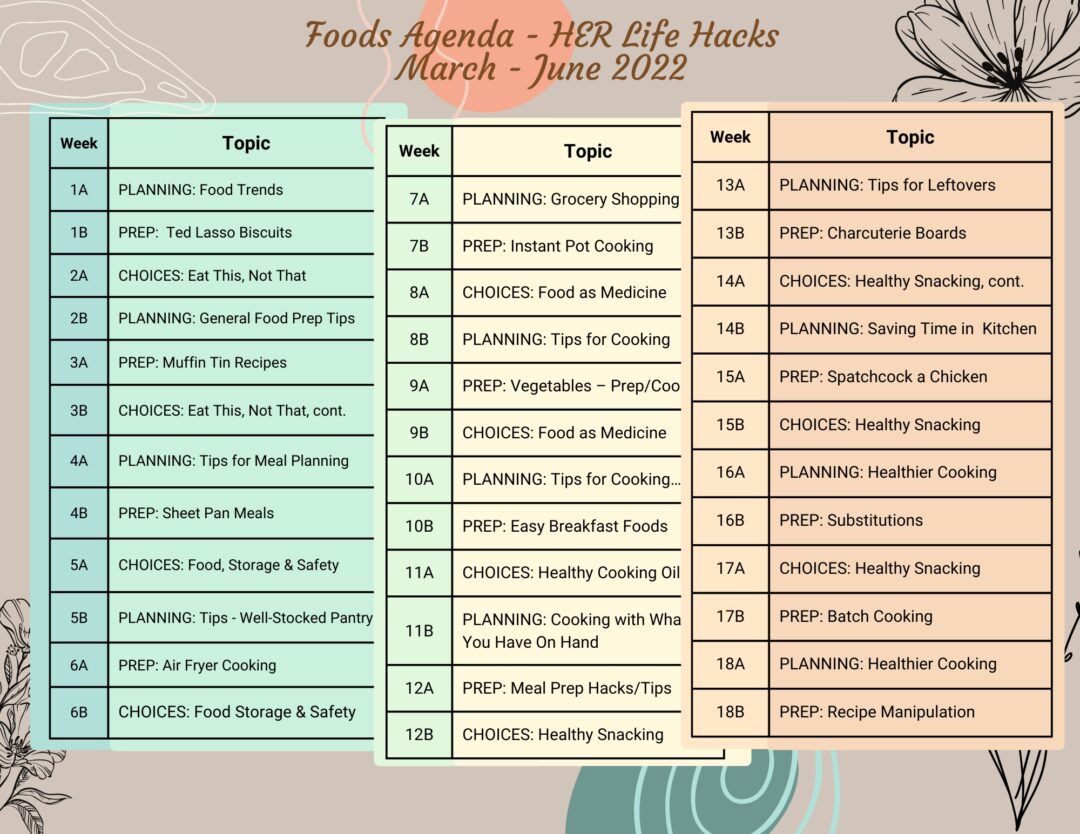
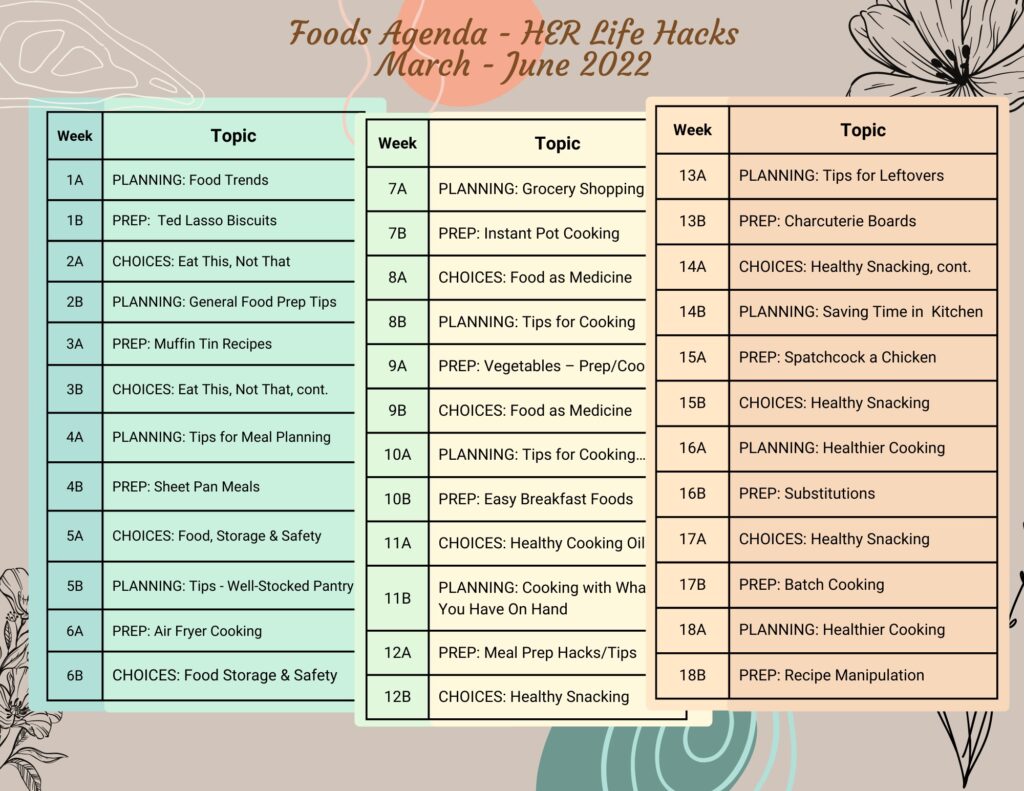
For the next four months, HER Life Hacks will be focused on FOOD. Look for new blog posts every Tuesday and Thursday. Topics will be alternated among the three category areas that you, my readers, helped me plan: Meal Planning; Meal Prep; and Healthy Food Choices.
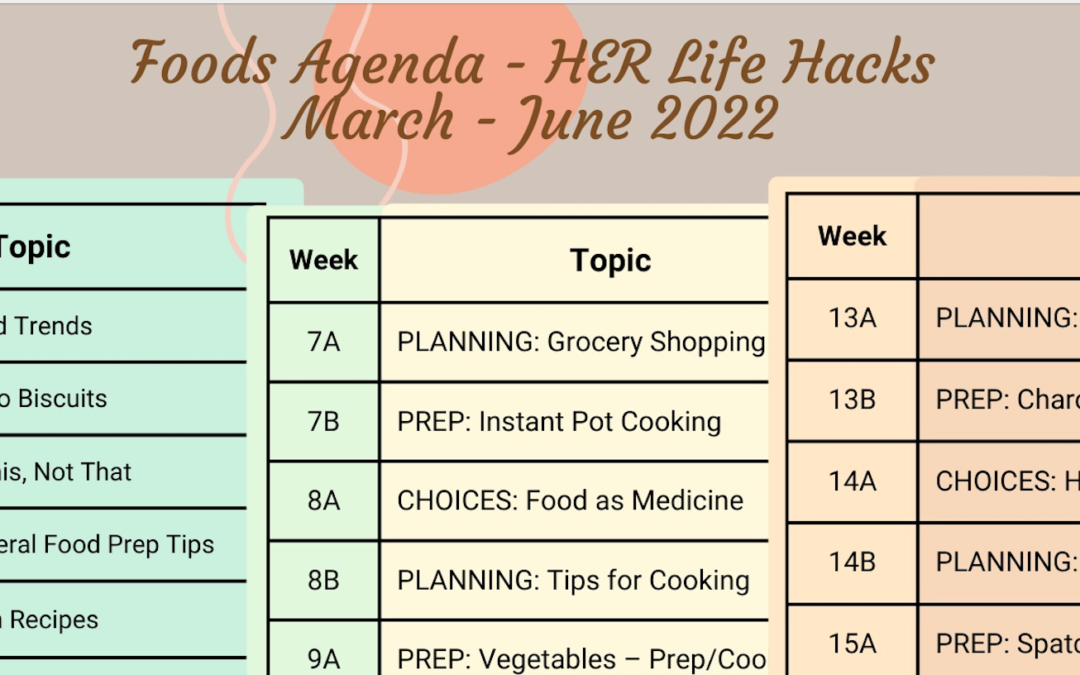
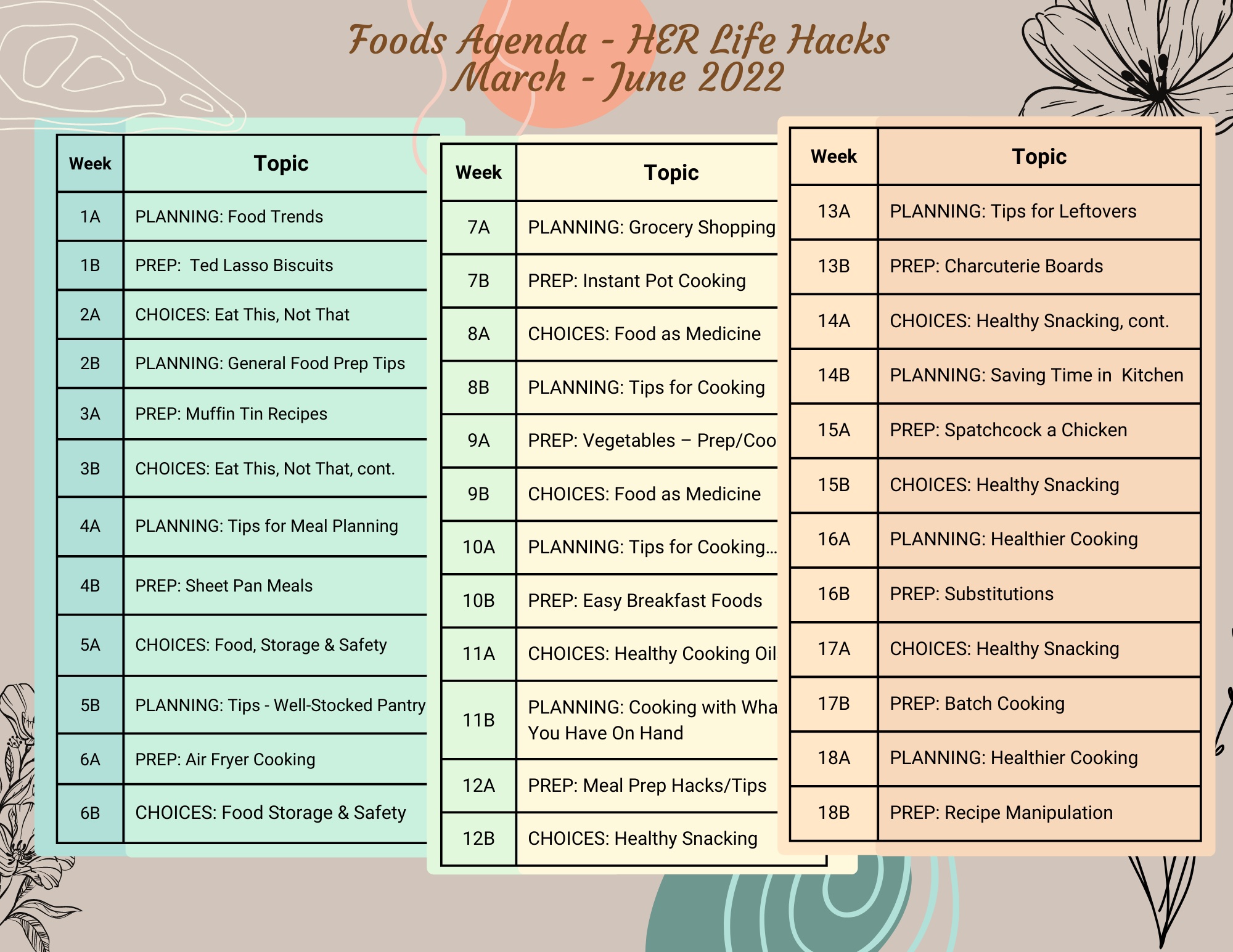
For your reference, here is the agenda scheduled for March – June 2022. This post is Week 2B. If you’d like a copy to download, you may download it HERE.
Share this post with your friends and invite them to join us as we journey through this FOODS agenda!
by Vicki Peel | Mar 8, 2022 | Food |
If I guessed that eating out for you means a dash through a fast food drive-thru, would I be correct? I would bet on it.
Since the COVID pandemic, even your favorite restaurants have turned themselves into fast food restaurants. And they did it just to survive.
What about the choices you are making at your favorite fast food restaurant? How aware are you of what you are actually eating? And think about this – how do you feel afterwards?
Eating healthier is harder than ever. As the price of food (along with everything else) skyrockets, it is understandable that your food choices reflect your desire to save money. And that means fast food is at the top of the cheaper food options. And when most restaurants closed their doors to the public, it was so much easier to just pull up to the closest drive-thru.
Even as restaurants began to reopen to the public, many people were hesitant to return to enclosed public places.
But can you really make healthy food choices at a fast food restaurant? Yes, you can. But it isn’t always easy.
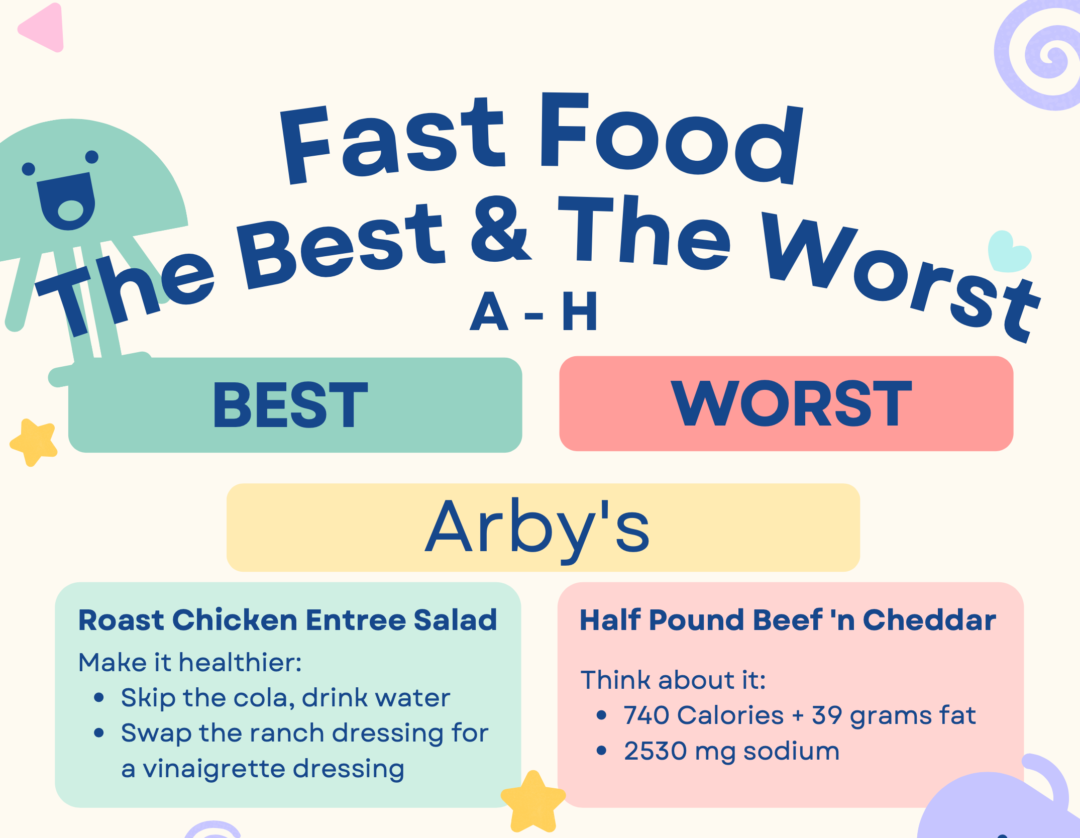
So, I created an infographic of the best and the worst foods at 10 popular fast food restaurants.
This is a look at the best and worst food to eat at Arby’s, the first restaurant of the 10 included in the infographic.
You can download your free copy of the entire infographic HERE! This one is a two-page spread, the first of which covers restaurants from A to H – Arby’s to Hardee’s. The second page covers K to W – KFC to Wendy’s.
I also created a one-page, two-column infographic, which can be downloaded HERE. I suggest that you fold it in half for a quick and easy reference. I used a glue stick to glue the back of the folded copy together so I could simply flip back and forth between A-H and K-W information.
Have your eating habits changed? Been eating too much fast food?
Use the Comment section below to share your concerns about eating habits. Are you happy with yours?
by Vicki Peel | Mar 3, 2022 | Food |
The amount of foods tossed out by Americans is staggering. Are we being safe or simply wasteful?
“Ninety Percent of Americans misinterpret the dates on labels, according
To the Natural Resources Defense Council (NRDC), and they throw out
Food that could still be consumed or frozen for later use.”
If you thought there were federal regulations on date labeling, you’d be wrong. Baby formula is the only federally-regulated food item.
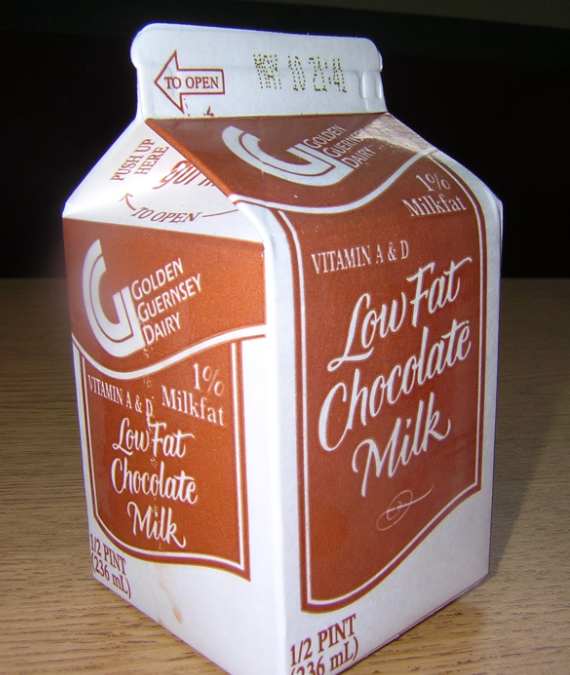
So what do those date labels mean? They are often manufacturer’s best guess as to how long their food will taste fresh. They really don’t mean anything about whether it’s safe to eat. It’s about food quality, not food safety.
Here are what a few of the food labels currently mean:
- Best If Used By/Before – guarantees the date by which the product will retain its best quality or flavor
- Sell By – is set by manufacturers to alert retailers when to remove a product from their shelves
- Use By – guarantees the last date by which a product will retain its best quality
- Packed on – indicates when an item was packaged
You can take measures to maintain freshness of food as long as possible. First, store foods at the proper temperature. Refrigerated foods should be stored no lower than 40° F and frozen food should be kept at 0° F.
So, how do you tell if your food is safe to eat? The best option is to apply the tried-and-sometimes-true “sniff, taste, and see test”. How does it smell? If the food smells different from what it should, consider that one indication of safety. Of course, you can see some indications that food has gone bad. Mold or discoloration are a definitive sign. And taste will tell you when something is wrong.
Generally, canned goods can last 2-5 years. But cans with dents and bulges should be discarded.
Grains and dried goods can probably be used well past their expiration dates, but meat, dairy and eggs have shorter shelf lives.
The Cleveland Clinic suggests these general guidelines for freshness:
- Milk – 7 days (keep in back of refrigerator where it is the coldest)
- Eggs – 3-5 weeks (also store in back of refrigerator)
- Ground meat/poultry – 1-2 days
- Cooked meat/poultry – 3-4 days
- Lunch meat – 2 weeks unopened, or 3-5 days opened
- Dry pasta – 1-2 years
- Steaks – 3-5 days
- Fresh poultry – 1-2 days
- Canned fruit – 12-18 months; 5-7 days in refrigerator after opening
- Rice and dried pasta – 2 years; 3-4 days in refrigerator after cooking
Recommended freezer shelf life for best quality:
- Hamburger/other ground meats – 3-4 months
- Chicken of turkey (whole) – 1 year
- Soups and stews – 2-3 months
- Lunch meat – 1-2 months
As a concerned consumer, you can:
- Stay aware of the dates on your food and store them properly.
- Use your good judgment (and eyes, ears and nose) to determine whether to eat questionable foods.
- Freeze food to prolong its shelf life when possible.
- Read labels and educate yourself about what they mean.
I’m Vicki Peel, former home economics teacher and educational administrator. If you are not receiving my emails, coupons, and freebies, look for the Subscribe block (below right) and submit your contact information. I will not share your information with anyone, and all the content you will receive as part of our community is free. I may occasionally promote someone else’s paid content, offer a product for your consideration or share an item that I think might be of use to you. However, you are under no obligation to purchase anything – ever. So, sign up now so you won’t miss anything during our March – June foods extravaganza!!
https://HERLifeHacks.com
by Vicki Peel | Mar 2, 2022 | Food |
What do Ted Lasso and a meal prep post have in common? BISCUITS. Of course, not the Southern kind of biscuits like my grandmother taught me how to make. No, we’re talking about British biscuits – or cookies.
If you are a Ted Lasso fan, you know that every day Ted would take a little box of biscuits to his boss, Rebecca. Eventually, we found out that Ted made them himself. And now, Ted’s recipe has been released to the world.
And so – take a look at how to made Ted Lasso Biscuits!
Click HERE to watch video!
This makes a very tender shortbread, but it is also pretty plain. You could try other options to liven it up a bit, such as adding butterscotch or semi-sweet bits onto the hot biscuits and spread them as icing upon melting. Or you could add some vanilla or almond extract into the mixture before patting in pan to cook.
Ready to try it for yourself? Click HERE to get a copy of the recipe.
And leave your comments below about how your recipe turned out! Or email me with comments and pictures! I want to feature you in future posts or emails!
by Vicki Peel | Mar 1, 2022 | Food |
Practically everything about our lives has been disrupted since the pandemic took control, even our food acquisition, preparation, and consumption. Certainly, I have eaten at home much more, ordered groceries online, and am on a path to reducetarianism (more about that later).
According to food experts, there are several food trends predicted for 2022. Some of these trends started at the beginning of the pandemic. Others have evolved in response to economic, agricultural, and global changes. Some may be fleeting, while others may be here to stay.
In general, 2022 trends include:
- Still cooking at home;
- Snacking throughout the day;
- Eating foods to make you feel better;
- Experimenting with new flavors and textures;
- Creating new beverage rituals; and
- Choosing products that are better for the planet.
Here are 15 specific food trends that may be likely to impact you and me.
- Reducetarianism
Although you may not be familiar with the word, you’re probably aware of the concept. Reducitarians are those who are reducing their consumption of meat, dairy, and eggs without cutting them out completely.
My husband and I have discovered that we don’t need as much meat as we were used to consuming. Therefore, we often share a plate at restaurants and cook less meat at home. We also are buying better quality meats, which include grass-fed animals and organic eggs from pasture-raised chickens.
- Hibiscus
Hibiscus is an edible hot pink flower with a high Vitamin C content. It is already being used in seltzers and teas. Expect to see it coming out in fruit spreads and yogurts.
- Sunflower seeds
OK, you’re familiar with sunflower seeds, which are also found in trail mix and granola. Sunflower seeds consist of high-quality proteins and unsaturated fats, making them a hearty and healthy snack food. More foods are now incorporating sunflower seeds in crackers, ice cream, and dips.
- Tumeric
I’m sure you’re familiar with the health benefits of turmeric, which has been on the food radar for years now. But food companies are adding turmeric to soups, smoothies, and packaged foods. That expands your opportunities to include turmeric in your diet.
- Mocktails
Many people have been trying to reduce their alcohol consumption, and mocktails, which are cocktails without alcohol, allow them to do that without sacrificing the flavor.
- Plant-based protein
The increased popularity of plant-based protein correlates directly to less meat consumption. It has been touted as a healthier alternative to meat, and many are getting aboard the trend.
- Condiment obsession
People have become tired of the same old flavors, and food companies have responded with condiments that have bolder flavors, especially spicy and hot.
- New green kitchen
Buyers are spending more on environmentally-friendly products, especially now as the cost gap between those and conventional foods is shrinking. This includes things like reusable bags for food storage and composting.
- Underground ordering
When restrictions were imposed that excluded eating out in restaurants, many states loosened their restrictions to allow restaurants and chefs to sell “cottage foods”. That meant people could order specific foods via direct messaging and social media, and pick up their order at varying locations.
- Fishless fish
With our oceans in trouble environmentally, the production of plant-based seafood is growing. Aquaculture, raising farmed tilapia and catfish, did not prove to help the environment, as their emmision of greenhouse gases were as high as those for beef. As a non-fish lover, I don’t think I’ll be trying plant-based seafood!
In addition, you might also hear more about lab-grown (as opposed to plant-based) sushi-grade “fish”. Not interested in that either!
- Grocery loyalty
With increasing grocery prices and more people engaging in online ordering and delivery, national and regional grocery stores are banking on annual memberships to keep customers loyal to them. They are offering incentives and benefits that help offset the increasing grocery prices, and promoting how they are helping customers to save money.
- Cannibas
There has been a marked increase in Cannabis in many products, and chefs are also adding it into their dishes.
- Coffee alternatives
Coffee prices in October 2021 were at a 30-year high. So, naturally other options were developed and advertised. People were looking for caffeine-free products that tasted like coffee.
And Amazon sells coffee alternatives, such as Teecino Caramel Nut Dandelion Tea, which is described as rich and roasted herbal tea that’s caffeine free and prebiotic with detoxifying dandelion root.
Another Amazon product is Crio Bru Ghana French Roast, a natural healthy brewed cacao drink, which is a great substitute to herbal tea and coffee. It is 99% caffeine-free, gluten-free and advertised as low-calorie honest energy.
- Allergy-friendly food for kids
Statistics show that 1 in 13 kids has at least one food allergy. This has been a basically untouched market, which is just now becoming more commonplace. Mo’Pweeze is a 100% allergen-free and vegan bakery, which is available online. Partake Foods also sells online products such as allergy-friendly cookies and mixes.
- Eating to Support Mental Health
Hippocrates first said “Let food be thy medicine”. Science is constantly publishing information about how different foods affect your mood, mental health, and wellness in general. More people are focused on mindful eating and making food choices in line with this concept.
What about you? How has the pandemic changed your cooking and eating habits? Have you embraced any of these emerging food trends? Please respond in the comments section below. I’d love to see how you and other people are responding in this area of their lives.