
When my mother died, we went looking for her papers.
I really didn’t know where to start or what to do. As the person in charge, I knew I had to get the death certificates from the funeral home (you need more than you think) and then go to the Clerk of Court in our county. That’s where legal documents are handled. It may be called something else in other parts of the country. That was where I got the list of what I needed to do to be able to close the estate.
But just having the list of what needed to be done was only the beginning. The list didn’t tell me how to gather the information, only that it needed to be submitted.
For a long time, I wished I had been given more information, more instructions, more help. And maybe my mother should have told me where documents were and what was the status of her estate.
But I had this nagging suspicion that asking those kinds of questions was like hastening her death, something that I wanted to avoid at all costs. As it turned out, the costs kept me unaware and unprepared for what was to come.
Things became clearer as I started thinking about making the kind of preparations I wished I had when my mother died.
She left us the system she was given
My mother did exactly what her generation was taught to do.
The will went to the lawyer, who kept it. The deed went in the safety deposit box at the bank, which kept it. The insurance company kept the policy and mailed a paper reminder every single year, whether she wanted one or not.
Her records were scattered — but they were scattered across institutions that held them for her.
That’s the part we’ve forgotten. Her generation had custodians. Getting your affairs in order was barely a task, because you didn’t need a master list. You needed to know who to call, and there were maybe five people to call.
The system worked. Not because she managed it well, but because it managed itself.
Then the custodians disappeared
Look at what happened in one generation.
Statements stopped arriving in the mail. Accounts moved behind logins. Money spread out across banks and brokerages and apps. Photographs went into a cloud that sends nobody a reminder about anything.
The paper trail that used to lead to a person now leads to a screen that wants a password.
Nobody is keeping the master list anymore. No institution is holding your affairs on your behalf. That job got handed to each of us individually — quietly, with no announcement, no manual, and nobody to teach the method.
So here’s what I’ve come around to, and it changed how I think about all of this:
This is a brand-new job. It appeared in one generation, and that generation is ours.
We are the first people who have ever had to do it. That isn’t a personal failing on anyone’s part. It’s a gap in the world, and we happen to be standing in it.
The part nobody says out loud
There’s a person on the other side of this work, and they have a name and a legal role.
Executor.
Your child, most likely. And they will do that job during the worst weeks of their life.
They’ll be grieving. They’ll be performing an unfamiliar legal role with real deadlines, in front of institutions demanding documents they have never heard of. Every one of those documents will need to be found before it can be handed over.
And they’ll be doing all of it while standing in your kitchen holding your dishes, trying to work out whether keeping them is love or clutter — and whether letting them go is freedom or betrayal.
Grief, an unfamiliar legal job, and guilt over objects. All at once, in the same house, in the same week.
That’s what we’re leaving. Not the estate — the search.
Which is why the work isn’t organizing, and it was never about tidiness. Every hour we spend on this now is an hour they don’t spend searching.
This week’s step: choose the ONE place
Not a system or a filing method or even an afternoon of sorting.
One place. A single physical location where your important papers — or notes pointing to them — will live from now on.
Think of it as the first pin on a map. Everything else you’ll eventually do needs somewhere to go, and without a destination you’re only moving paper into a slightly better pile.
How to choose it
The checklist I give away tells you what belongs in the one place, that even that list is only a starting point.. It doesn’t tell you how to pick the place. That’s the part I’m working out this fall, and here’s what I have so far.
Someone else has to find it without you. The test: could you tell a person over the phone, in one sentence, exactly where it is? “The blue accordion folder in the hall closet, top shelf.” If it takes a paragraph, it’s the wrong place.
It holds pointers, not everything. Some originals have to live elsewhere — a will at the bank, a deed at the county, a policy with the company. The one place holds a note saying where each one is. You’re building a map, not a vault.
Never account numbers, PINs, or passwords. A pointer says where, never what opens it. That’s the security you need to incorporate.
It has to survive you being unavailable. If the only key is on your keyring or the only password is in your head, you’ve created more problems.
Boring and obvious beats clever. No hiding places. The person who needs this will be tired and sad and not thinking clearly.
It has to be one. Not three good places. Just one. You can add a second later, but you almost certainly won’t need to.
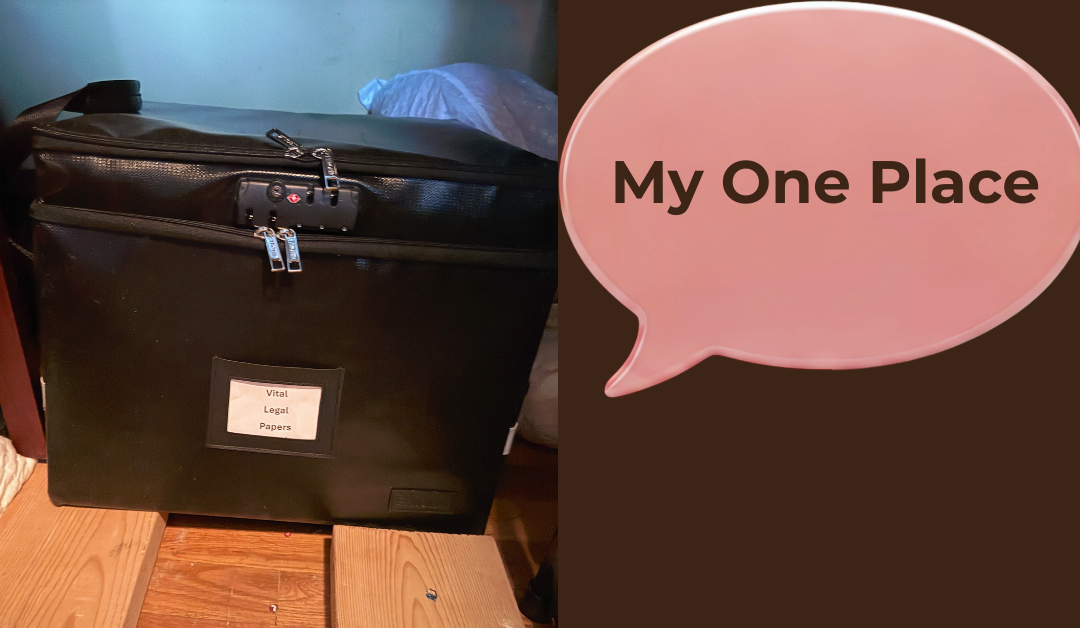
I’ve chosen a fireproof file box that lives on the floor of the closet under the stairs. It is in the very back and I felt that was a safe enough space that anyone with knowledge of it could get to.
The first question I couldn’t answer
My will is in our safety deposit box at the bank, which felt responsible right up until I asked myself something simple: how would my children actually get into it?
And the answer to that may vary depending on legal requirements where one lives.
For my mother, the first step was to get death certificates from the funeral home. Since they are public documents, I didn’t have to prove I was the executor of the estate. Every time you have to close an account in the name of the deceased, you may need a death certificate, which is why you will need several copies. I started with 10 copies, which were enough for my mother’s estate.
When my mother-in-law died, my husband was the executor, and he took a death certificate to the bank and was able to get the will from the safety deposit box. They also inventoried everything that was in the box at that time.
Legal procedures may vary from location to location. One thing that is true in the United States is that the funeral home notifies the Social Security office to stop payment of Social Security checks.
But as laws change, procedures one must follow also change.
That’s what doing this in public keeps giving me. I keep finding the questions I would have skipped if I were only teaching it.
Your turn this week
Choose your one place. That’s all.
Don’t fill it. Don’t sort anything. Don’t set aside an afternoon. Walk through your house, pick the spot, and say it out loud to somebody.
Nobody taught our parents how to do this, and nobody taught us either. We’re not behind — we’re first. So we build the method as we go, one small step a week.
If you want to know what will eventually go in your one place, the Vital Legal Papers Checklist is free, and it’s the list I’m working from myself. I’m sure I’ll find things to add to it. Just click the title below to get your copy.
Vital Legal Papers Checklist
Next week we start putting things in. I’ll set a timer and keep it under one hour.
Vicki,
This is incredibly valuable information along with a workable process. If everyone does this, it will indeed be the last gift they leave their loved ones.
Wondering if you’ve moved to a different platform because this doesn’t seem to be part of your Substack.
Thanks so much, Maureen! I write a slightly different post for Substack.